SceneTrace
The reference index for Chinese short dramas—unified search, heat rankings, and AI drama tracking.
SceneTrace
Submitted by the team

The Discovery Void in a Billion-Dollar Content Boom
Chinese short dramas—vertical, episode-based micro-soap operas—have exploded into a multi-billion-dollar content category, yet they suffer from a structural discovery problem that general-purpose platforms have largely ignored. Titles are scattered across dozens of apps, from domestic giants like Hongguo to overseas players like ReelShort, each with its own ecosystem and no shared metadata standard. Fans who remember a plot point, an actor's face, or a trope like "CEO/Billionaire" often cannot find the title again, because search engines are optimized for conventional media and fail to index these vertical dramas' fragmented distribution.
SceneTrace enters this void as a specialized search engine and directory, purpose-built for the short drama format. Rather than competing with streaming platforms, it acts as a discovery layer—aggregating titles, cast, episode counts, story tropes, and watch links into a unified index. The site's homepage promises exactly that: "Find the short drama you can't stop thinking about." This is not a vanity project; it addresses a real economic inefficiency in a market where content supply vastly outstrips discoverability.
From Vague Memory to Watch Path: How SceneTrace's Search Actually Works
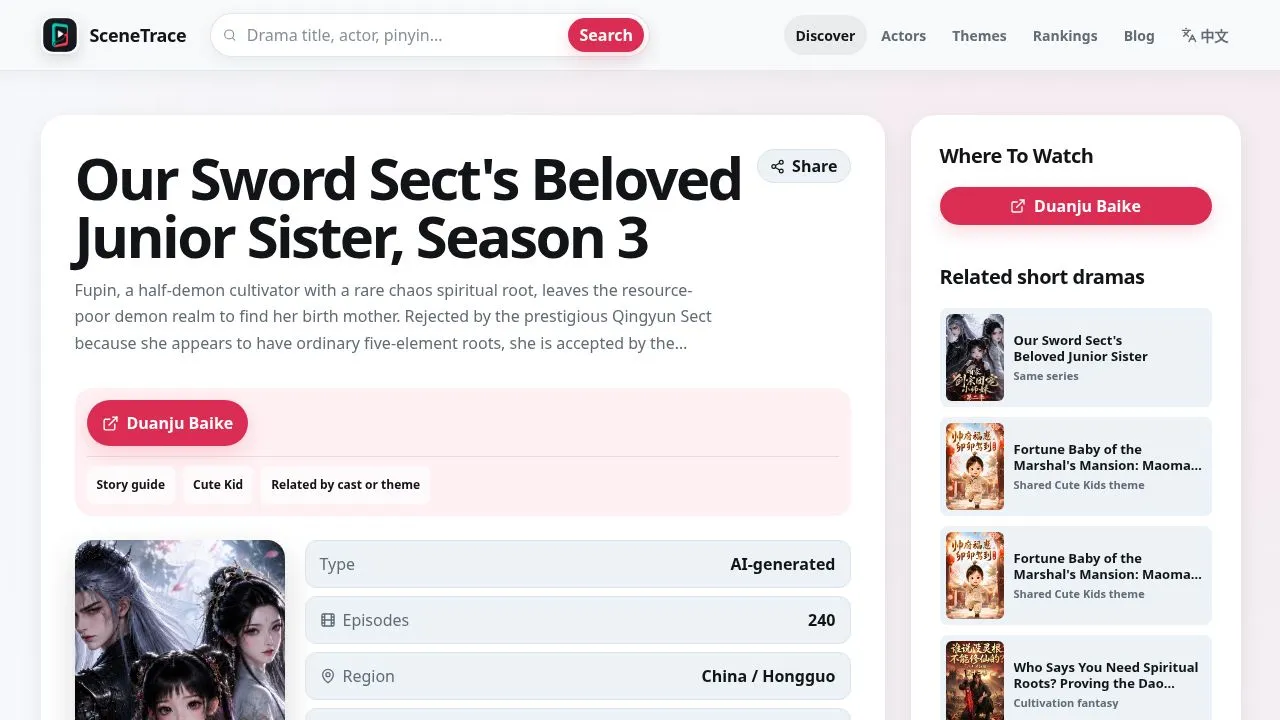
SceneTrace's core mechanism is a unified search that accepts a wide range of fuzzy inputs: drama titles, actor names, pinyin aliases, character names, story tropes, episode counts, or even a plot clue. The search index spans multiple dimensions—titles, actors, pinyin, tropes, source pages, and watch paths—enabling a query like "CEO romance with hidden identity" to return relevant titles with their metadata and where to watch them.
Each drama gets a dedicated details page with cast, episode count, story clues, and direct links to the original platform. This is the product's fundamental value: converting a vague memory into a concrete watch path in seconds. For a genre where titles are often translated inconsistently across platforms, the inclusion of pinyin aliases is a clever technical wedge—it bridges the gap between Chinese-language originals and global audiences searching in romanized form.
Actor pages further extend the utility, listing known titles, aliases, and social volume metrics. This transforms SceneTrace from a simple lookup tool into a discovery engine: users can follow a face they liked into their next story, a behavior pattern common in drama fandom. The site also curates trope-based browsing (CEO/Billionaire, Rebirth, Hidden Identity, etc.), which mirrors how audiences actually think about these dramas—not by title, but by narrative formula.
The Data Aggregation Moat: Hongguo, ReelShort, and the AI Drama Frontier
SceneTrace's competitive advantage lies in its data aggregation. The platform pulls from multiple sources: Chinese platforms like Hongguo, global apps like ReelShort, and—notably—AI-generated short dramas. This is a significant differentiator. While traditional directories might cover mainstream titles, SceneTrace explicitly tracks the emerging AI drama segment, with rankings for "AI short dramas" that include series like "The Rent-Collecting Old Man, Season 3" (118 episodes) and "Who Says You Cannot Cultivate Without a Spiritual Root? Season 22" (100 episodes).
This AI drama coverage is forward-looking. As generative video tools lower production costs, the volume of AI-generated content is likely to explode, creating an even greater need for discovery. SceneTrace is positioning itself as the reference index for this new content wave, which incumbents have not yet addressed.
The heat rankings—Chinese, Global, AI, and Actors—add a layer of real-time market intelligence. The "Signal" score appears to be a proprietary popularity metric, updated weekly, providing a snapshot of what's trending. For industry professionals (talent scouts, marketers, researchers), this is potentially more valuable than the consumer-facing search. It offers a data-driven view of actor popularity and platform distribution, which is otherwise opaque.
Competitive Field: Why General Search and Platform Directories Fall Short
SceneTrace's primary competitors are not other short drama directories—there are few, if any, direct equivalents—but rather the status quo: general search engines (Google, Baidu) and platform-specific directories (Hongguo's own app, ReelShort's in-app browse). Both fail for the same reason: they lack comprehensive, cross-platform metadata.
General search engines are optimized for conventional web pages, not for the ephemeral, app-native content of short dramas. A query like "CEO romance hidden identity" returns generic results, not specific titles with watch links. Platform directories only cover their own content, forcing users to check multiple apps—a friction that SceneTrace eliminates by aggregating everything in one place.
The closest substitutes are fan communities (Reddit, Douban) and social media, where users manually ask for titles based on vague descriptions. This is inefficient and unreliable. SceneTrace's structured database offers a deterministic alternative: instead of hoping a human recognizes a plot clue, users get algorithmic matching.
However, the competitive landscape is not static. A major platform could build its own cross-platform directory, or a general-purpose AI search tool (like Perplexity) could evolve to handle such queries. SceneTrace's edge lies in its specialized focus and its early lead in data aggregation, particularly for AI dramas.
Commercialization Path: From Free Utility to Industry Data Infrastructure
Public materials do not disclose SceneTrace's pricing or revenue model; the site appears to be free for users. This is typical for a discovery utility, but it raises the question of how the business will monetize. Several paths are plausible.
The most direct is affiliate or referral fees: when a user clicks through to watch a drama on Hongguo or ReelShort, SceneTrace could earn a commission. This aligns incentives—the platform drives qualified traffic to content providers and gets paid for it. However, short drama platforms may not have established affiliate programs, and the revenue per click could be low.
A more strategic path is B2B data licensing. SceneTrace's heat rankings, actor social volume metrics, and trend data are valuable to talent agencies, production companies, and marketers who need to track the market. Selling this data as a subscription service (e.g., a "Pro" tier with advanced analytics) would transform the platform from a consumer utility into an industry data infrastructure. This is a higher-margin, more defensible business model.
Another option is advertising or sponsored listings, where drama platforms pay to be featured in rankings or search results. This is common in directory businesses, but it risks compromising the integrity of the rankings—a trade-off that must be managed carefully.
The go-to-market motion appears to be organic, driven by SEO and word-of-mouth within fan communities. The site's content is structured for search engines (e.g., dedicated pages for each drama and actor), which could attract significant organic traffic over time. However, the niche audience means the total addressable market is limited, so the economics will depend on converting a small but passionate user base into revenue.
The 3–5 Year Trajectory: From Directory to Category Standard
Over the next 3–5 years, SceneTrace's trajectory hinges on two factors: the growth of the short drama market and the platform's ability to expand its data coverage and commercial offerings.
The short drama market is still in its hyper-growth phase, both in China and globally. As more players enter (including AI-generated content), the discovery problem will only intensify. SceneTrace is well-positioned to become the default reference index, similar to how IMDb became the standard for film, but with a more dynamic, data-driven approach.
Scalability constraints will emerge. Manual curation and data aggregation are labor-intensive; the platform will need to automate more of its pipeline, potentially using AI to parse and categorize new titles. This is both a challenge and an opportunity—if SceneTrace can build a self-updating index, it could handle the influx of AI-generated dramas at scale.
The biggest risk is competition from a larger player. A platform like Tencent or ByteDance could launch a similar directory with more resources. However, their incentives may not align—they would be aggregating competitors' content, which is not in their interest. This gives SceneTrace a neutral-party advantage.
In the long term, SceneTrace could evolve beyond a directory into a broader entertainment data platform, covering other vertical formats or even traditional dramas. But the immediate opportunity is clear: own the discovery layer for the short drama boom before anyone else does. If it executes well, SceneTrace could become the category standard, the go-to resource for fans and industry professionals alike.