Impact-Site-Verification: 41b53a0c-6d04-458b-a457-fe9e29acde1a

AI & Machine Learning··5 min read

Senzia

Create AI videos, images, and audio in one studio—no editing skills needed.

NN

NewName Editorial

Editorial Team

Senzia product image 1
Senzia product image 2
Senzia product image 3

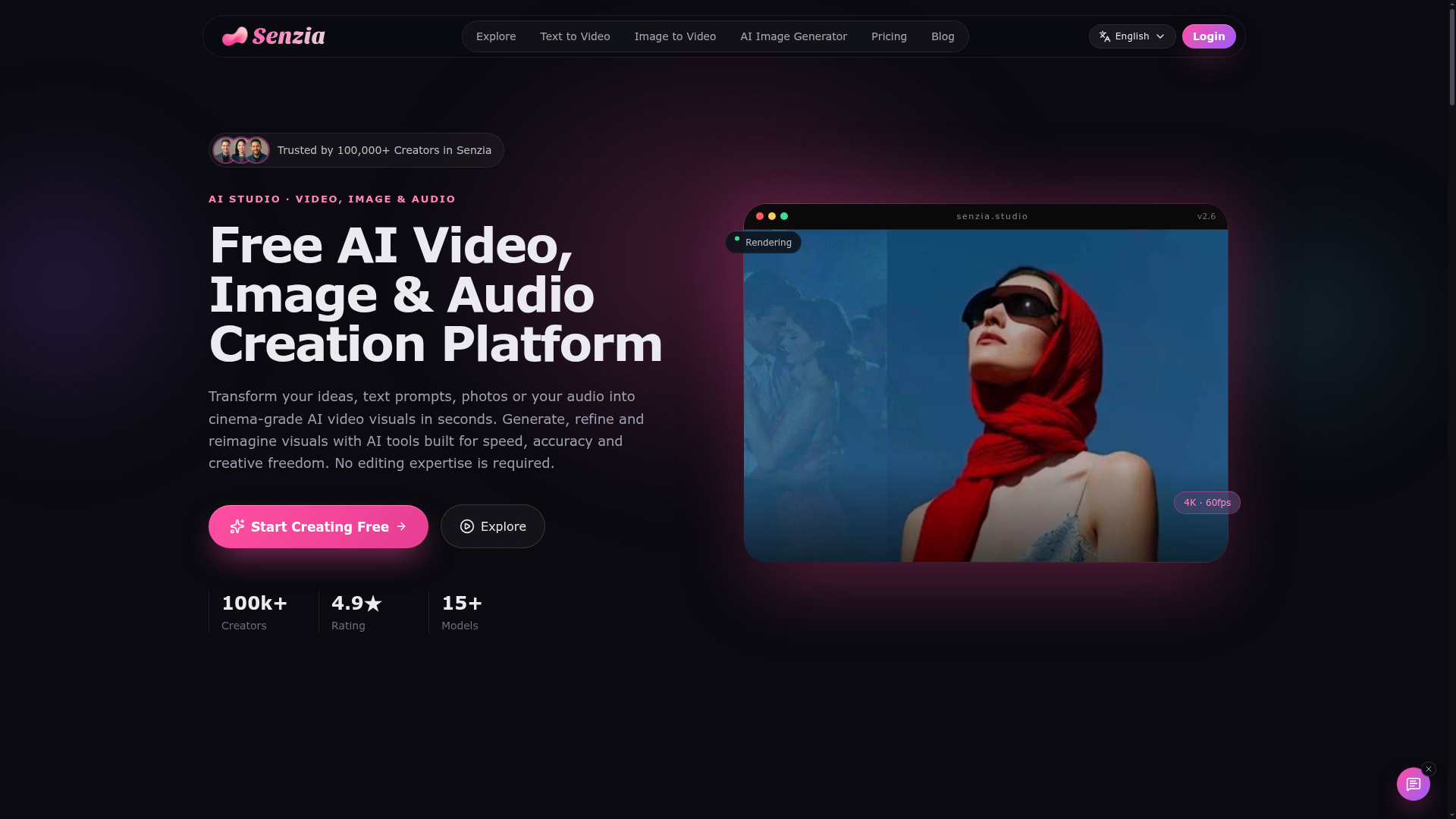
Senzia enters a crowded field of AI content tools with a simple but ambitious promise: stop juggling five different apps to make a video. The platform bundles text-to-video, image-to-video, AI image generation, and AI audio generation into a single workflow, aiming at creators who want cinema-grade output without opening a traditional editing suite. The pitch is familiar—"no editing expertise required"—but the execution leans on a model-agnostic hub that aggregates engines like Seedance, Sora, and Wan. Whether that aggregation is enough to stand out in a market already packed with specialized tools is the question this article explores.

The All-In-One Bet: Why Senzia Puts Video, Image, and Audio Under One Roof

Most AI creation tools start narrow: a text-to-video generator, an image upscaler, a voice cloner. Senzia starts wide. The homepage calls it an "AI Studio · Video, Image & Audio," and the feature list spans text-to-video, image-to-video, AI image generation, AI audio generation, plus a collection of niche tools like face swap and AI avatars. The underlying logic is workflow consolidation. A marketer making a campaign might need a hero video, a few stills for social, and a voiceover—Senzia lets them do all three without exporting files between platforms. That's a real pain point, and the site's user testimonials echo it: one digital marketer says they "produce content faster without jumping between tools." For solo creators and small businesses, the all-in-one pitch is genuinely appealing, even if it risks being a jack-of-all-trades.

Model Roulette: How Senzia Turns Top AI Engines Into a Buffet

Senzia's differentiation isn't a proprietary model—it's the aggregation of others. The site lists Seedance 2, Sora 2, and Wan 2.6 for video, and Nano Banana, Wan, and Gemini for images. This is a smart hedge: instead of betting on one model's strengths, Senzia lets users pick the engine that fits the task. A creator who wants hyper-realistic motion might choose Sora; someone after stylized animation might prefer Wan. The "15+ models" badge on the homepage signals breadth, and the blog's comparisons—like a head-to-head of AI kissing video generators—reinforce that Senzia is positioning itself as a neutral hub. But this model-agnostic approach also means Senzia's quality ceiling is tied to its partners. If a leading model gets pulled or falls behind, Senzia's value proposition weakens. The platform is essentially a curated buffet, and the chef is someone else.

From Prompt to 4K: The Workflow That Skips the Editing Suite

The core workflow is straightforward: type a prompt, pick a model, and generate. For image-to-video, you upload a still and Senzia adds "realistic depth, sweeping camera motion and lifelike physics." The site emphasizes speed—"within seconds"—and output quality up to 4K at 60fps, a spec that rivals dedicated video tools. The absence of a traditional timeline editor is deliberate; Senzia is not for fine-grained cuts or multi-track audio. Instead, it's for rapid iteration: generate, refine, reimagine. The gallery of templates offers a starting point for users who don't know what to prompt, and the "Apply This Template" buttons reduce friction to one click. This is a workflow built for social media managers and small business owners who need volume, not for film editors who need control. The tradeoff is clear: you trade granular control for speed and simplicity.

The Pricing Twist: Credits, One-Off Payments, and the 'Uncensored' Lane

Senzia's pricing page is refreshingly simple: "One-off payment, no subscription," with credits as the virtual currency. Users buy credits and spend them per generation, with consumption varying by model and feature. This avoids the subscription fatigue common in SaaS, but it also means costs can be unpredictable—a complex video might eat more credits than a simple image. The FAQ notes credits have no cash value outside the platform, so there's a lock-in element. More intriguing is the "uncensored" and "unrestricted" product line visible in the footer: tools like "Uncensored AI Image Generator" and "Unrestricted Photo to Video." This is a deliberate niche play, catering to adult creators and those who hit guardrails on mainstream platforms. It's a risky positioning—it could attract a loyal audience or alienate mainstream advertisers—but it's a clear differentiator in a market where most tools enforce strict content policies.

What the Name 'Senzia' Signals—and What It Doesn't

The name "Senzia" has a soft, almost pharmaceutical ring to it—it doesn't scream "AI video generator." That's not necessarily bad. It evokes a sense of "sense" (as in sensory) and "essence," hinting at a creative, multi-sensory platform. The .cc domain (Cocos Islands) is less common than .com or .ai, but it's short and brandable, and the site uses it consistently. The logo and wordmark are clean, with a modern sans-serif feel. The name doesn't signal the uncensored niche, which is probably wise—it keeps the mainstream door open. But it also doesn't signal "video" or "AI," so Senzia relies on its tagline and content to communicate what it does. For a platform that aggregates multiple models, a neutral name like this makes sense; it's a studio, not a single tool.

The Open Questions: Trust, Quality, and the Crowded Creator Market

Senzia's biggest challenge is trust. The homepage claims "100,000+ creators" and a 4.9-star rating based on 2,148 reviews, but these are self-reported metrics. The testimonials read like polished marketing copy, and the blog's comparisons—which pit Senzia against competitors like Pollo AI and ClipFly—are transparently promotional. The platform also faces a crowded market: Runway, Pika, and Luma are established names, and OpenAI's Sora is a looming giant. Senzia's edge is its all-in-one convenience and its willingness to serve uncensored niches, but that edge is narrow. For a marketer who needs quick, polished assets, Senzia is a plausible choice. For a serious filmmaker, it's likely too shallow. The platform's future depends on whether it can maintain model partnerships, keep credit pricing transparent, and build a community that trusts its quality claims. If it does, it could carve out a loyal user base; if not, it risks being just another AI tool in a sea of sameness.