Impact-Site-Verification: 41b53a0c-6d04-458b-a457-fe9e29acde1a

AI & Machine Learning··6 min read

Sidekick

Text a number, get a work order, and keep tribal knowledge from retiring.

NN

NewName Editorial

Editorial Team

Sidekick product image 1
Sidekick product image 2
Sidekick product image 3

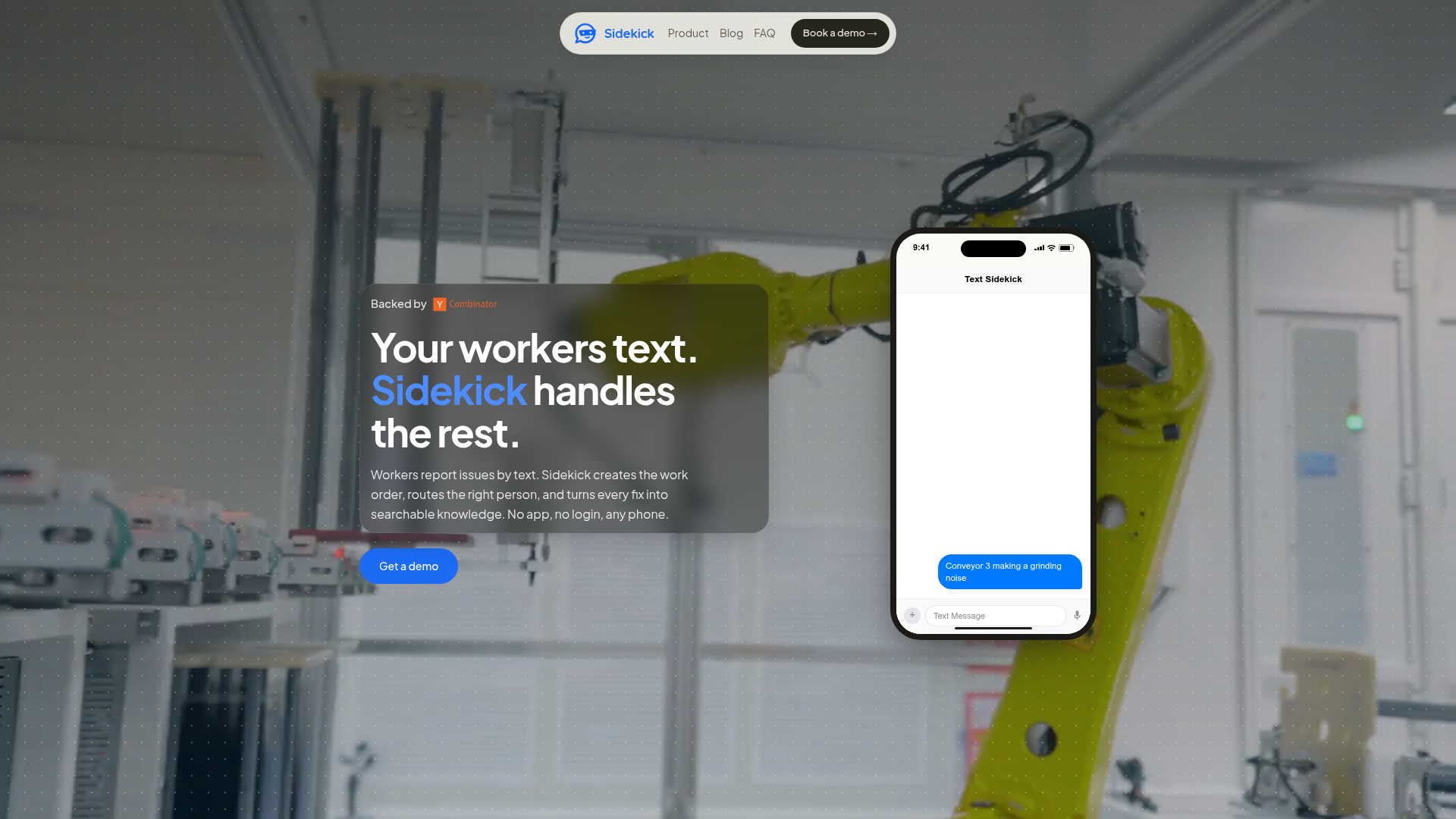
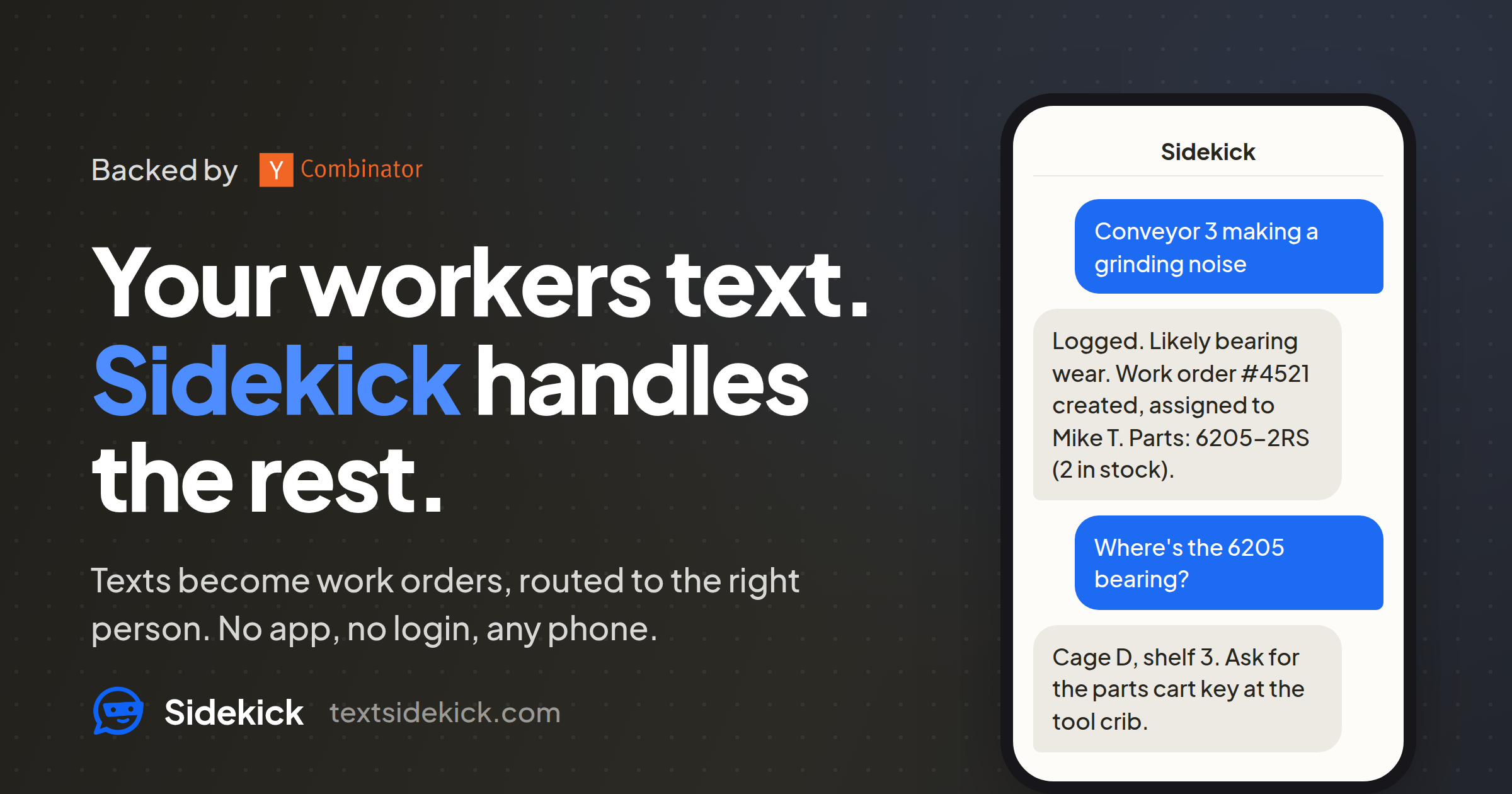
Sidekick is an AI agent that lives inside a text message. It's built for the factory floor, the warehouse, the kitchen—the places where the work happens away from a desk. The pitch is disarmingly simple: workers text a number the way they'd text a coworker, and Sidekick handles the rest. It creates work orders, routes the right person, and turns every fix into searchable knowledge. No app, no login, no training. That's the whole bet.

The company, backed by Y Combinator, is targeting what it calls "the 80% of American workers without a desk." It's a bold claim, but the product design backs it up. Sidekick isn't trying to drag frontline workers into a SaaS dashboard; it's meeting them where they already are—on SMS.

The 80% problem: software that ignores the factory floor

Most enterprise software is built for people who sit at computers. But the majority of workers don't. They're on their feet, moving between machines, dealing with a conveyor that's making a grinding noise at 9:41 AM. They don't have time to log into a ticketing system or learn a new app. They have a phone in their pocket, and they know how to text.

Sidekick's thesis is that the frontline has been underserved not because the problems are unsolvable, but because the interface has been wrong. Asking a forklift operator to file a ticket is a non-starter. Asking them to text a number? That's natural. The website makes this explicit: "Workers report issues by text. Sidekick creates the work order, routes the right person, and turns every fix into searchable knowledge." No forms, no tickets, no chasing.

This isn't just about convenience. It's about capturing information that would otherwise be lost. When a worker notices a small issue and has no easy way to report it, the issue gets ignored until it becomes a breakdown. Sidekick lowers the barrier to reporting, which means more issues get caught early.

SMS as the ultimate low-friction interface

The genius of Sidekick is its insistence on plain SMS. No app to download, no account to create, no password to forget. Workers text a number the same way they'd text a coworker. They can send texts, photos, voice memos—in any language. The AI understands it all.

This is a deliberate design choice. The FAQ drives it home: "No. Sidekick works over plain SMS. Workers text a number the same way they'd text a coworker. There's no app to download, no account to create, and no password to forget. Managers use a web dashboard."

For managers, there's a web dashboard to see what's happening. But for workers, the phone is the entire interface. This asymmetry is smart: it puts the complexity on the AI, not on the user. Sidekick handles questions and alerts on its own, and escalates to the right manager the moment it should.

There's a practical benefit beyond ease: SMS works on any phone, even the cheapest feature phone. In industries where workers might not have smartphones, or where installing apps is prohibited, SMS is the universal interface. Sidekick's FAQ even asks, "What if workers are not allowed to install apps or use complex tools?" The answer is implicit: that's exactly the scenario Sidekick was built for.

From text thread to work order: how Sidekick triages

When a worker texts "Conveyor 3 making a grinding noise," Sidekick doesn't just log it. It creates a plan: log the issue, create work order #482, route Mike T. with parts info, and save the fix to knowledge. The worker sees the plan in the same thread, so they know their report was heard and what happens next.

This is where the AI does more than parse text. It understands context. It knows that Conveyor 3 is on Line 2, is a FlexLink X85, was installed in September 2019, has run 1,240 hours since service, and had a bearing replaced under work order #4521. That's not just a ticket; it's a living asset record. Sidekick keeps a record of every machine, with manuals, service history, and runtime, and it schedules preventive maintenance before things break.

For a frontline worker, this means their text message is enough to trigger a well-informed response. They don't have to fill out a form with the asset ID and model number; Sidekick already knows. This is a powerful combination: the simplicity of a text message with the depth of an asset management system.

The thread also keeps everyone posted. The worker sees the work order number, who's assigned, and when it's resolved. No chasing, no status meetings. The information flows to the people who need it, automatically.

The knowledge base that survives retirement

Perhaps the most compelling part of Sidekick is its promise to capture tribal knowledge. Every fix, every workaround, every answer is recorded into a searchable plant history. When a veteran retires, their know-how stays.

The website shows a sample knowledge base: "Conveyor 3 bearing failure — Replace 6205-2RS · resolved by Mike T." Each entry cites the source, the person, and the date. It's not just a log; it's a searchable memory. Ask what worked last time and get the exact fix, who did it, and when.

Sidekick goes further by turning this knowledge into documents on demand. Safety procedures, employee handbooks, FAQs—all generated from the captured answers and SOPs, with every claim citing its source. "Documents written from your own knowledge base, not the internet." This is a clever twist on AI-generated content: instead of hallucinating from the web, it compiles from verified internal knowledge.

For manufacturers, this is a real pain point. When a veteran retires, decades of experience walk out the door. Sidekick's pitch is that it can bottle that knowledge. The website says it bluntly: "Nothing walks out the door."

Naming: 'Sidekick' as a promise, not a product

The name "Sidekick" is a deliberate choice. It positions the AI as a helpful companion, not a replacement. It's the sidekick to the worker, handling the paperwork while they do the real work. It's also the sidekick to the manager, triaging and escalating so they can focus on the big picture.

The domain, textsidekick.com, reinforces the SMS-first approach. It's not just "sidekick.com" (which would be too generic); it's "text sidekick," telling you exactly how you interact with it. The name is memorable, friendly, and descriptive. It avoids the cold, enterprise-y feel of "workforce management platform" and instead feels like a tool that's on your side.

There's a risk, though. "Sidekick" is a common word, and it might get lost in a sea of other "sidekick" products. But in the context of frontline operations, it stands out. It's not a tech buzzword; it's a plain-English promise.

Open questions: trust, pricing, and the AI's mistakes

Sidekick is still early. The website doesn't disclose pricing, and the FAQ asks "What does pricing look like?" but the answer is hidden behind a plus sign. That's a common tactic for sales-led products, but it also means potential customers can't self-serve.

More importantly, there's the question of trust. The FAQ asks, "What happens when the AI gets something wrong?" The answer isn't shown, but it's a critical issue. If Sidekick misroutes a work order or gives wrong instructions, workers might lose faith. The AI is learning from every fix, but it's not infallible.

There's also the question of integration. The FAQ asks, "Can I use it alongside my current systems?" Again, the answer is hidden. But for a product to be truly useful, it needs to work with existing ERP or CMMS systems. Sidekick's asset records and work orders are useful on their own, but they're more powerful when they sync with the systems of record.

Despite these open questions, Sidekick's approach is refreshing. It's a rare AI product that reduces friction instead of adding it. By meeting workers where they are—on SMS—it has a chance to actually be adopted. And by capturing tribal knowledge, it provides a compelling ROI that goes beyond efficiency.

For manufacturers, warehouses, and any operation with frontline workers, Sidekick is worth a look. It's a small bet on a big idea: that the simplest interface can be the most powerful.