Sigvi
Sigvi's AI revenue agent turns independent fleets into a keyless, automated rental network.
NewName Editorial
Editorial Team


The car rental industry has long been a game of middlemen: aggregators list cars, but the actual rental experience—keys, inspections, pricing, maintenance—remains stubbornly manual. Sigvi, a Vilnius-based startup with a pre-seed round of €1.2 million, is attempting to automate the entire chain. It doesn't just list cars; it operates them. By aggregating vehicles from independent fleet operators and private owners, Sigvi manages everything end-to-end with an AI engine that handles dynamic pricing, bookings, keyless 24/7 access, automated inspections, predictive maintenance, and customer support. This is a thesis about owning the operational layer, not just the booking layer.
The car rental middleman, automated
Traditional car rental aggregators like Kayak or Rentalcars.com are lead generators. They send customers to a rental desk, where the real work begins: paperwork, key handover, vehicle inspection, and the dreaded upsell. Sigvi's approach is different. It positions itself as an "AI revenue agent"—a term that suggests not just a booking platform, but an active manager of revenue and operations. The website's tagline, "Go further, spend less," hints at the customer benefit, but the underlying model is about efficiency for the supply side.
Sigvi aggregates cars from independent fleet operators and private owners, effectively creating a distributed rental network. This is a marketplace, but with a twist: Sigvi controls the operational stack. The AI engine handles dynamic pricing, which means prices adjust based on demand, availability, and other factors. It also manages bookings, keyless 24/7 access (presumably via a mobile app), automated vehicle inspections (likely using computer vision), predictive maintenance scheduling, and customer support. This is a full-stack approach that most aggregators avoid.
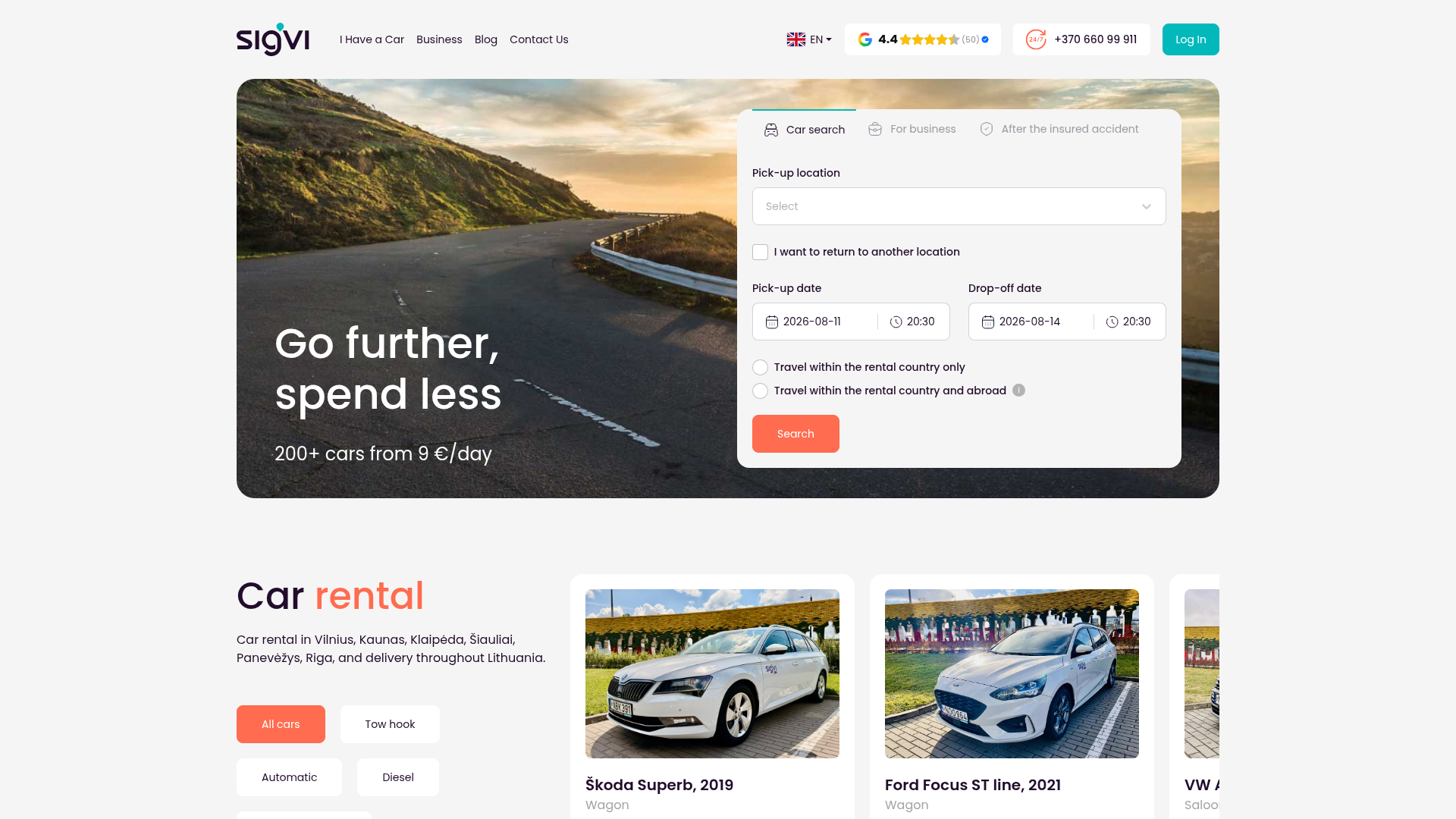
The evidence from the website shows a live inventory of cars across Lithuania and Poland, with locations in Vilnius, Kaunas, Klaipėda, Šiauliai, Panevėžys, Riga, and Warsaw. The fleet includes Škoda Superbs, VW Passats, Audi Q5s, and even a BMW 228i Cabrio. Prices start from €9/day, with specific cars listed at €16–€29/day. This is not a theoretical platform; it's operational.
The AI revenue agent, unpacked
The term "AI revenue agent" is central to Sigvi's positioning. It suggests that the AI is not just a chatbot or a recommendation engine, but an active agent that optimizes revenue. Dynamic pricing is the most tangible manifestation: the AI likely adjusts daily rates based on supply, demand, seasonality, and local events. This is common in hospitality and ride-sharing, but less so in traditional car rental, where pricing is often static or manually adjusted.
Keyless 24/7 access is another AI-enabled feature. It likely uses a mobile app to unlock the car, eliminating the need for physical key handover. This enables self-service pickup and return, which reduces labor costs and enables after-hours operations. Automated vehicle inspections likely use photos or sensors to assess damage before and after rental, reducing disputes. Predictive maintenance scheduling uses telematics data to anticipate issues before they become breakdowns, improving fleet reliability.
Customer support is also automated, though the website shows a phone number and a support page, suggesting a hybrid model. The AI handles routine queries, but humans are available for complex issues. This is a pragmatic approach.
The AI revenue agent is the core of Sigvi's value proposition. It's what differentiates Sigvi from a simple aggregator. By automating operations, Sigvi can offer lower prices (from €9/day) while maintaining margins. It also enables scale: the AI can manage a growing fleet without proportional increases in staff.
A marketplace with a fleet of its own
Sigvi's model is a hybrid: it aggregates vehicles from independent operators and private owners, but it also appears to operate its own fleet. The website lists cars with specific locations and license plates, suggesting that Sigvi has physical control over the vehicles. This is not a pure marketplace like Turo, where owners list their cars and renters connect directly. Sigvi is more like a managed marketplace: it brings supply and demand together, but it also handles the operational layer.
This hybrid model has advantages. It allows Sigvi to ensure quality and consistency, which is often a problem in peer-to-peer rental. It also enables dynamic pricing and predictive maintenance, which require data from the vehicles. However, it also means Sigvi bears more risk: it's responsible for maintenance, insurance, and utilization. The tradeoff is between asset-light (pure marketplace) and asset-heavy (fleet ownership). Sigvi is somewhere in between.
The website's "I Have a Car" section suggests that Sigvi is actively recruiting private owners. This is a supply-side growth strategy: instead of buying cars, Sigvi can onboard existing vehicles. The AI engine can then integrate these cars into the rental network, managing pricing and operations. This is a scalable approach, but it depends on the AI's ability to handle heterogeneous vehicles and owner expectations.
The inventory shows a mix of older (2014-2019) and newer (2023) cars, with a focus on practical wagons and SUVs. This suggests a target market of budget-conscious travelers and business users. The pricing is competitive, with many cars under €25/day.
The Baltic launchpad and the road to Poland
Sigvi is based in Vilnius, Lithuania, and its operations are concentrated in the Baltics and Poland. The website lists locations in Vilnius, Kaunas, Klaipėda, Šiauliai, Panevėžys, Riga (Latvia), and Warsaw (Poland). This is a regional focus, but the pre-seed round of €1.2 million is aimed at "international expansion." The round was led by Helsinki-based Superhero Capital, with participation from Vladas Lašas, a Lithuanian business angel.
The Baltic market is small, but it's a good testing ground for an AI-driven model. The region has high smartphone penetration and a tech-savvy population, which is conducive to keyless access and automated processes. Poland is a larger market with a growing car rental demand, and Sigvi's presence in Warsaw suggests it's already expanding.
The choice of markets is strategic. The Baltics and Poland are underserved by traditional car rental giants, which focus on airports and major cities. Sigvi can offer a more flexible, lower-cost alternative. The AI engine can optimize pricing in real-time, which is particularly valuable in markets with fluctuating demand.
The funding will likely be used to expand the fleet, develop the AI further, and enter new markets. However, the company is at pre-seed stage, so it's still early. The challenge will be scaling operations while maintaining quality and profitability.
What the name Sigvi signals
The name "Sigvi" is short, distinctive, and brandable. It doesn't have an obvious meaning, which is a double-edged sword. On one hand, it's easy to trademark and doesn't tie the brand to a specific language or culture. On the other hand, it doesn't convey anything about car rental or AI. This is a common approach for tech startups: invent a name that can be molded into a brand.
The domain sigvi.com is clean and professional, which is a plus. The name is likely derived from the founders' names or a combination of words, but the website doesn't explain it. This ambiguity allows Sigvi to define its own meaning over time.
In the context of the car rental industry, the name Sigvi sounds modern and tech-forward, which aligns with the AI positioning. It's not descriptive like "Rent-a-Car," but it's memorable and easy to pronounce. The risk is that it doesn't communicate what the company does, so Sigvi must invest in marketing to build awareness.
The tagline "Go further, spend less" is customer-centric, but it doesn't mention AI or the operational model. This suggests that Sigvi is targeting end consumers, not just fleet owners. The "AI revenue agent" label is more for the B2B side, appealing to potential partners and investors.
Overall, the name Sigvi is a deliberate choice to create a distinct brand identity. It's not generic, and it has the potential to become a recognized name in the car rental tech space.
The open questions for Sigvi's model
Sigvi's model is ambitious, but there are open questions. First, can the AI engine truly handle the complexity of car rental operations? Dynamic pricing is one thing, but predictive maintenance and automated inspections require reliable data and algorithms. If the AI fails, the operational costs could skyrocket.
Second, how will Sigvi handle the liability and trust issues? Renting a car involves insurance, damage disputes, and safety concerns. Sigvi's automated inspections and keyless access need to be robust enough to prevent fraud and accidents. The company's 4.4 rating (based on 50 reviews) suggests early customers are satisfied, but it's a small sample.
Third, can Sigvi scale beyond the Baltics and Poland? The car rental market is competitive, with established players like Hertz and Enterprise, as well as tech-driven startups like Getaround. Sigvi's AI advantage could be a differentiator, but it needs to prove its model in more markets.
Finally, the funding is modest (€1.2 million pre-seed). This is enough for initial expansion, but Sigvi will need additional funding to compete on a larger scale. The company's ability to demonstrate traction and unit economics will be crucial.
For now, Sigvi is a promising experiment in applying AI to a traditional industry. Its success will depend on execution, not just technology. But if it works, it could redefine how car rental operates, making it more efficient, affordable, and accessible. That's a thesis worth watching.