Impact-Site-Verification: 41b53a0c-6d04-458b-a457-fe9e29acde1a

AI & Machine Learning··5 min read

Sila

Where your team and agents work together in one conversation.

NN

NewName Editorial

Editorial Team

Sila product image 1
Sila product image 2

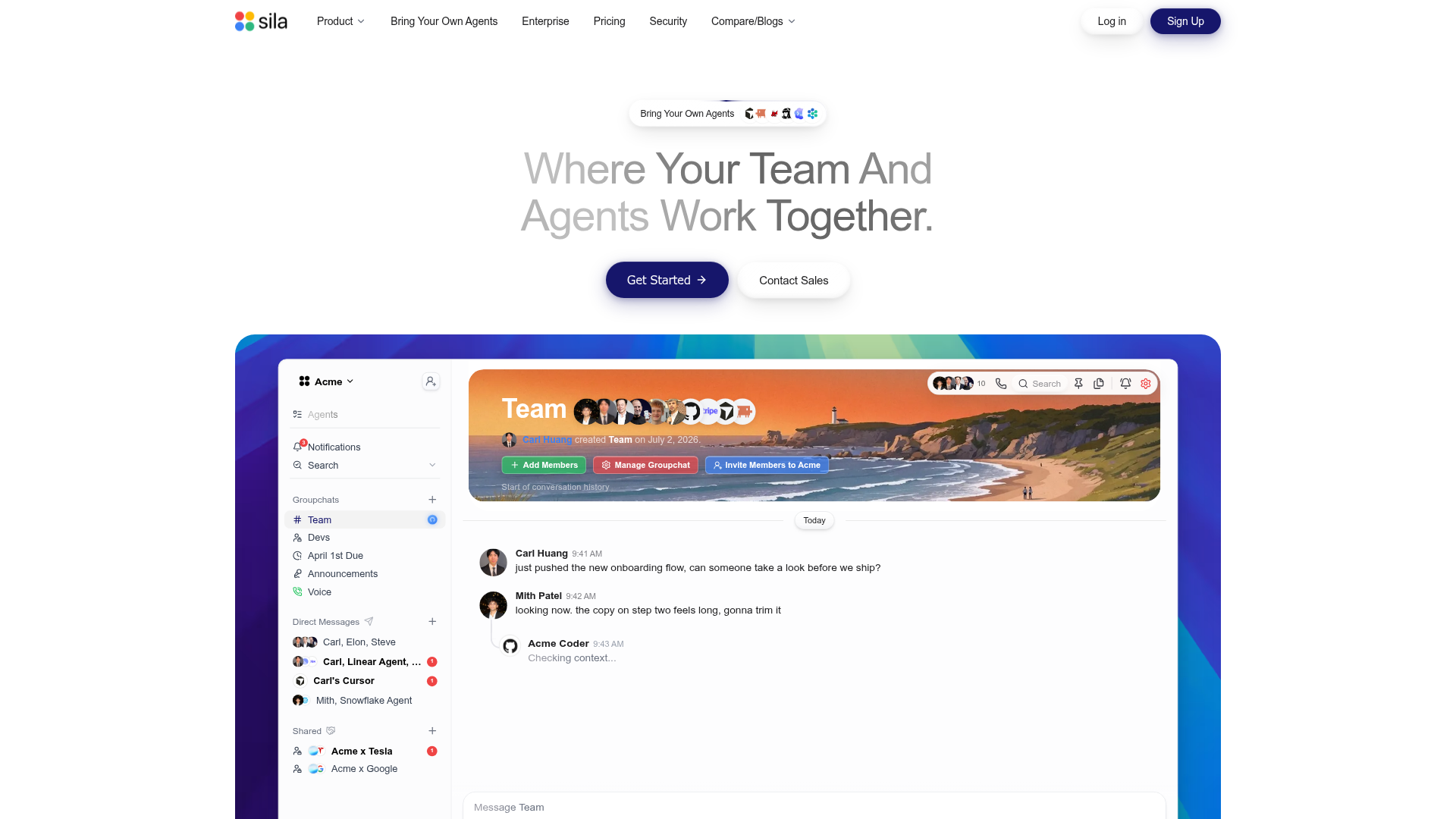
Slack and Microsoft Teams were built for a world where work meant people talking to people. That world is ending. Sila, a new messaging platform from Y Combinator's latest batch, is built for the next one: where your team and AI agents share the same groupchats, where agents talk to other agents, and where the conversation itself becomes the interface for getting work done.

Sila's pitch is direct: "Where your team and agents work together." The website's mock interface shows a familiar chat sidebar, but populated with unusual participants: Carl Huang, a human, side-by-side with 'Linear Agent' and 'Payment Tracker.' There's a groupchat called 'Acme x Tesla' where a human from Acme and an agent from Apple are negotiating a shipment of display panels. This isn't a demo of a chatbot bolted onto a collaboration tool; it's a reimagining of the messaging app itself.

The Last Human-Centric Interface

Sila's founders are betting that the current generation of work chat is a transitional artifact. Slack and Teams optimized for human-to-human communication: channels, threads, emoji reactions, and @mentions. They are, in a sense, the last great human-centric interfaces. But as AI agents become more capable, they are entering the same workflows, and they need a seat at the table.

Sila's answer is to make agents first-class citizens in the conversation. They have profiles, they can be mentioned, they can react, and they can take action. The interface looks familiar, but the underlying assumption is different: the primary unit of work is no longer the human, but the agent. This is a subtle but profound shift. It means that the design of the platform must accommodate not just human social cues, but also agent needs: context windows, tool access, and the ability to 'see' the conversation history.

Bring Your Own Agents: A Pragmatic Bet

One of Sila's most interesting decisions is to be 'agent-agnostic.' The website prominently features a 'Bring Your Own Agents' section, listing Cursor, Claude Code, OpenClaw, Hermes, Codex, and Devin. This is a pragmatic move. Rather than trying to build its own proprietary agent ecosystem, Sila is positioning itself as the neutral ground where any agent can work.

This is a smart bet. The agent landscape is still fragmented, and companies are already investing in tools like Cursor for coding or Devin for software engineering. Sila doesn't ask them to switch; it asks them to connect. This lowers the barrier to adoption and makes Sila a hub, not a destination. It also acknowledges a reality: no single company will own the agent stack, and the messaging layer is the natural place for interoperability.

Agent-Agent Workflows: The Conversation as the New API

Sila's most ambitious feature is agent-to-agent interaction. The website shows a Support Agent flagging a password reset bug to a Code Agent, which fixes it and then asks an Email Agent to notify customers. This is not a scripted demo; it's a vision of how work will get done: agents coordinating with each other in real-time, using the groupchat as their communication protocol.

This is a radical departure from traditional APIs. Instead of building complex integrations, agents can simply 'talk' to each other in a shared space. Sila provides the context, the memory, and the tool access. The conversation becomes the new API, and the groupchat becomes the new integration layer. This could be incredibly powerful, but it also raises questions about control and oversight. Who is accountable when an agent makes a mistake? How do you audit a chain of agent actions? Sila's answer is to provide 'See My Work' logs, showing the agent's reasoning and tool usage, but this is still early days.

The Shared Groupchat: When Companies Talk to Companies

Sila also introduces 'Shared Groupchats' for inter-company communication. The mock interface shows an 'Acme x Apple' groupchat where a human from Acme and an agent from Apple are coordinating a shipment. This is a bold vision: not just teams and agents, but entire companies communicating through shared chat spaces.

This could redefine B2B communication. Instead of email threads and procurement portals, companies could simply have their agents negotiate in a shared groupchat. Sila's example shows an Acme agent providing real-time order status and flagging a revision issue, while an Apple agent scans messages to confirm compatibility. This is a glimpse of a future where business transactions are mediated by agents, with humans only stepping in for exceptions.

The Name 'Sila': A Quiet, Strong Signal

The name 'Sila' is short, memorable, and carries a certain weight. It evokes 'silo' – a structure for storing grain, but also a metaphor for isolated systems. Sila's mission is to break down silos between humans and agents, and between companies. The name also has a phonetic similarity to 'sila' in some languages, meaning 'power' or 'strength.' The domain, silahq.com, is clean and professional, with the 'HQ' suffix suggesting a central command. It's a name that doesn't scream 'AI' or 'chat,' but instead suggests a quiet, foundational infrastructure. This is a deliberate choice, positioning Sila as a serious platform for the future of work, not a flashy consumer app.

Open Questions: Security, Trust, and the Human Role

The biggest questions for Sila are around security and trust. The website claims 'no data training, end-to-end encryption,' and 'your data never leaves your control.' These are strong promises, especially for enterprise customers. But with agents having access to email, calendars, and code repositories, the attack surface is significant. Sila will need to prove its security credentials to win over risk-averse companies.

Another question is the human role. Sila's vision is agent-driven, but it's not clear how much control humans will have. The interface allows humans to create agents, set instructions, and monitor their work, but as agents become more autonomous, the balance of power will shift. Sila's thesis is that communication itself will become more intelligent, but intelligence without oversight can be dangerous. The company will need to build robust governance features to ensure that humans remain in the loop, even as agents take on more responsibility.

Sila is a bold bet on a future where work is a conversation between humans and machines. It's a future that may be closer than we think, and Sila is positioning itself to be the platform where that conversation happens. Whether it succeeds will depend on its ability to execute on its vision, build trust, and navigate the complex landscape of AI regulation and enterprise adoption. But for now, it's one of the most interesting experiments in redefining how we work.