Skyvern
Vision-based browser automation that survives UI changes, with a Rust rewrite for speed.
NewName Editorial
Editorial Team
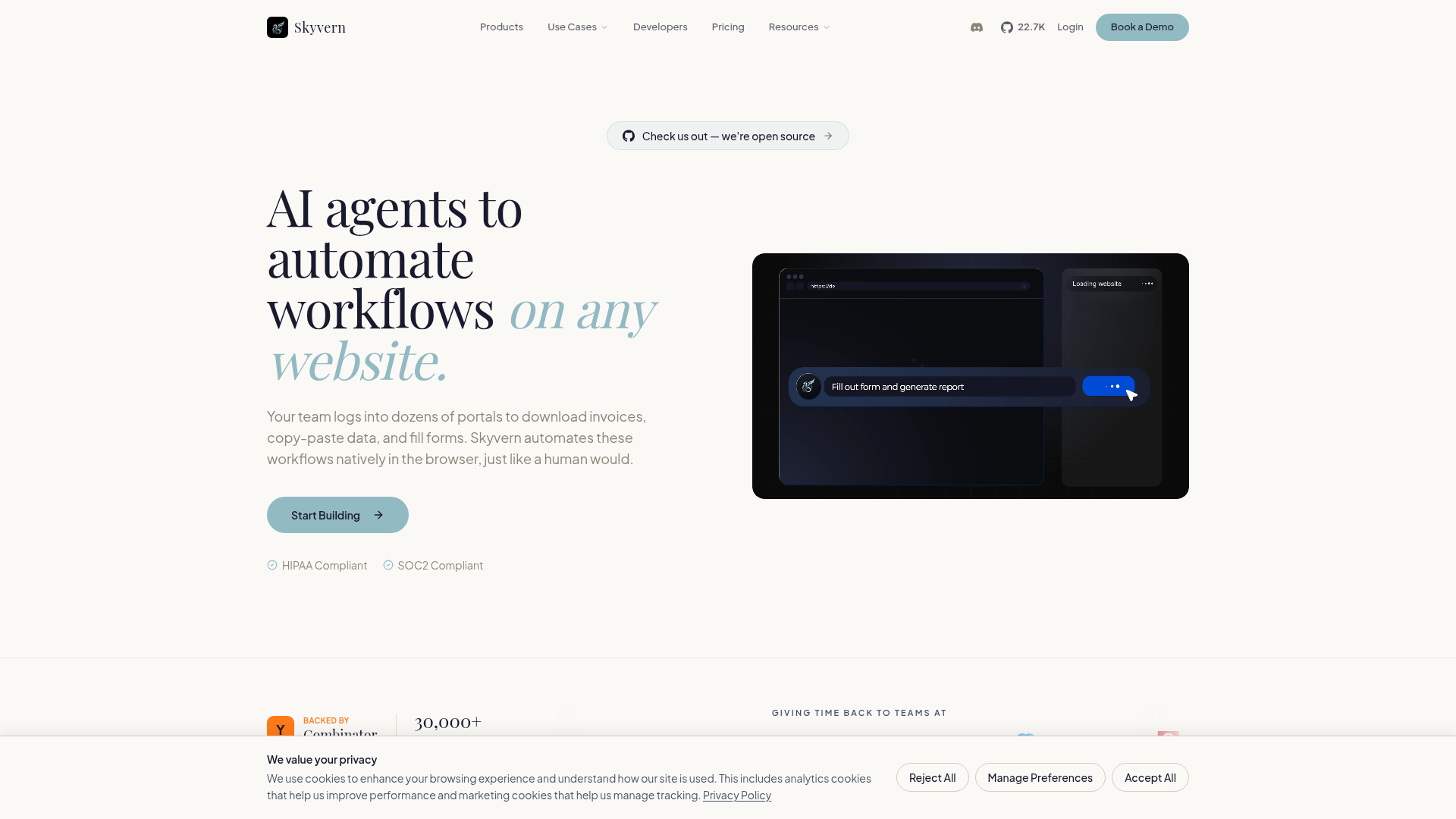

Every operations team has a version of this story: a vendor portal redesigns its login flow, and the scraper that worked yesterday returns nothing but a 404 and a pile of unresolved tickets. For years, the answer has been more engineering time — patching selectors, updating XPaths, hoping the DOM stabilizes. Skyvern is built on a different premise: stop writing selectors altogether and let a vision-based AI agent read the page the way a human would. The company's pitch is that its agents can log in, navigate, fill forms, and extract data across thousands of portals without breaking when a button moves or a field is renamed. It's a bold claim, and the company has paired it with an unusual technical move — a rewrite of Playwright in Rust, called Rustwright, that it says uses 70% less memory and runs 2.55x faster. That combination of AI-driven adaptability and low-level performance engineering is what makes Skyvern worth a closer look.
When a portal redesign breaks your scraper at 3 a.m.
The core problem Skyvern targets is the brittleness of traditional browser automation. Playwright, Selenium, and Puppeteer all rely on selectors — CSS paths, XPaths, or accessibility attributes — to locate elements on a page. These selectors are tightly coupled to the DOM structure, so any change to the HTML, a class name, or a layout shift can cause a script to fail. The company's website draws a direct comparison: "Selector-based scripts break when UI changes" and "Automation tightly coupled to DOM structure." For teams managing hundreds of vendor portals, this means constant maintenance. Every time a portal updates, someone has to debug and refactor the script. Skyvern's answer is to use computer vision to interpret the page visually, rather than relying on the underlying code. The agent sees the page as a human would — a login button is a login button, regardless of its CSS class.
Vision over selectors: the architectural bet
Skyvern's approach is a fundamental shift from scripted automation to what the company calls "vision-based" AI. Instead of writing code that targets specific elements, users describe the goal in natural language, and the agent figures out the steps. The website's example is telling: "Go to vendor.acme.com, log in with our credentials, download all invoices from the last 30 days, and save them as PDFs." The AI Copilot then generates a structured workflow, but the execution relies on the agent's ability to perceive and interact with the page in real time. This is a different architecture from RPA tools that record and replay sequences, which the company criticizes as "built for one-off tasks" and "limited adaptability." Skyvern blends LLM reasoning with executable code, aiming for deterministic, repeatable workflows that can handle dynamic websites. The bet is that vision is more robust than selectors, and that LLMs can reason about unfamiliar pages without hallucinating.
The messy middle: CAPTCHAs, 2FA, and the workflows RPA avoids
The most honest part of Skyvern's pitch is its focus on the messy realities of real-world automation. Many AI agents fail at authentication flows, but Skyvern claims to handle CAPTCHAs natively — no third-party solving services — and to manage two-factor authentication (2FA) and TOTP codes. This is the kind of detail that separates a demo from a production tool. The website also highlights proxy network support for country, state, or zip-code-level targeting, which is essential for scraping sites that geo-block. And for compliance, Skyvern offers explainable AI: every run includes a summary of actions taken and why, which is critical for audits. These features address the reasons why many RPA projects stall — not because the basic automation is hard, but because the edge cases are endless.
Rustwright: a rewrite that reveals Skyvern's priorities
Skyvern's tagline on Y Combinator's site is not about AI agents but about a performance rewrite: "Rustwright: Rewrite of Playwright in rust that uses 70% less memory (and is 2.55x faster)." This is a telling signal. While most AI-agent startups focus on model quality and prompt engineering, Skyvern is investing in the underlying browser automation layer. Playwright is the de facto standard for browser automation, but it runs on Node.js, which has significant memory overhead. By rewriting it in Rust, Skyvern aims to reduce memory usage by 70% and increase speed by 2.55x, according to the company. This matters for scaling: running thousands of browser instances in the cloud is expensive, and memory is often the bottleneck. A Rust-based engine could lower costs and improve performance, giving Skyvern a technical edge that competitors may overlook.
Naming the storm: what 'Skyvern' signals about the category
The name "Skyvern" is a portmanteau of "sky" and "govern" or "cavern"? The website doesn't explain it, but the name suggests a lofty, all-encompassing reach — automating anything under the sky. It's a strong, memorable name that evokes both breadth and control. The domain skyvern.com is clean and brandable, which is a plus in a crowded market. The name positions Skyvern as a platform rather than a niche tool, aligning with its ambition to handle "any website." However, the name doesn't hint at the technical sophistication of Rustwright, and it may be too abstract for enterprise buyers who prefer descriptive names. Still, in the AI agent space, a distinctive name helps cut through the noise.