Slashy
Slashy turns email into a workflow engine, not a storage bin.
NewName Editorial
Editorial Team
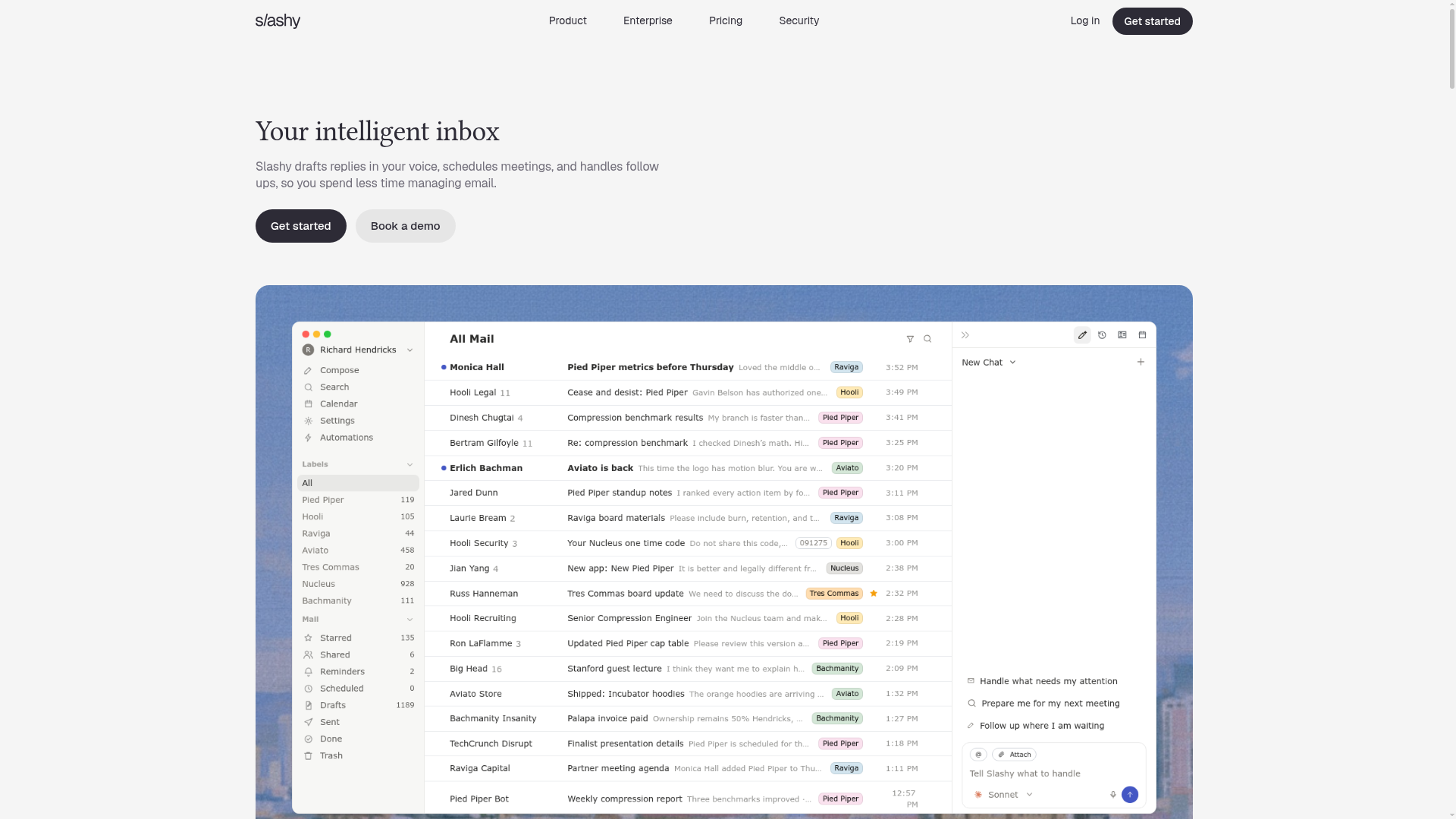
For founders, email is not a communication channel; it is a second job. Every thread carries a hidden to-do: reply with the right context, schedule the meeting, remember to follow up, and never let a quiet thread slip. Slashy, a Y Combinator-backed startup, is building an "intelligent inbox" that treats email not as a storage problem but as a workflow engine. Its pitch is simple: draft replies in your voice, schedule meetings, handle follow-ups, and do it all from iMessage. But the deeper story is about memory and follow-through—the two things that make email exhausting—and about a marketing strategy that uses Silicon Valley's favorite fictional compression algorithm to say something real.
The inbox as a second job, and the layer that removes it
Slashy's about page frames the problem in terms founders recognize: "email is where customers ask, investors reply, candidates decide, and teams unblock work." The hard part is not storing or sorting messages; it is understanding context, deciding what happens next, writing the response, finding time on the calendar, and remembering to follow through. Most email clients stop at the first step. Slashy's thesis is that the next layer of value is in the preparation and follow-through—the work that happens around the email itself.
The product is not another text box that asks you to explain the thread it is already sitting beside. Instead, Slashy reads the full thread, uses the context in your inbox and calendar, and brings you something useful to review. You stay in control of what gets sent, but the busywork of drafting, scheduling, and nudging is handled. The goal, as the company puts it, is "less time spent managing email and more important work actually finished."
Why 'middle-out' is more than a joke
Slashy's landing page is a love letter to Silicon Valley. The sample inbox is full of Pied Piper, Hooli, Raviga, and Erlich Bachman. There is a "middle out" demo, a cease-and-desist from Gavin Belson, and a compression benchmark where Dinesh and Gilfoyle argue over methodology. It is funny, but it is also strategic. The show's core joke was that Pied Piper's "middle-out" compression algorithm could make data infinitely small. Slashy is making a similar claim about email: compress the work of managing an inbox into a few keystrokes or a text message.
The reference is not just decoration. It signals that Slashy understands its audience—founders and operators who live in email and who appreciate the absurdity of the work. It also positions the product as a compression tool for time, not just data. The landing page even includes a fake thread where Gavin Belson asks to license Pied Piper's compression engine, and Slashy drafts a reply that is professional, concise, and on-brand. It is a demonstration of the product's core value: taking a complex thread and compressing it into the reply you would have written.
The anti-GPT-slop standard: writing like you, not like a model
One of the most distinctive sections on the landing page is a side-by-side comparison titled "Your writing style, not AI slop." It shows a draft reply to Richard Hendricks about an acquisition, annotated with the sins of generic AI writing: "GPT slop opener," "buzzword," "nobody says this," "way too wordy," "too stiff." The message is clear: Slashy is not another tool that produces bland, corporate-speak emails. It learns your voice, your preferences, and your relationships, and it drafts replies that sound like you.
This is a critical differentiation. The market is flooded with AI writing tools that generate grammatically correct but soulless prose. Slashy's bet is that founders and investors will not trust a tool that makes them sound like a press release. The product's memory feature is designed to capture your style over time—"write like a text, not a Silicon Valley keynote" is one of the example preferences—and to apply it consistently. The result is a draft that is not only accurate but also authentic.
The comparison also serves as a subtle critique of the competition. By calling out "GPT slop," Slashy is positioning itself as the tool for people who care about how they sound, not just what they say. It is a high bar, and the company knows it. The landing page promises that Slashy "reads the full thread and drafts the reply you would have written," which is a strong claim. But the emphasis on voice and style suggests that Slashy is willing to be judged on the quality of its prose, not just its speed.
iMessage as the control surface: email without opening email
One of Slashy's most interesting features is its iMessage integration. The landing page shows a phone screen where you can text Slashy a request like "Find Monica's last email, draft a reply confirming Thursday at 10:00 AM, and attach the Pied Piper deck." Slashy responds with the draft, and you can approve it without ever opening your email app. This is a radical rethinking of the inbox: email becomes a backend, and your messaging app becomes the front end.
The iMessage integration is not just a convenience; it is a statement about where work happens. Founders spend as much time in iMessage as they do in email, and Slashy is meeting them there. The same logic applies to Slack, which is also listed as a messaging integration. The product is designed to be "everywhere you work," and that means not forcing you into a new interface.
This approach has a practical benefit: it reduces the friction of checking email. Instead of opening the inbox, scanning for urgent threads, and deciding what to do, you can simply text Slashy and get a summary, a draft, or a follow-up. The result is that email becomes something you delegate, not something you do.
Follow-through as a feature: reminders, nudges, and automations
Email is full of open loops. You promise to send a deck, you wait for a reply, you forget to follow up. Slashy turns follow-through into a feature. The product "watches for replies, reminds you when a thread goes quiet, and drafts the next nudge." It also lets you set reminders with natural language: "If no reply, set reminder for: Re: Pied Piper metrics before Thursday."
This is where Slashy moves beyond a simple drafting tool. It is an assistant that tracks the state of your conversations and takes the next step before you ask. The landing page shows an example of an automation: "Follow up on unanswered Hooli emails—draft the nudge when a Hooli acquisition thread goes quiet." This is not a static rule; it is a dynamic response to the flow of your inbox.
The follow-through feature is especially valuable for founders, who are judged on responsiveness. One testimonial from an investor says, "Founders remember who got back to them first. Now I'm always that person." Slashy is selling more than time; it is selling reputation.
Memory that compounds: learning your voice and relationships
Slashy's memory is the engine behind its drafting and follow-through. The product "learns your voice, relationships, decisions, and preferences from every email, event, and correction." It remembers that Monica Hall prefers Thursday mornings for board calls, that you only schedule investor meetings on Wednesdays, and that you write like a text, not a keynote. This memory is personalized and persistent, and it improves with every interaction.
The memory feature is what makes Slashy feel like an assistant rather than a tool. It is the difference between a generic AI draft and one that knows the context of your relationships. The landing page shows an example of a meeting prep automation: "Research attendees and send a brief before every Pied Piper board call." This requires not just access to your calendar but an understanding of who is important and why.
The risk, of course, is privacy. Slashy addresses this head-on with a security section that emphasizes encryption, SOC 2 Type II compliance, and a promise that your emails are never used to train AI models. This is a critical trust signal for a product that reads your inbox.
Security and pricing: trust as a feature
Slashy's security page is reassuringly specific: data is encrypted in transit with TLS 1.2+ and at rest with AES 256, and independent auditors evaluate controls against AICPA Trust Services Criteria. The company also states that "our agreements require AI providers not to retain them." This is the kind of detail that matters for a product handling sensitive email.
Pricing is straightforward: Professional is $25/user/month billed annually (or $30 monthly), with a 7-day free trial and a credit card required. Enterprise is custom, with SSO, SCIM, guided onboarding, and custom security controls. This is a typical SaaS structure, but the emphasis on security and enterprise features suggests that Slashy is aiming for larger teams, not just solo founders.
The combination of security, memory, and follow-through makes Slashy a compelling option for anyone who lives in email. It is not just a smarter inbox; it is a way to compress the work of email into a few minutes a day. And with its Pied Piper branding, it is a product that knows exactly who it is for.