Softr
Softr turns plain-language prompts into secure, production-ready business apps—no code, no stack sprawl.
NewName Editorial
Editorial Team
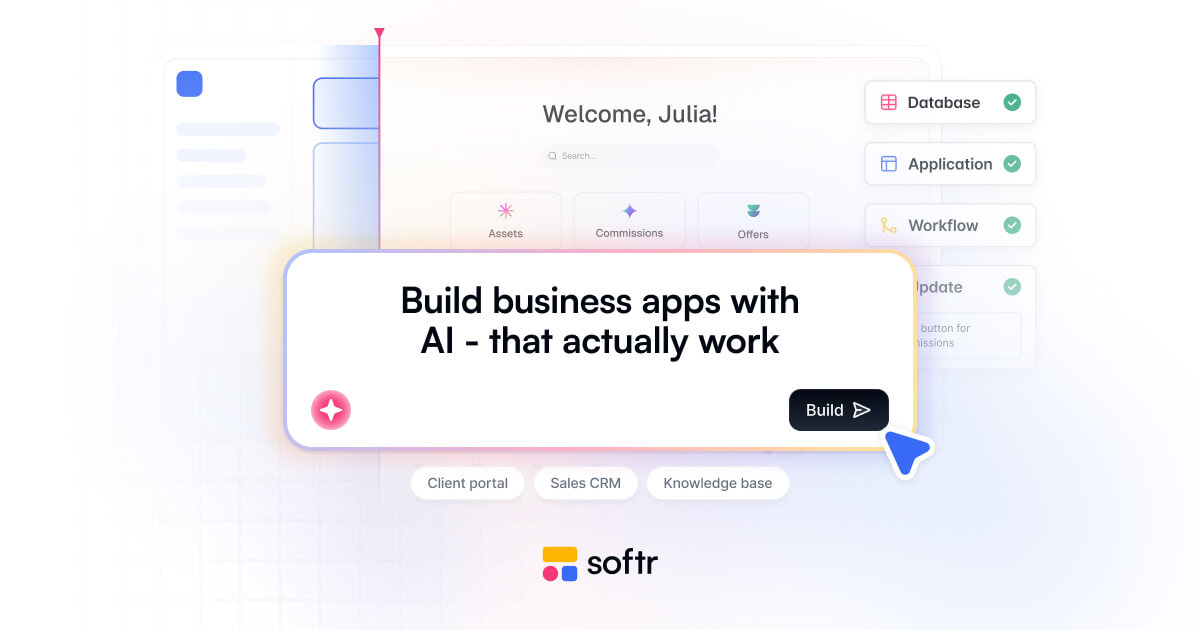
For years, the promise of no-code was simple: you don't need a developer to build a tool. But the reality was a patchwork—a database here, an automation there, a front-end bolted on. Softr's new pitch is more ambitious: describe the app you need, and the platform generates the entire thing—database, business logic, and interface—already secure and ready for real users. This isn't just a feature update; it's a bet that the future of business software is not assembling components but describing outcomes.
The end of the app-building middleman
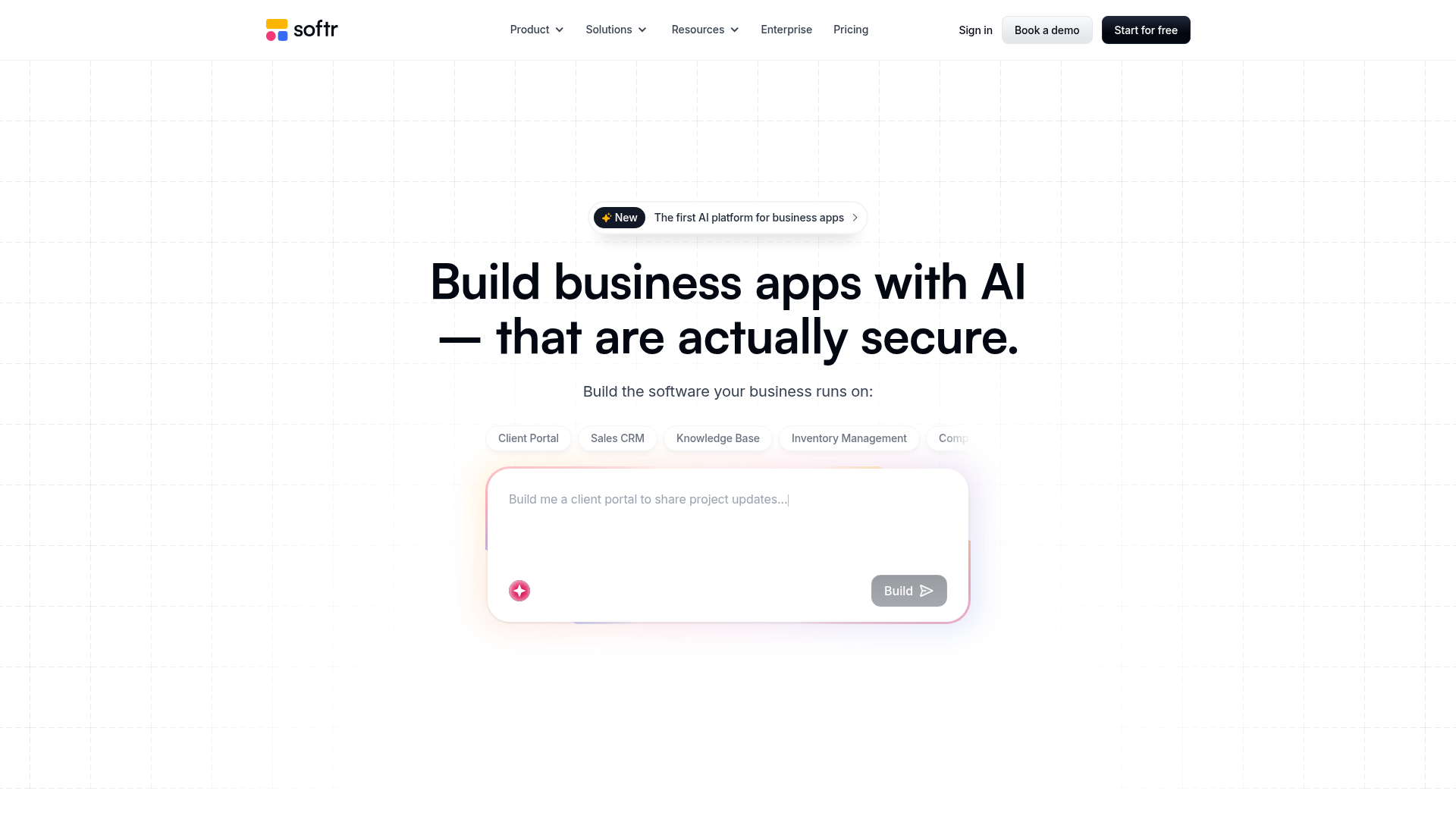
Softr's homepage now leads with a prompt: "Build me a client portal to share project updates..." and a Build button. That's a deliberate shift from the old no-code paradigm, where you'd start with a blank canvas and drag blocks. Instead, Softr positions AI as the primary interface. The platform claims to handle "everything—interface, database, workflows" from a simple description. This is a direct challenge to the traditional no-code workflow, where the user is still the architect. Softr wants to be the architect, and the user becomes the client who approves the blueprint.
This is a meaningful evolution. No-code tools like Bubble or Airtable still require you to understand data modeling, relationships, and logic. Softr's AI-first approach aims to eliminate that cognitive load. But it also raises a question: how much control do you give up? The site's answer is that you can "iterate with AI or visually" and "control most critical parts of your app yourself—roles, permissions, security." In other words, Softr is trying to have it both ways: AI-generated speed, with human oversight on the parts that matter.
From no-code builder to AI platform: what actually changed
Softr's website still lists familiar no-code features—apps, databases, workflows, forms, mobile apps, integrations. But the framing has changed. The tagline now reads: "Softr is the AI platform for building the software your business runs on without code or developers." The word "platform" is deliberate. Softr is no longer just a tool for building a client portal; it's a system that can replace multiple tools in your stack.
The site's "Platform" section explicitly lists what Softr replaces: off-the-shelf software, custom-coded apps, and spreadsheets. It also names specific competitors: Airtable, Supabase, Google Sheets for databases; Zapier, Make, n8n for workflows. This is a bold positioning. Softr isn't just an alternative to one tool; it's an alternative to the entire stack of tools that a small business might use to run operations. The AI component is the enabler—it's what makes it feasible to generate a full app with database and logic in one go.
But is this just marketing? The evidence suggests Softr has actually built the components. The site details a built-in database, workflow automation, and integrations with major data sources like Airtable, Notion, and PostgreSQL. The AI is not just a prompt-to-UI generator; it's integrated into the platform's core, including AI agents that can run on autopilot. This is more than a cosmetic change.
The database is the product: why Softr's built-in data layer matters
One of the most interesting decisions is Softr's move to include a built-in database. Historically, Softr was known as a front-end for Airtable—you'd design an interface on top of your existing data. Now, the platform offers its own database, which it claims can replace Airtable, Supabase, and Google Sheets. This is a strategic shift: Softr wants to own the data layer, not just the presentation layer.
Why does this matter? Because the database is the foundation of any business app. If you control the data, you control the logic, the permissions, and the integrations. Softr's built-in database is designed to be "flexible" and to power apps and workflows directly. This eliminates the need for a separate database tool and the integration glue that comes with it. For a small business, this could be a significant simplification: one platform for data, logic, and UI.
But there's a tradeoff. If you already have your data in Airtable or PostgreSQL, Softr still supports those as data sources. So the built-in database is an option, not a mandate. This flexibility is smart—it lets existing users migrate at their own pace while new users can start fresh without external dependencies.
Replacing the stack: Airtable, Zapier, and the spreadsheet trap
Softr's website is explicit about what it replaces: Airtable, Supabase, Google Sheets, Zapier, Make, n8n. This is a direct attack on the modern business stack, where data lives in a spreadsheet, automation runs through a third-party tool, and the UI is a custom build. Softr's pitch is that you can consolidate all of this into one platform.
The implications are significant. For a small business, this could mean fewer subscriptions, fewer integration headaches, and a single source of truth. The site's use cases—client portals, CRMs, inventory management, intranets—are all common scenarios where businesses currently piece together multiple tools. Softr's AI could generate a custom CRM that fits your exact workflow, rather than forcing you to adapt to a generic one.
However, this consolidation also creates a lock-in risk. Once your business runs on Softr, migrating away could be painful. The platform's response is to support data export and integrations with other tools, but the deeper the integration, the harder the exit. This is a classic platform tradeoff, and it's worth noting for any business considering a move.
Security as the differentiator: roles, permissions, and the enterprise promise
The homepage headline is telling: "Build business apps with AI – that are actually secure." Security is not an afterthought; it's the headline. Softr is making a direct appeal to enterprises, and the customer logos—Netflix, Google, Stripe, UPS—reinforce that. The platform promises that you can "control most critical parts of your app yourself—roles, permissions, security."
This is a crucial point. AI-generated apps often raise red flags about security and data governance. Softr is trying to preempt that concern by emphasizing that the AI handles the heavy lifting, but the human retains control over who can see and do what. The platform also offers enterprise-grade features, though the site doesn't detail specifics like SSO or compliance certifications. Still, the positioning is clear: Softr wants to be the AI platform that enterprises trust, not just a toy for hobbyists.
The challenge is that security is a spectrum. A client portal for a small business has different requirements than an ERP for a Fortune 500. Softr's flexibility in roles and permissions is a good start, but the real test will be in the details—audit logs, data residency, and integration with enterprise identity providers. The site doesn't disclose these, so it's an open question for now.
The tradeoff: abstraction vs. control in business software
At its core, Softr's AI platform is an exercise in abstraction. You describe what you want, and the system builds it. This is powerful, but it comes with a tradeoff: you lose the fine-grained control that comes from building with code or even with traditional no-code tools. Softr's answer is that you can iterate visually and control security, but there's a limit to how much you can tweak the underlying logic.
This tradeoff is not unique to Softr—it's the fundamental bargain of all AI-generated code. The question is whether the abstraction is worth it. For a business that needs a custom internal tool quickly, the answer is likely yes. For a business with complex, idiosyncratic workflows, the answer may be no. Softr's positioning suggests it's targeting the former: businesses that are currently overspending on "pricy software with unused features" and want something that fits their workflow perfectly.
Ultimately, Softr is making a bet that the future of business software is not buying off-the-shelf or building from scratch, but describing what you need and letting AI handle the rest. The platform's success will depend on whether it can deliver on that promise without sacrificing the security and control that enterprises demand. The evidence so far suggests Softr is serious about the attempt, but the real proof will be in the apps that businesses run on it every day.