Impact-Site-Verification: 41b53a0c-6d04-458b-a457-fe9e29acde1a

AI & Machine Learning·Pre-seed··6 min read

Solving.AI

In-app AI guidance that teaches employees software by seeing their screen.

NN

NewName Editorial

Editorial Team

Solving.AI product image 1
Solving.AI product image 2

Every enterprise knows the scene: a new hire stares at Salesforce, a manager squints at NetSuite, and the 200-page training manual sits unopened on a virtual shelf. Software adoption rates have always been the silent killer of digital transformation budgets. Solving.AI, a Montréal startup with a pre-seed round of $1.1 million, is betting that the fix isn't better manuals or more training sessions—it's an AI that lives inside the software itself.

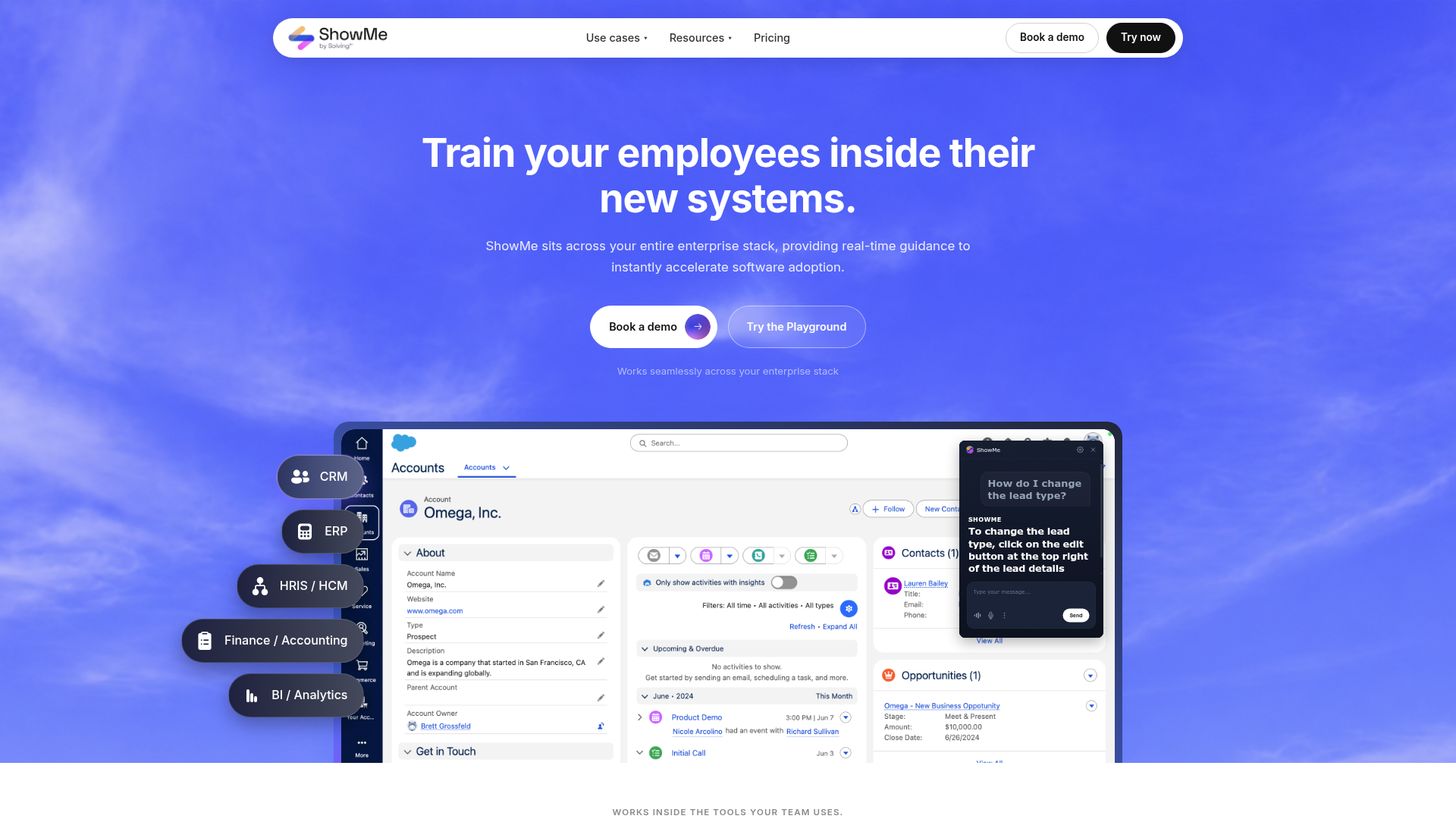
The product, called ShowMe, is a Chrome extension that watches what you do on screen and answers questions in plain language, either typed or spoken. It doesn't just give generic instructions; it points to the exact button you need to click, on the exact page you're looking at. That might sound like a small improvement, but it's a fundamental shift from how software training has worked for decades.

The 200-page manual problem

Solving.AI's pitch starts with a familiar pain: employees don't read manuals, and even when they do, they can't apply the instructions to their specific situation. The company's website puts it bluntly: "No one reads 200-page training manuals. This creates friction, slows adoption, and leads to bad system usage." The cost is real—every hour spent struggling with complex software is lost productivity, and every support ticket is a drain on IT resources.

The problem is especially acute in enterprise software like Salesforce, SAP, and Workday, which are powerful but notoriously complex. Traditional training methods—classroom sessions, video tutorials, wikis—are static and quickly become outdated. They don't account for the fact that each user's screen looks different, with different data, permissions, and workflows.

ShowMe's answer is to meet users where they are, literally. Instead of forcing them to leave the app to find help, it overlays guidance on top of the interface. If you ask "How do I change the lead type?", it shows you the edit button at the top right of the lead details page—not a paragraph of text that describes it.

ShowMe's trick: it sees what you see

The core technical bet behind ShowMe is that context is everything. The extension captures what's visible on your screen and uses that to ground its responses. This is what the company calls "sees your screen"—a feature that sets it apart from generic AI chatbots that answer questions in a vacuum.

For example, if you're on a specific record in Salesforce and ask "How do I update this account?", ShowMe knows you're looking at the account detail page and can guide you to the correct edit button, rather than giving a generic walkthrough. This screen-awareness also enables voice-first interaction: you can ask out loud, and ShowMe will hear you, see your screen, and show you where to click.

This is a significant technical challenge. The AI must parse the visual layout of a web app, understand the user's intent, and map that to actionable steps—all in real time. Solving.AI is building this for a wide range of enterprise software, including Salesforce, HubSpot, NetSuite, and SAP, and the company claims it works with "any web-based tool" because it runs in the browser.

The DAP trap and how ShowMe escapes it

Digital adoption platforms (DAPs) like WalkMe and Pendo have tried to solve the adoption problem for years, but they've earned a reputation for being heavy and brittle. Solving.AI's website takes a direct shot: "Old-school DAPs take months to build. They rely on static, coded rules that break whenever your software updates."

That's a real pain point. DAPs typically require IT teams to manually create step-by-step walkthroughs for every workflow, which is a huge upfront investment. And when the underlying software changes—which happens frequently in cloud apps—those walkthroughs break, requiring maintenance.

ShowMe's approach is different. Instead of coded rules, it uses AI to interpret the interface dynamically. It reads the screen, understands the context, and generates guidance on the fly. This means it can adapt to changes in the software without manual updates. The company claims setup takes less than a day: you upload your SOPs and training documents, and ShowMe processes them to create a "contextual business logic layer" that informs its responses.

This is a compelling value proposition. For IT teams, it promises to eliminate the maintenance burden of traditional DAPs. For employees, it promises help that's always in context and always up to date.

Deploy in a day, not a quarter

Solving.AI emphasizes speed of deployment. The website highlights "< 1 day" as the time to deploy, achieved by adding a script tag or distributing a Chrome extension. This is a stark contrast to the multi-month implementations that DAPs and training programs often require.

The company also cites "~95% support ticket deflection" as a key metric, meaning users resolve their questions inside the app without opening a ticket. While this number comes from Solving.AI's own materials and may not be independently verified, it signals the product's potential to reduce support costs.

For organizations rolling out new software, ShowMe can be embedded in the onboarding process. The use cases listed on the site—employee training, software adoption, AI-assisted workflows, and onboarding—all point to a tool that's designed to be part of the change management process, not an afterthought.

What the name says about the ambition

The company name, Solving.AI, is both a mission statement and a bit of a pun. It suggests a focus on solving problems with AI, but it's also generic enough to be ambiguous. The product name, ShowMe, is more concrete: it's an imperative, a request for demonstration. It positions the tool as something that shows you how to do things, rather than just telling you.

The domain solving.ai is clean and memorable, though it may be too broad for a product that's specifically about software training. Still, the brand has a cohesive story: Solving.AI solves the problem of software adoption, and ShowMe is the mechanism.

The open question: can it scale beyond the demo?

The biggest risk for Solving.AI is whether the technology can live up to the promise of universal compatibility. The website lists a range of supported software, but "any web-based tool" is a bold claim. Enterprise apps are notoriously idiosyncratic, with complex iframes, custom components, and non-standard UI elements. ShowMe's screen-reading approach may struggle with some of these, and the company will need to continuously improve its models to handle edge cases.

Another open question is security. ShowMe sees what users see, which means it has access to potentially sensitive data. The company addresses this with GDPR compliance, SOC 2 Type II certification, and a commitment that "data never used for training." But enterprises will need to trust that these safeguards are robust, especially in regulated industries.

Finally, the market is crowded with competitors, from traditional DAPs to newer AI-powered assistants. Solving.AI's differentiation lies in its screen-awareness and quick deployment, but it will need to prove that these advantages translate into lasting customer value.

For now, Solving.AI has a clear thesis: the best way to teach someone to use software is to guide them inside the software itself. If ShowMe can deliver on that promise, it could become a standard part of the enterprise tech stack. If not, it'll be another cautionary tale about the difficulty of changing how people learn.