Impact-Site-Verification: 41b53a0c-6d04-458b-a457-fe9e29acde1a

AI & Machine Learning··5 min read

Sprocket

The AI agent that designs hardware, writes software, and buys parts—all in one workflow.

NN

NewName Editorial

Editorial Team

Sprocket product image 1
Sprocket product image 2
Sprocket product image 3

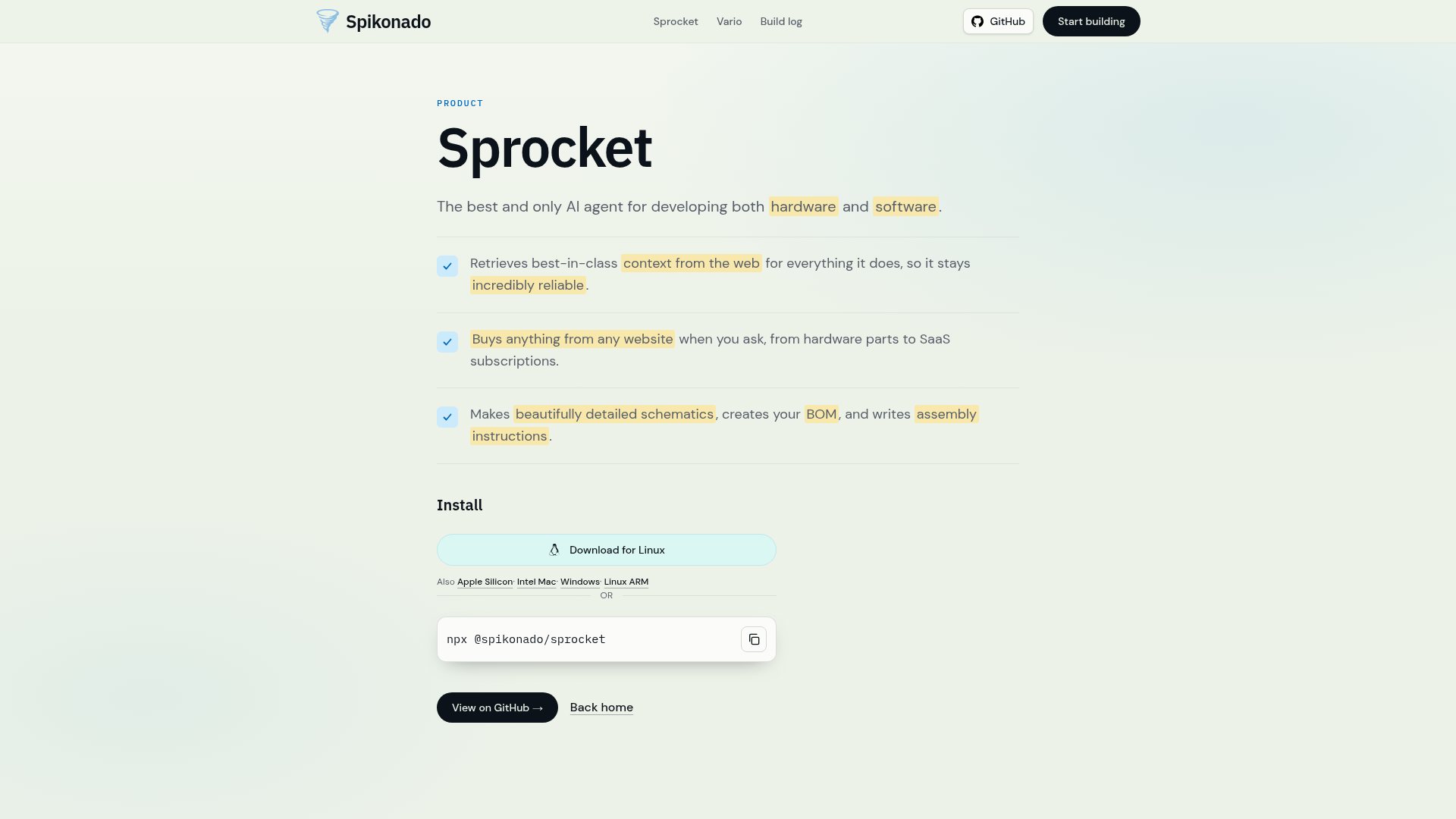
Sprocket is not another coding copilot. It is an AI agent that claims to handle both hardware and software development, a rare combination in a field dominated by software-only assistants. The tagline—"The Best AI Agent for Hardware and Software Development"—is audacious, but the product's features suggest a serious attempt to bridge the physical and digital worlds. From buying components on the web to generating assembly instructions, Sprocket aims to be a full-stack partner for makers and engineers.

The Dual-Domain Ambition: Why Hardware and Software Agents Rarely Mix

Most AI agents are built for software: they write code, review pull requests, and debug. Hardware development is a different beast, requiring knowledge of physical components, schematics, and manufacturing constraints. Sprocket's pitch is that it can do both, which is unusual. The website lists three core capabilities: retrieving web context, purchasing items, and creating schematics with BOMs. This is not a feature list you see on a typical dev tool. It signals a product that wants to own the entire lifecycle of a physical product, from concept to assembly.

The ambition is clear, but the execution is what matters. Public materials are thin on technical details, but the product's existence suggests a belief that AI can handle the messy, multi-step process of hardware design. Whether it can truly replace human intuition in circuit design or mechanical engineering remains to be seen, but the attempt is noteworthy.

Web-Grounded Actions: Context That Keeps Sprocket Honest

One of Sprocket's key features is its ability to "retrieve best-in-class context from the web for everything it does." This is a significant differentiator. Many AI agents rely on static training data, which can be outdated or incomplete. By pulling real-time information from the web, Sprocket can stay current with the latest components, datasheets, and best practices. This is especially critical in hardware, where part availability and specifications change frequently.

The emphasis on web grounding also addresses a common criticism of AI agents: hallucination. By anchoring its actions in up-to-date web data, Sprocket aims to be more reliable. The website claims this makes it "incredibly reliable," a bold promise. But the approach is sound: if the agent can verify facts against live sources, it reduces the risk of generating incorrect schematics or recommending obsolete parts.

From Schematic to BOM: Sprocket's Hardware Workflow

Sprocket's hardware workflow is where it truly stands out. The product promises to "make beautifully detailed schematics, create your BOM, and write assembly instructions." This is a complete package for hardware development, covering design, procurement, and documentation. For a hobbyist or small team, this could be a game-changer, automating tasks that are often tedious and error-prone.

The BOM (Bill of Materials) is a critical output. It lists all components needed for a project, including part numbers, quantities, and sources. Sprocket's ability to generate this automatically, perhaps using web data to find current suppliers, could save hours of manual work. The assembly instructions add another layer, making the product useful for manufacturing or DIY kits.

However, the site does not provide examples of these outputs, so it's hard to assess their quality. The claim of "beautifully detailed" is subjective, but the intent is clear: Sprocket wants to be the go-to tool for hardware documentation.

The Purchasing Agent: When AI Gets a Credit Card

Perhaps the most intriguing feature is Sprocket's ability to "buy anything from any website when you ask." This moves beyond generating designs to taking real-world action. For a hardware project, this could mean automatically ordering components from Digi-Key or Mouser. For software, it could mean subscribing to a SaaS service. This is a bold step, as it involves financial transactions and trust.

The implications are significant. If Sprocket can reliably purchase parts, it could streamline the entire development process, from design to delivery. But it also raises questions about safety and accountability. What if the agent buys the wrong part? Who is liable? The website does not address these concerns, but they are critical for adoption.

This feature also sets Sprocket apart from other AI agents, which typically only generate code or text. By integrating purchasing, Sprocket becomes a more autonomous agent, capable of executing tasks end-to-end. This is both exciting and risky.

Naming and Branding: The Mechanical Metaphor

The name "Sprocket" evokes a mechanical gear, a fitting metaphor for a product that bridges hardware and software. It suggests precision, motion, and connectivity—all relevant to development. The name is memorable and distinct, avoiding the generic "AI" or "bot" suffixes that plague the category. The domain, spikonado.com, is less intuitive, but the product page is easily accessible.

The branding positions Sprocket as a tool for builders, not just coders. The tagline "The Best AI Agent for Hardware and Software Development" is confident, but it also invites scrutiny. The use of "best" is a bold claim, but it reflects the product's ambition to be the definitive solution in a nascent space.

Overall, the name and branding are effective, though the domain could be stronger. The mechanical metaphor is apt and memorable, making Sprocket stand out in a crowded field.

Open Questions: Trust, Safety, and the Road Ahead

Sprocket is an ambitious product, but it faces significant challenges. Trust is paramount, especially when the agent is making purchases. Users will need assurance that Sprocket can be relied upon to make correct decisions. The web-grounded context helps, but it's not foolproof.

Safety is another concern. An AI that can buy things and generate hardware designs could be misused, either accidentally or maliciously. The product will need robust safeguards, but the website does not mention any.

Finally, the product is still in early stages, with a version 0.3.1 release. The lack of detailed documentation or case studies makes it hard to evaluate its true capabilities. However, the concept is compelling, and if executed well, Sprocket could become a valuable tool for hardware and software developers alike.

For now, Sprocket is a promising experiment. It's a product that dares to bridge two worlds, and that alone makes it worth watching.