Stratum Industries
AI agents that clear government backlogs in minutes, not years—with a human still deciding.
NewName Editorial
Editorial Team
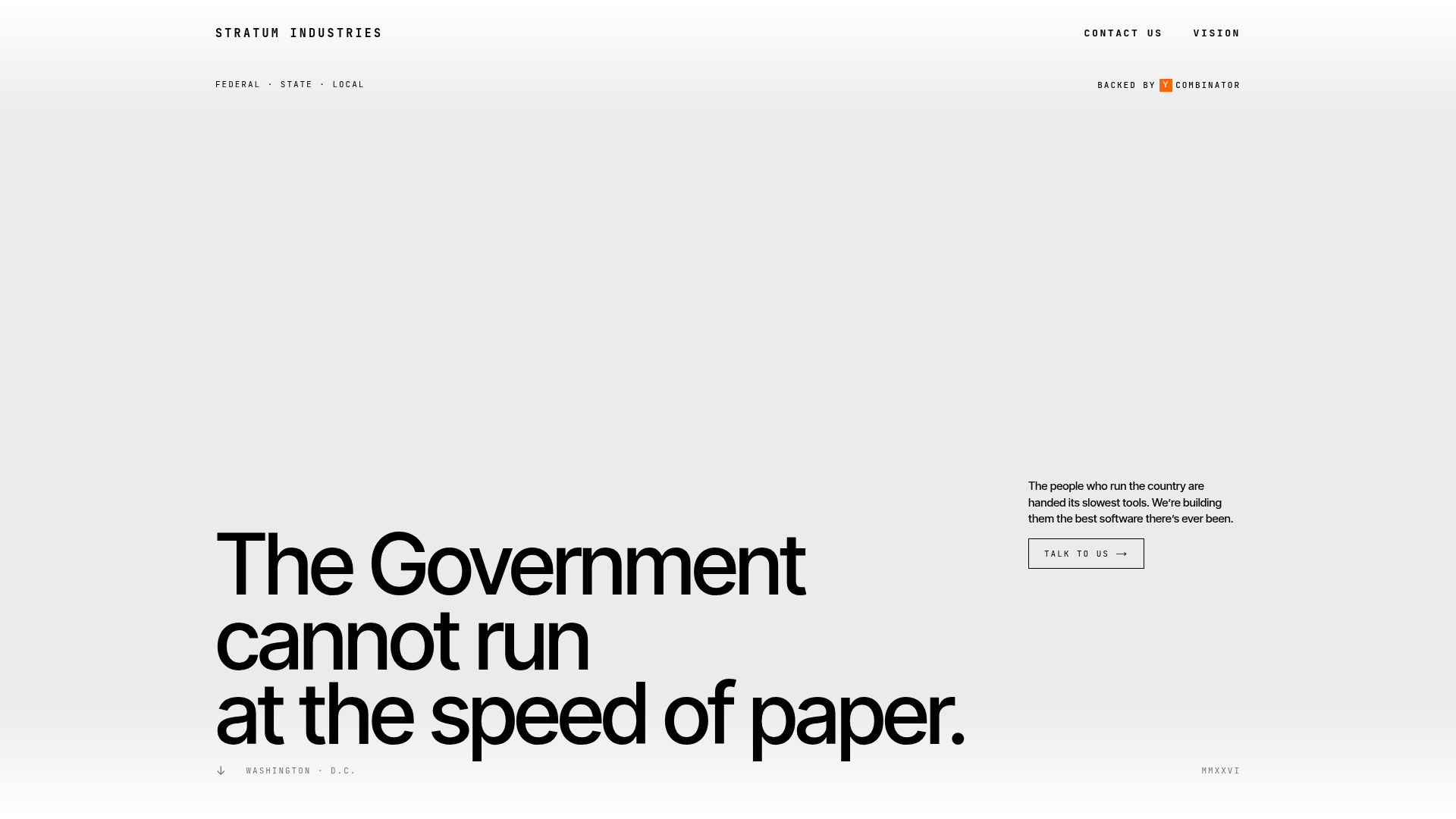
Stratum Industries is not selling a faster form reader. It's selling a story about the speed of America itself. The company's website opens with a declaration: "The Government cannot run at the speed of paper." Then it walks you through a history of American firsts—light bulbs, powered flight, transistors, the internet, moon landings—and argues that every one of them had to pass through the same slow government approval gauntlet before reaching anyone. The approval isn't the problem, Stratum insists. The software it runs on is.
That's a bold thesis, and it's backed by a product that is refreshingly concrete. Stratum is an AI platform that reviews government applications end-to-end. It reads every page of a file, checks it against the agency's own rubric, routes each step to the most accurate and cost-effective model, and sends missing information back to the applicant as a single, specific request. The human officer gets a summarized file with every citation behind it, and makes the final call. The company claims backlogs that took years clear in minutes, with hundreds of agents running in parallel on the same queue.
The backlog is the product
Stratum's pitch is built on a universal pain point: the government backlog. The website lists the categories—patents, FDA drug registrations, SEC filings, building permits, passports, disability ratings, pensions, survivor benefits—and then makes it personal. A veteran waiting on a disability rating, a retired couple waiting on a pension, a widow waiting on the survivor benefit that decides whether she makes rent this month. "They already did their part," the site says, "and what they're waiting on isn't a decision—it's a queue."
That framing is smart. It shifts the problem from bureaucratic inefficiency to a technical one: the queue itself. Stratum's answer is to make the queue irrelevant by processing applications in parallel, not serially. The website's "Standard Procedure" graphic—form, wait, more forms, wait, eventually approval—is a familiar horror story. Stratum's alternative is a six-step flow that ends in seconds, not months. The company is not vague about the mechanism: it uses multiple AI models, each routed to the task it does best, with a human officer approving or denying at the end.
The backlog is a perfect wedge. It's measurable, it's painful, and it's bipartisan. No one likes waiting years for a permit or a claim. Stratum's tagline—"Clearing the entire U.S. Government backlog"—is audacious, but it's also a concrete goal that can be tracked. The company doesn't disclose current customers or metrics, but the ambition is clear.
The human-in-the-loop is the sales pitch
In an era of AI skepticism, Stratum is careful to keep a person in the loop. The website repeats it like a mantra: "A person still makes the decision. That part never moves." The officer gets a summarized file with citations, and the final approval or denial is theirs. This is not just an ethical choice; it's a sales pitch to government buyers who need to justify automation to oversight committees and the public.
The human-in-the-loop also addresses a real risk: AI errors in high-stakes decisions like disability ratings or drug approvals. By keeping a human accountable, Stratum can position itself as an augmentation tool rather than a replacement. The officer's job changes from reading every page to reviewing a summary and making a judgment call. That's a compelling value proposition for overworked civil servants.
But there's a tension. If the AI is doing the reading, the summarizing, and the routing, how much real oversight does the human actually have? The website doesn't say. It promises auditable steps, but the details of how an officer can dig into the AI's reasoning are thin. This is a critical question for adoption, and Stratum will need to answer it with more than a slogan.
The agent-to-agent endgame
Stratum's long-term vision is even more radical. The website describes a future where the best form is no form at all. You orchestrate an agent to tell the government what you need—a permit, a license, a claim—and your agent fills out the application and files it. The agency's agent picks it up, reviews it, asks your agent for missing information, and then summarizes the file for a human officer. The whole exchange happens in a day, without you ever interrupting your work.
This is agent-to-agent communication, and it's a natural extension of the AI agent trend. It's also a profound shift in how citizens interact with government. Instead of filling out forms, you delegate to software. The website's timeline shows the entire process resolving by 2:40 PM on the same day. It's a compelling vision, but it's also speculative. The infrastructure for government agencies to orchestrate their own agents is not yet public, and the security and privacy implications are enormous.
Stratum is positioning itself as the layer that makes this possible. The name "Stratum" suggests a foundational layer, and the website's "Layer 03" section describes Stratum as "the platform that eliminates the government's backlog." The company wants to be the substrate on which all government filing and review runs. That's an ambitious goal, and it's one that will take years to realize, if ever.
Stratum is a name that wants to be a layer
The name "Stratum" is a deliberate choice. It evokes geological layers, but also the idea of a foundational software layer. The website reinforces this with its "Layer 01" through "Layer 05" structure, each describing a different aspect of the problem and solution. The name is abstract, but it's paired with a clear tagline and a concrete product description. It's not a descriptive name like "GovFlow" or "PermitAI"; it's a brand name that aspires to be a category.
The domain, stratumindustries.co, is a bit long, but it's functional. The "Industries" suffix adds a sense of scale and industrial strength, which fits the company's ambition. The name might be too generic for some—"stratum" is a common word—but in the context of government IT, it stands out. It sounds like a company that builds infrastructure, not a flashy consumer app.
The branding is consistent: dark, serious, full of American iconography. The website includes images of Apollo missions, Abraham Lincoln, Steve Jobs, Michael Jordan, Elon Musk, and even a Trump rally photo. This is not subtle. Stratum is aligning itself with American exceptionalism, with the idea that the country's greatness is held back by its bureaucracy. It's a risky branding strategy, as it could alienate half the political spectrum. But it's also a clear signal of the company's values and its target audience: those who believe in American greatness and want to restore it.
The American exceptionalism gamble
Stratum's website is a manifesto. It talks about "the new age of America" and promises that "by America's 252nd year there will be no paperwork left." This is not the language of a typical B2B SaaS company. It's the language of a movement. The company is betting that its customers—government agencies, and the politicians who fund them—will respond to this patriotic framing.
The gamble is that this rhetoric will resonate more than it alienates. In a polarized country, tying your product to a specific vision of American history is risky. But it also creates a strong brand identity. Stratum is not just selling software; it's selling a story about the future of the country. That's a powerful motivator for early adopters.
The risk is that the story overshadows the product. The website spends more time on American exceptionalism than on technical details. There are no case studies, no customer logos, no pricing. For a company that is Y Combinator-backed (as the site notes), this is an unusual approach. It suggests that Stratum is still early, and that it's relying on its vision to attract initial partners.
Ultimately, Stratum's success will depend on whether it can deliver on its promises. Clearing the entire U.S. government backlog is a monumental task, and the company will face immense technical, regulatory, and political hurdles. But if it can clear even a fraction of that backlog, it will have proven that the layer can be rebuilt. And if it can't, the name "Stratum" will be a reminder of a layer that never materialized.