Surface Labs
Surface Labs closes the loop between lead research and revenue, turning every campaign into a learning system.
NewName Editorial
Editorial Team


The pitch is almost too simple: "The AI research assistant that tells you who every lead is instantly." But Surface Labs is aiming far beyond the inbox. The company, backed by Y Combinator, is building what it calls "marketing superintelligence" — a system that doesn't just enrich leads but learns from every campaign outcome and feeds that knowledge back into future marketing. That's a different ambition than the typical lead-gen tool, and it's worth unpacking.
The five-second research window
The core promise is speed. Surface claims its agents research leads in under five seconds. That's not just a convenience feature; it's a behavioral shift. When a lead comes in, the sales rep doesn't have to open ten tabs, dig through LinkedIn, and guess at the company's priorities. Surface does that work instantly, delivering a profile that answers three questions: who they are, what their company does, and why they matter.
This is the kind of automation that doesn't just save time — it changes how reps follow up. Instead of a generic "saw you downloaded the whitepaper" email, they can lead with a specific observation about the prospect's business. The five-second window is the difference between a rep who's done their homework and one who's still doing it.
From lead enrichment to lead intelligence
Lead enrichment is a crowded category. Every CRM has a native enrichment feature, and there are dozens of point tools that append firmographic data. Surface's distinction is that it doesn't stop at data. The platform's "Lead Data Layer" unifies buyer signals, campaign history, and CRM outcomes into a single context. Then "Lead Agents" use that context to research and qualify each lead with evidence-backed reasoning.
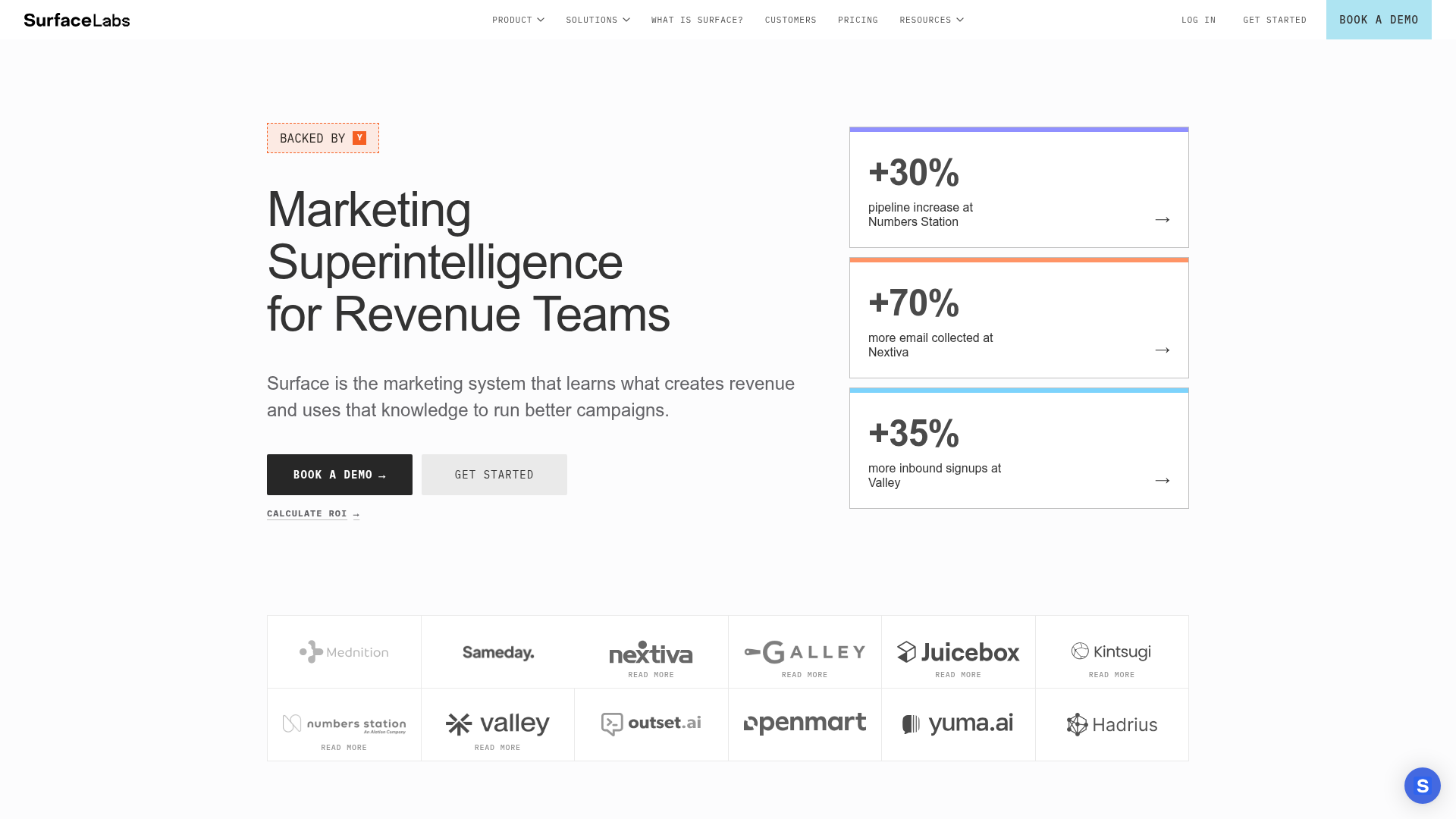
That's a meaningful step up. Enrichment tells you a company's size and industry. Intelligence tells you why this specific lead might buy, what their pain points likely are, and how to position your product. Surface's agents are designed to do that reasoning, not just fetch data. The company's customer stories reinforce this: Numbers Station saw 95% of leads enriched automatically, and a 30% increase in pipeline. GovSpend reported a ~154% effective lead lift from the same traffic. These are early signals, but they suggest the intelligence layer is what moves metrics, not just the data.
The closed loop: why Surface calls itself a learning system
The most interesting part of Surface's architecture is the feedback loop. The platform doesn't just execute campaigns; it captures conversion and revenue outcomes and feeds them back into the system. That's the "closed-loop optimization" that the company mentions in its product pages. Every campaign becomes a learning event, and the system gets smarter with each iteration.
This is rare in marketing software. Most tools are execution engines — they help you launch campaigns, but they don't learn from the results. Surface is trying to build a system that treats revenue as the teacher. The company's about page says it plainly: "Revenue is the teacher." That's a philosophical stance, but it's also a product architecture. The "revenue feedback signals" are a core component of the platform, not an afterthought.
If Surface can pull this off, it changes the economics of marketing. Instead of paying for tools that produce content or capture leads, you're paying for a system that compounds its own effectiveness. That's the "superintelligence" promise — not a single AI feature, but a system that improves itself.
Where the agentic CMS fits in
Surface is also building an "Agentic CMS" — a content management system designed for AI agents. The company describes it as "coming soon," but it's a logical extension of the platform. If agents are going to create and execute campaigns, they need a place to store, manage, and version that content. A traditional CMS is built for human editors; an agentic CMS is built for machines that need to iterate quickly.
This is a bet on the future of content operations. If AI agents are going to produce a high volume of campaign variations, the CMS needs to be the system of record for that output. Surface's content campaign agents already turn "one campaign brief into dozens of ad variations." The agentic CMS would give those variations a home, with permissions and governance for human oversight.
It's a smart move, but it's also a risk. The CMS market is dominated by incumbents like WordPress and Contentful, and enterprises are slow to switch. Surface is positioning itself as a new category, but it will need to convince marketing teams that an agent-first CMS is worth the migration.
The trust question: autonomy is earned
Surface's about page includes a principle that stands out: "Autonomy is earned." The company says agents begin with clear controls and earn greater trust over time. This is a deliberate response to the anxiety around AI agents — the fear that they'll run wild and make costly mistakes.
By designing for gradual autonomy, Surface is acknowledging that trust is a barrier to adoption. Marketing teams won't hand over their campaigns to an AI system on day one. They need to see it work on small tasks, prove its judgment, and then expand its scope. This "earned autonomy" model is a sensible go-to-market strategy, but it also raises questions about how the system learns and who's accountable when it makes a mistake. The company doesn't disclose specifics on how it measures agent trust or what controls are available, but the principle suggests they're thinking about governance.
What Surface doesn't tell you
Surface's marketing is heavy on outcomes — conversion lifts, pipeline increases, hours saved. But it's light on specifics about how the learning system works under the hood. What data does it use to train its models? How does it avoid bias in lead scoring? What happens when the system learns the wrong lesson from a noisy signal? These are open questions that the company doesn't address on its public pages.
There's also the question of integration. Surface lists CRM and MAP sync as part of its inbound capture, but it doesn't detail which CRMs it supports natively or how deep the integration goes. For a platform that promises to unify buyer signals and revenue outcomes, the quality of those integrations will be critical.
Finally, there's the pricing question. Surface doesn't publish pricing on its site, which is common for enterprise software but makes it hard to assess the value proposition. The customer stories suggest real ROI, but without pricing transparency, it's hard to know if that ROI is accessible to mid-market teams or reserved for enterprises.
Surface Labs is an ambitious bet on a new kind of marketing system — one that doesn't just execute but learns. The five-second lead research is the hook, but the closed-loop architecture is the real product. If the company can deliver on its learning promise, it could redefine how marketing teams think about their stack. But the proof will be in the execution, and the details it hasn't shared yet.