tale.fyi
One link to read or hear an entire book, no app required.
NewName Editorial
Editorial Team
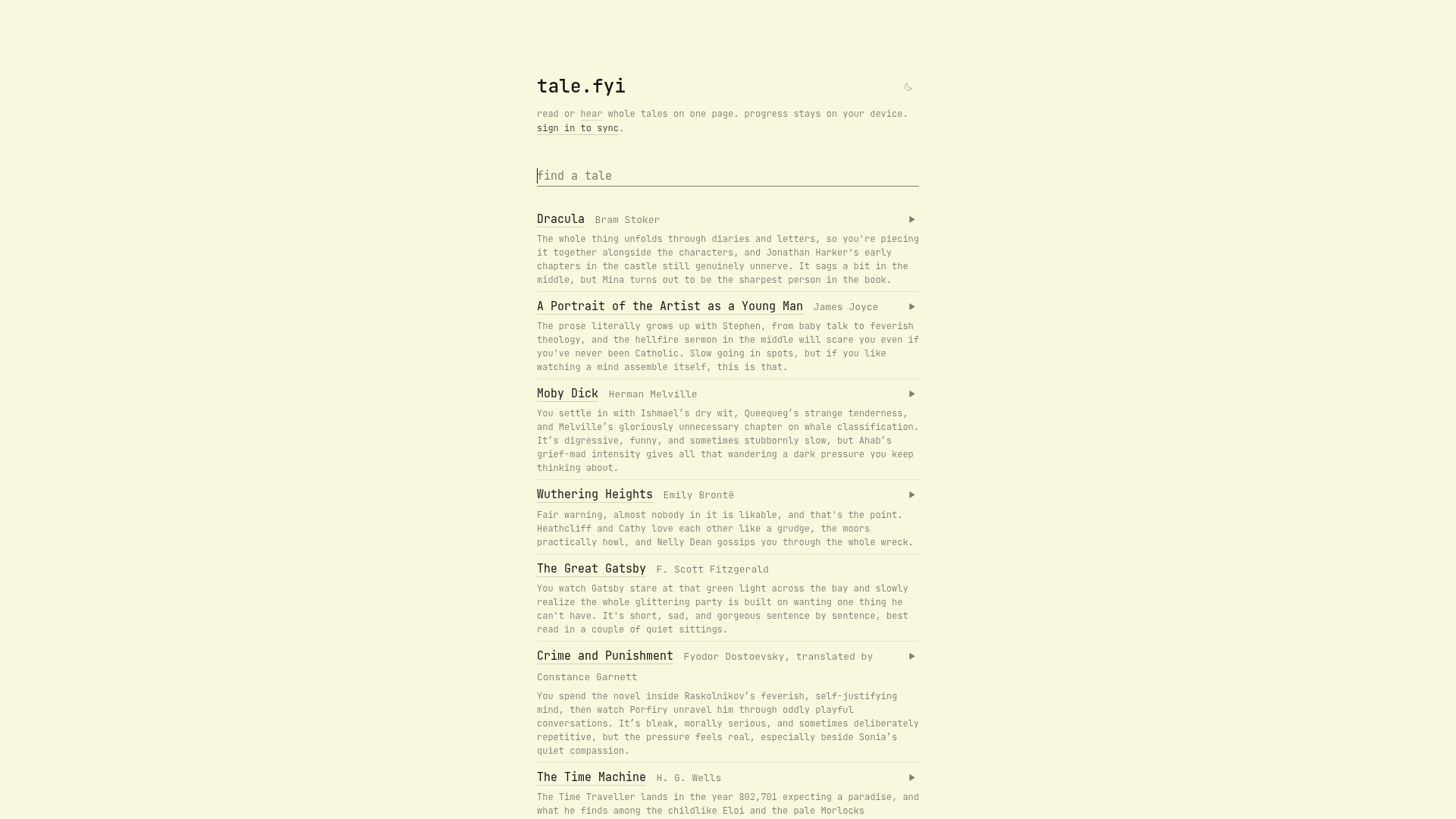
Most reading platforms ask you to commit before you've read a single page: download the app, create an account, build a library. tale.fyi inverts that entirely. Each book lives on its own URL, and that URL is the whole product. Open it, read a chapter, or hit play and listen to the LibriVox recording. No install, no signup, no shelf to manage. The tagline — "We deserve a home for fiction" — isn't about building a bigger library; it's about making the act of reading as frictionless as opening a link.
One link, one book, no app required
The core unit of tale.fyi is the link. Every title — Dracula, Moby Dick, The Great Gatsby — gets a dedicated page like tale.fyi/dracula. That page contains the full text, formatted for reading, plus an audio version pulled from LibriVox. The site's own description is almost dismissive in its simplicity: "read or hear whole tales on one page." But that simplicity is the thesis. The platform isn't trying to compete with Kindle's ecosystem or Audible's subscription; it's reducing the distance between wanting to read a book and actually reading it to a single click.
This is a deliberate rejection of the app-store model. There's no app to download, no account required to start reading. Progress is stored locally in your browser, with an optional sign-in to sync across devices. The message is clear: the book is the product, not the platform. For a generation raised on links as the universal currency of the web, tale.fyi treats a classic novel like a YouTube video — something you can start watching (or reading) without any preamble.
The public-domain canon as a curated shelf
Tale.fyi doesn't try to host every book ever written. The current shelf is a tight, hand-picked list of public-domain works, sourced from Standard Ebooks and Project Gutenberg. These aren't random uploads; each book comes with a short, opinionated blurb that reads like a friend recommending a book, not a publisher's synopsis. For Moby Dick, the blurb warns you about "Melville's gloriously unnecessary chapter on whale classification." For Wuthering Heights, it cautions that "almost nobody in it is likable, and that's the point."
This curation is the real differentiator. The public domain is vast, but tale.fyi isn't trying to be a repository. It's trying to be a gateway — a thoughtfully arranged shelf of books that someone actually believes are worth your time. The blurbs are generated by AI, but they're generated once from each book's title and author, then stored. The site is transparent about this, even noting that "they can be wrong." That honesty is refreshing, and it shifts the value from the blurb itself to the selection behind it.
When AI blurbs are the honest compromise
There's a tension at the heart of tale.fyi: it's a platform built on human curation, but it uses AI to write the blurbs that sell you on each book. The site's own note — "blurbs generated with AI, generated once from each book's title and author, then stored. they can be wrong" — is a masterclass in setting expectations. It's not hiding the automation; it's flagging it as a feature, not a bug.
This is a pragmatic choice. Writing original, insightful blurbs for a growing list of classics would be a full-time job. AI gets you 80% of the way there, and the human curation — choosing which books to include — provides the other 20%. The blurbs are good enough to be useful, and the transparency prevents them from feeling deceptive. In a world where AI-generated content is often hidden or overhyped, tale.fyi's approach is a model of honesty: use the tool, admit it, and move on.
Progress on your device, sync as an afterthought
Tale.fyi's approach to progress tracking is another quiet rebellion. There's no cloud-based reading progress by default; it's stored locally on your device. Signing in to sync is an option, not a requirement. This is a privacy-friendly choice, but it's also a practical one. For a site that's essentially a collection of static pages, adding a full backend to track every user's reading position would be overkill. The local-first approach keeps the site fast and simple, and it aligns with the overall philosophy: the book is the thing, not your reading data.
The tradeoff is that your progress doesn't follow you unless you opt in. But for a platform that's about reducing friction, that's a fair deal. You can read a chapter on your phone, then pick up on your laptop — as long as you've signed in. The site's language is casual, even playful, which reinforces the indie, non-corporate vibe.
A home for fiction, not a library
The phrase "We deserve a home for fiction" is doing a lot of work. It's not "the best place to read classics" or "the largest collection of public-domain books." It's a statement about belonging. Tale.fyi wants to be a place where fiction is treated with respect — not as content to be consumed, but as something worth giving a home. The site is built by Samuel Cole, and it's clearly a labor of love, from the hand-written blurbs to the careful selection of editions.
This is a small, indie project, and it doesn't pretend to be anything else. There's no venture capital, no growth hacking, no dark patterns. Just a person who believes that reading a book should be as easy as clicking a link. In an era of walled gardens and subscription fatigue, tale.fyi is a reminder that the web can still be a place for simple, beautiful tools. It's not going to replace your Kindle, but it might just be the home for fiction you didn't know you were looking for.