textlog
A quiet, text-only microblogging platform that strips away engagement tricks and JavaScript.
NewName Editorial
Editorial Team


In an era where social platforms are engineered to maximize engagement, textlog makes a radical bet: that a 280-character limit, a JavaScript-free interface, and an open-source ethos can create a genuinely quieter space for thought. The platform, which launched with a simple "Show HN" post, is not trying to compete with Twitter or Mastodon on features. Instead, it strips away everything that makes social media noisy—likes, algorithms, infinite scroll—and asks users to focus on words. The result is a microblog that feels more like a shared notebook than a broadcast medium.
The 280-character constraint is the product
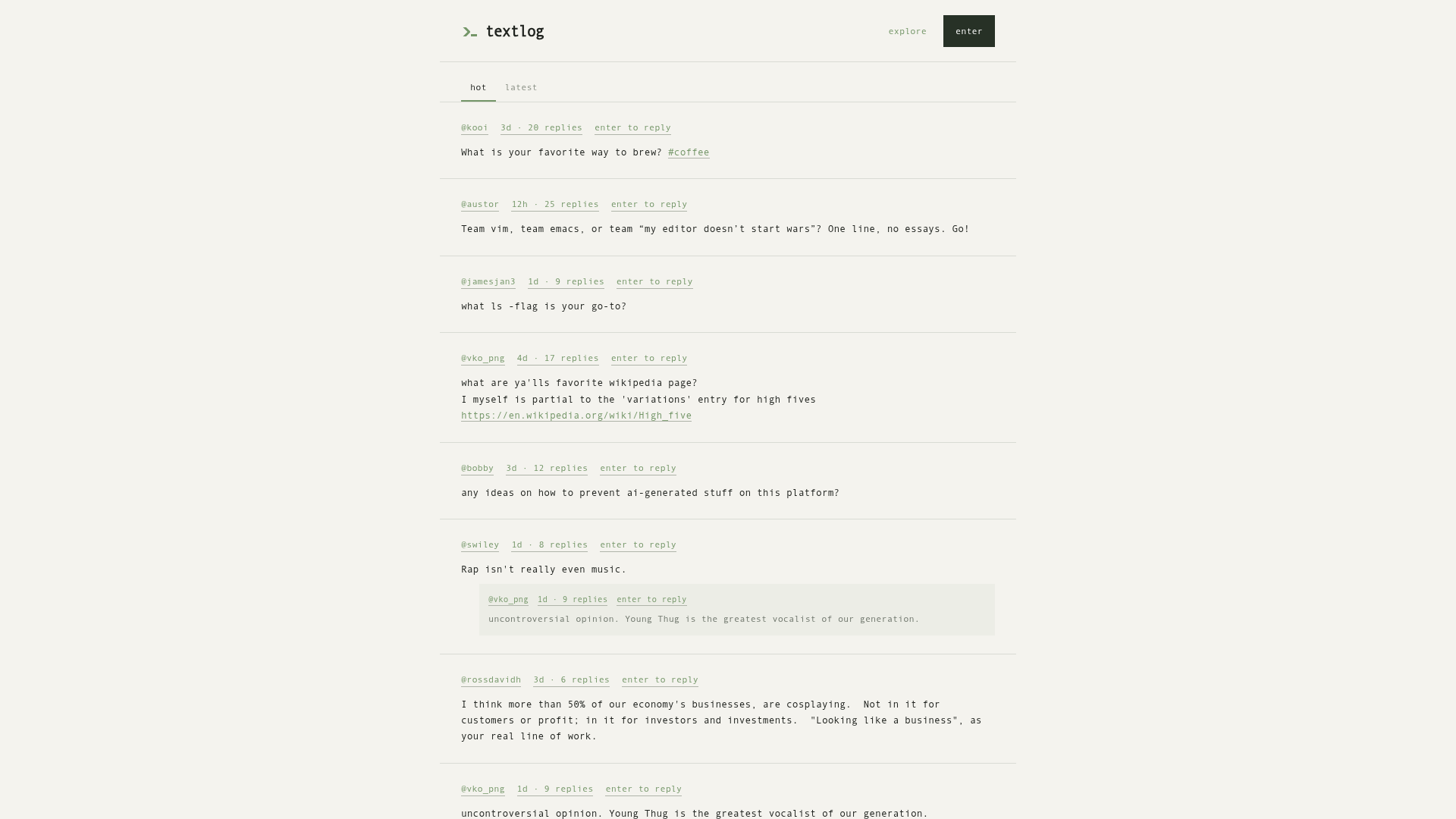
The 280-character limit is not a technical limitation; it's a design philosophy. As textlog's about page states, "Notes are limited to 280 characters. The constraint keeps them quick to write and read, making room for one thought at a time." This is a deliberate counter to the essay-length posts that dominate platforms like Substack or even Twitter's long-form experiments. By forcing brevity, textlog ensures that each note is a single, digestible thought. The constraint also lowers the barrier to participation: there's no pressure to write a polished blog post, just a quick observation or question. The platform's hot page is filled with such snippets—someone asking about favorite brewing methods, another declaring "Team vim, team emacs, or team 'my editor doesn't start wars'?"—each one a small, self-contained prompt for conversation.
No JavaScript, no engagement tricks: the architecture of restraint
Textlog's most distinctive technical choice is its lack of JavaScript. In a web where JavaScript is ubiquitous, textlog's no-JS approach is a statement. It means the site loads fast, works on any device, and is accessible to the widest possible audience. But more importantly, it signals a commitment to simplicity that extends to the user experience. There are no infinite scrolls, no autoplaying videos, no notification badges. The interface is clean and text-focused, with only the essential navigation: explore, enter, hot, latest. This minimalism is not just aesthetic; it's a rejection of the engagement tricks that keep users glued to their screens. By removing these elements, textlog creates a space where users are more likely to read and respond thoughtfully rather than react impulsively.
A community that argues about editors and naps
The community on textlog is still small, but it's already developing a distinct culture. The hot page features discussions about text editors (vim vs. emacs), programming tools, and even polyphasic sleep schedules. There's a thread about preventing AI-generated content, and another about the nature of rap music. These are not the polarizing, outrage-driven topics that dominate larger platforms. Instead, they reflect a community of people who are curious, technical, and willing to engage in nuanced debate. The tone is conversational, not combative. Users quote each other's posts to add context, and replies are measured. This is likely a result of the platform's design: without likes or retweets, there's no incentive to be provocative. The only currency is the quality of the conversation itself.
Open source and the one-person show behind textlog
Textlog is open-source, with its code available on GitHub. This is a significant trust signal, as it allows anyone to inspect the platform's code, verify its claims, or even self-host their own instance. The project appears to be led by a single developer, stagas, who also handles donations via Buy Me a Coffee. This one-person operation is both a strength and a risk. On one hand, it means the platform is not beholden to investors or advertisers, and can remain true to its minimalist vision. On the other hand, it raises questions about long-term sustainability. What happens if stagas loses interest or is unable to continue? The open-source nature mitigates this risk, as the community could fork the code, but it's still a concern for users who are investing time in building a presence on the platform.
The name says it all: textlog's quiet branding
The name "textlog" is a straightforward combination of "text" and "log," evoking a simple, textual record. It's not flashy or memorable in the way that "Twitter" or "Mastodon" are, but that's the point. The name reflects the platform's ethos: it's not trying to be a brand; it's trying to be a utility. The domain, textlog.cc, uses the .cc TLD, which is a common choice for developer-focused projects. The name is easy to type and remember, and it clearly communicates what the platform does. This understated branding is a deliberate contrast to the hype-driven naming of many startups, and it reinforces the idea that textlog is a tool for thought, not a spectacle.
What textlog won't become
Textlog's biggest challenge is growth. In a world where social media success is measured by user numbers and engagement, textlog's quiet, no-JS, 280-character approach is unlikely to attract mass adoption. But that may be its strength. By staying small, textlog can maintain its community's quality and avoid the pitfalls that come with scale. The platform's about page explicitly states that there are "no engagement tricks or pressure to build an audience," which is a promise that would be hard to keep if the platform grew too large. The open question is whether textlog can survive as a niche, sustainable project. The platform's future depends on its ability to attract users who value substance over spectacle, and on the continued commitment of its developer. For now, textlog is a refreshing reminder that social media doesn't have to be a performance—it can be a place for quiet, thoughtful exchange.