Impact-Site-Verification: 41b53a0c-6d04-458b-a457-fe9e29acde1a

Community··5 min read

The Line

A focused forum for freedivers to share knowledge, swap gear advice, and connect worldwide.

NN

NewName Editorial

Editorial Team

The Line product image 1
The Line product image 2

Freediving is a sport of extreme focus, yet its community has been scattered across the most distracting corners of the internet. Ask a question about equalization technique and you might get a YouTube comment, a Reddit reply, or a Facebook group thread that disappears into the feed by evening. The Line, a new community forum for English-speaking freedivers, is an attempt to gather that scattered knowledge into one searchable, long-form archive.

Founded by Richard, a competitive freediver training at the national level in Poland, The Line is an independent project — not affiliated with any agency, brand, or governing body. It launched publicly in 2026 with a simple premise: give freedivers a dedicated place to discuss training, gear, competition, and safety, without the noise of social media. The site's tagline — "A community of freedivers who learn and dive together" — captures the ambition, but the real story is in the details: how the forum is structured, who is showing up, and what the name itself promises.

A sport held together by Facebook groups and Discord pings

Freediving has a peculiar community problem. It is a global sport with passionate practitioners, but no central hub. The About page of The Line spells out the pain: discussions are scattered across Facebook groups, Reddit threads, Discord servers, and YouTube comment sections. There is no dedicated, well-moderated, long-form forum for the global English-speaking freediving community.

That fragmentation has real consequences. Knowledge is ephemeral — a great tip about finning technique posted in a Discord server at 2 a.m. is lost to the scroll by morning. Search is nearly impossible across platforms. And newcomers face a steep learning curve with no clear archive of beginner advice. The Line's founder saw this gap and built a focused forum to fix it. The site's About page argues that a forum means better search, better archives, and a better signal-to-noise ratio than a chat app. It's a deliberate design choice, not an accident.

Why a forum beats a chat app for breath-hold knowledge

The Line's bet is that long-form, threaded discussion is superior to real-time chat for a sport where technique matters and safety is paramount. A forum allows for detailed write-ups on training plans, gear reviews, and competition reports — content that remains findable years later. The site's structure reflects this: threads are organized by tags like training, gear, competition, and introduction, making it easy to browse or search.

This is a contrarian position in an era when most communities default to Discord or Slack. But for a niche sport, a forum offers a better knowledge base. A question about the Garmin Descent MK3 versus Huawei's freediving watch, for instance, deserves a thoughtful comparison thread, not a flurry of pings. The Line's early threads show this ethos: "Do you have a structured training week?" and "What do you wish someone had told you before you started freediving?" are the kind of questions that benefit from considered, archived answers.

The Line's first threads: a snapshot of a community finding its feet

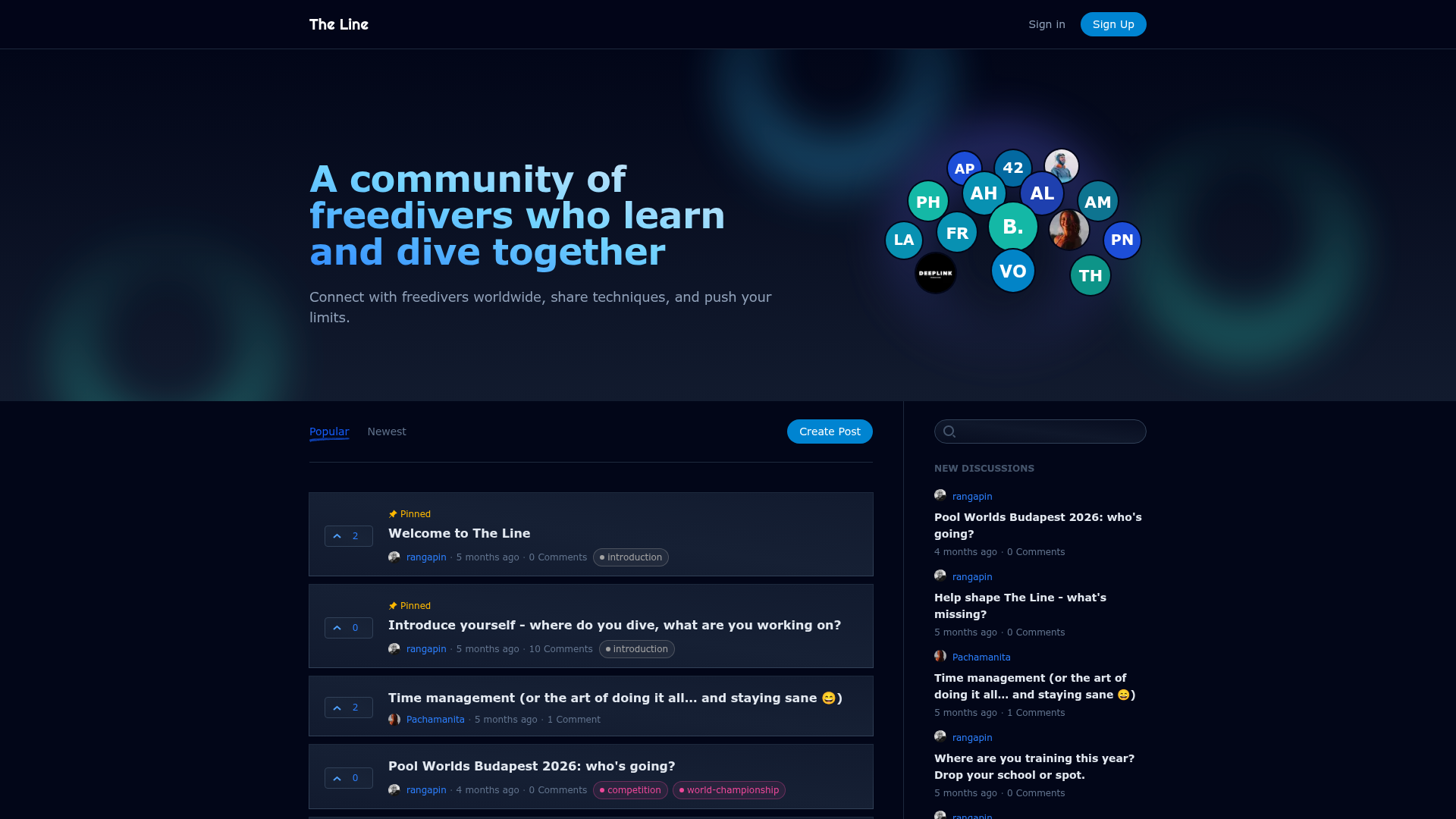
The forum is young — the earliest posts date back five months — but the content already reveals a community in formation. Pinned introductions set the tone: "Welcome to The Line" and "Introduce yourself - where do you dive, what are you working on?" invite members to share their backgrounds. The responses show a mix of avatars and initials, suggesting a small but international early user base.

Competition threads are prominent: one asks about Pool Worlds Budapest 2026, another about the AIDA Depth World Championship in Limassol. These are not just announcements; they are attempts to coordinate meetups and share experiences. Gear discussions are practical — the Garmin versus Huawei watch question is a classic gear-head debate. And there's a meta thread, "Help shape The Line - what's missing?", which signals that the founder is actively iterating with the community's input.

This is a community still finding its voice, but the early signals are promising. The threads are substantive, not spammy, and the tag system keeps everything organized. The Line is not yet a bustling metropolis, but it has laid out the streets.

Moderation by algorithm, judgment by human

One of the most interesting aspects of The Line is its moderation approach. The About page explains that all content is reviewed by an automated system that flags potentially problematic posts. Flagged content is then reviewed by a human — the AI does not automatically remove anything. This hybrid model aims to keep the forum useful and safe without being heavy-handed.

This is a thoughtful stance for a community that includes safety-critical advice. A beginner asking about breath-hold techniques needs accurate information, not just well-intentioned but dangerous tips. The human-in-the-loop approach ensures that nuanced judgment is applied, while the automated flagging helps manage the volume. It's a model that many larger platforms could learn from, and it suggests that The Line is thinking carefully about trust and quality from day one.

What the name 'The Line' signals — and what it risks

The name "The Line" is evocative in the freediving context. It could refer to the line that divers follow during a depth descent, the line between safety and risk, or the line of breath-hold athletes at a competition. It's a name that rewards insider knowledge — a good fit for a niche community.

But the name also carries risks. It's generic enough that it could be confused with other projects, and the domain theline.to is a clever use of the Tongan TLD, but it doesn't immediately scream "freediving" to outsiders. For a community that wants to attract beginners, the name might be a barrier. However, for the target audience of dedicated freedivers, the name is likely to resonate. It's a branding choice that prioritizes identity over discoverability — a tradeoff that makes sense for a community forum.

The open question: can a niche forum escape the cold-start trap?

Every niche forum faces the same challenge: attracting enough users to create value, while maintaining quality. The Line's early threads show that the founder is seeding discussions and engaging with members, but the community is still small. The "42" on the homepage likely refers to the number of members, a modest but real base.

The Line's success will depend on whether it can become the default destination for freediving knowledge. That requires not just content, but also search engine visibility, word-of-mouth, and perhaps partnerships with training schools or competitions. The founder's independence is a double-edged sword: it ensures authenticity, but limits resources.

For now, The Line is a promising experiment. It has identified a real gap, built a thoughtful product, and started to attract a community. Whether it can grow beyond its early adopters is the open question. But for freedivers who are tired of scrolling through Facebook groups, The Line offers a cleaner, more focused alternative — and that alone is worth watching.