Theia Markerless
Markerless 3D motion capture for biomechanics, from lab to field.
NewName Editorial
Editorial Team


For decades, biomechanics has been a marker-based affair. Researchers glue reflective balls to skin, lock subjects in a lab, and hope the cameras catch every angle. It's precise, but it's also slow, expensive, and profoundly unnatural. Theia, a Canadian startup, is betting that the future of motion capture is markerless—and that a machine learning model can extract lab-grade biomechanical data from plain video.
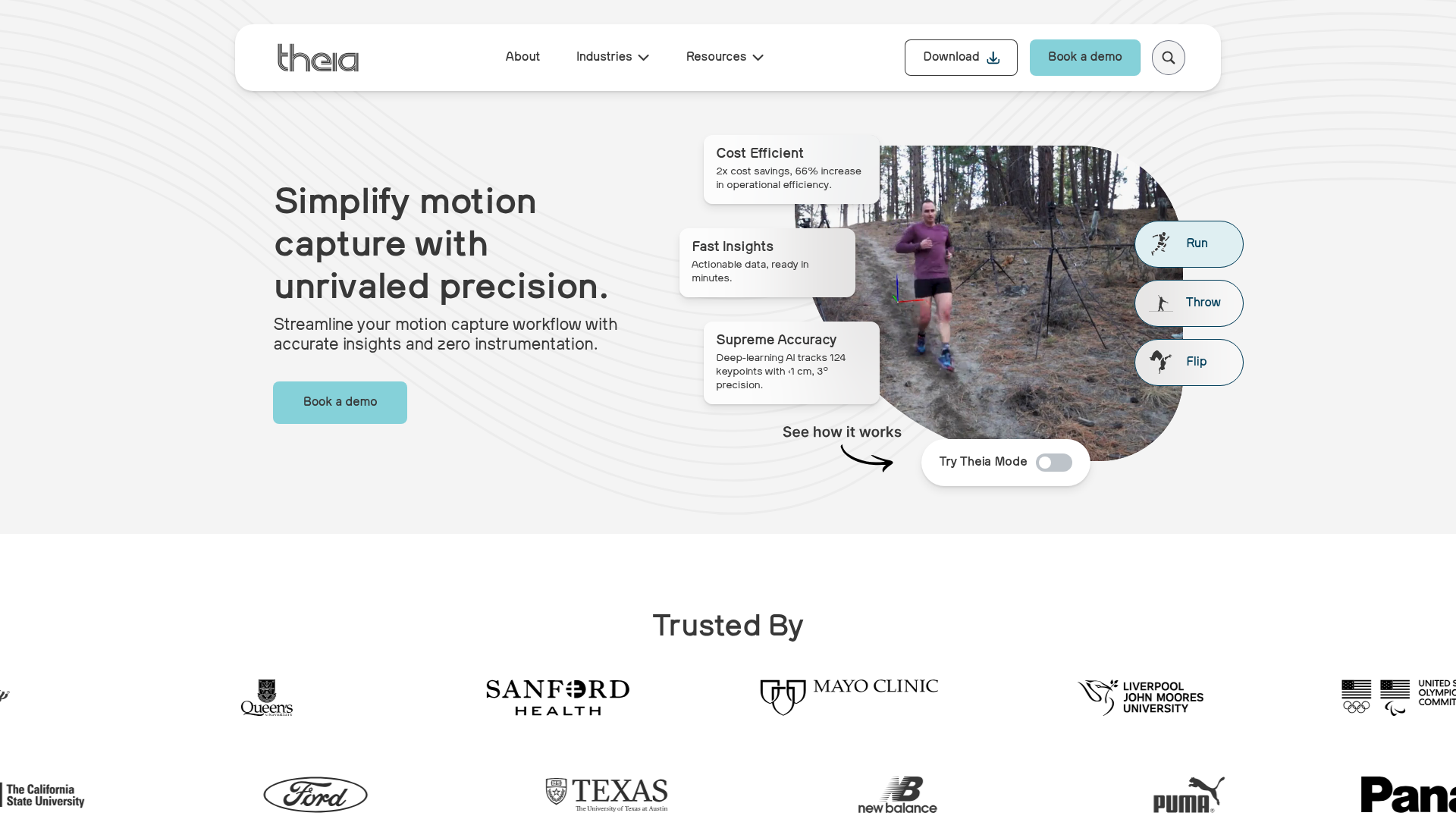
The pitch is bold: no markers, no spandex, no dedicated lab. Just cameras, a calibration board, and Theia's deep-learning pipeline. The company claims its AI tracks 124 keypoints with sub-centimeter accuracy and 3-degree precision, and that its workflow cuts costs by 2x while boosting operational efficiency by 66%. Those are strong numbers, but the real question is whether the biomechanics community—a field built on meticulous measurement—will trust a black-box algorithm over a century-old standard.
The Markerless Shift: Why Labs Are Ditching Spandex and Markers
Traditional motion capture is a pain. Subjects must wear skin-tight suits with reflective markers placed on specific anatomical landmarks. Setup takes hours, the lab environment is artificial, and any marker displacement can ruin the data. For researchers studying athletes, patients, or workers in real-world settings, this is a fundamental limitation.
Theia's approach eliminates the instrumentation entirely. Subjects wear their everyday clothing and move naturally in whatever environment matters—a clinic, a training field, or a factory floor. The AI does the rest, identifying keypoints from video and reconstructing a 3D skeletal model. This isn't just a convenience; it opens up studies that were previously impossible. As Robin Queen, a professor at Virginia Tech, puts it in Theia's materials, the technology enables "high-fidelity biomechanics in real-world settings" and lets researchers "meet athletes where they play and perform."
124 Keypoints and a Calibration Board: Inside Theia's Workflow
Theia's workflow is designed to be simple: calibrate, record, analyze. Calibration uses a standard wand or Theia's proprietary calibration board, which ships with the product, for a fully automatic setup. Recording is multi-camera video capture with no subject preparation. Analysis then kicks in: Theia3D tracks 124 keypoints, builds a 3D skeletal model, and exports data in formats like .c3d, the industry standard for motion capture.
This simplicity is a double-edged sword. On one hand, it lowers the barrier to entry, allowing teams like Driveline Baseball to expand from pitching analysis to full functional movement assessments without hiring a dedicated biomechanist. On the other hand, it requires users to trust that the AI's keypoint detection is accurate enough for their specific research questions. Theia's accuracy claims—<1 cm and 3 degrees—are impressive, but they're averages; edge cases like occlusions or unusual body types could still trip up the model.
From Gait Labs to Baseball Pitchers: Where Theia's Data Actually Flows
Theia's website highlights five industry verticals: biomechanics research, footwear/apparel/equipment, sports motion capture, functional movement profiling, and custom commercial solutions. The testimonials give a sense of the range. PUMA uses Theia3D to capture data on runners "from casual enthusiasts to professional athletes," rapidly expanding their movement database to inform footwear design. Sanford Health reports a 66% reduction in processing time compared to marker-based systems, enabling comprehensive data collection across research cohorts.
Driveline Baseball, a baseball performance company, uses Theia's command-line functionality and batch processing to scale biomechanics offerings across two new sites. The lack of markers means athletes can be assessed in real training environments, increasing throughput in their pitching labs. These are concrete, credible use cases—and they suggest Theia is not just a lab tool, but a platform that can embed biomechanics into commercial workflows.
The Trust Gap: Can AI Replace a Gold Standard?
Despite the promise, Theia faces a significant hurdle: trust. Marker-based motion capture is the gold standard because it's physically grounded—you know exactly where each marker is. AI-based markerless systems are inherently probabilistic; they infer joint positions from pixels. For clinical decisions or high-stakes research, that uncertainty can be uncomfortable.
Theia's answer is validation. The company cites accuracy figures and partnerships with institutions like Stanford Health, Mayo Clinic, and the U.S. Olympic & Paralympic Committee, which lend credibility. But the real proof will come from peer-reviewed studies and long-term adoption. The company's website doesn't disclose its funding or detailed validation data, so potential customers must rely on testimonials and the brand's growing footprint.
The Name, the Domain, and the Ambition of Theia
The name "Theia" is a clever choice. In Greek mythology, Theia is the Titaness of sight and clarity—fitting for a company that extracts precise data from visual input. It's short, memorable, and carries an air of scientific gravitas. The domain, theiamarkerless.ca, is less elegant; it's descriptive and functional, but it anchors the brand to a specific approach (markerless) that could become a liability if the technology evolves beyond that. Still, the name signals ambition: Theia aims to be the lens through which movement is understood.
For now, Theia is carving out a niche at the intersection of AI and biomechanics. Its success will depend on whether it can convince researchers and clinicians that markerless isn't just easier—it's better. The early evidence suggests it's on the right track, but the gold standard won't be replaced overnight.