Impact-Site-Verification: 41b53a0c-6d04-458b-a457-fe9e29acde1a

Developer Tools··4 min read

Themery

Themery: Perceptually engineered IDE themes, built with AI and published everywhere.

NN

NewName Editorial

Editorial Team

Themery product image 1
Themery product image 2

Themery starts with an accident. Founder Tiago published a dark, neon VS Code theme for himself and a few CTF nerds. It passed 225,000 downloads. That number taught him what most theme makers learn too late: people stare at your color choices for eight hours a day, and every low-contrast comment becomes a GitHub issue. Themery is his attempt to build a tool that treats theme design like engineering, not decoration.

The 225,000-Download Accident That Built Themery

Most developer tools begin with a roadmap. Themery began with a marketplace listing. Tiago's original theme, HackTheBox, was unapologetically dark and neon, designed for personal use. The download count—past 225,000—turned a hobby into a crash course. He learned that porting a theme to JetBrains took a month, Zed another week, and Neovim had its own semantics. Every editor is its own country, he wrote. That friction is the problem Themery attacks: not just making a theme, but making it work everywhere.

Why 'Looks Cool in a Screenshot' Is a Trap

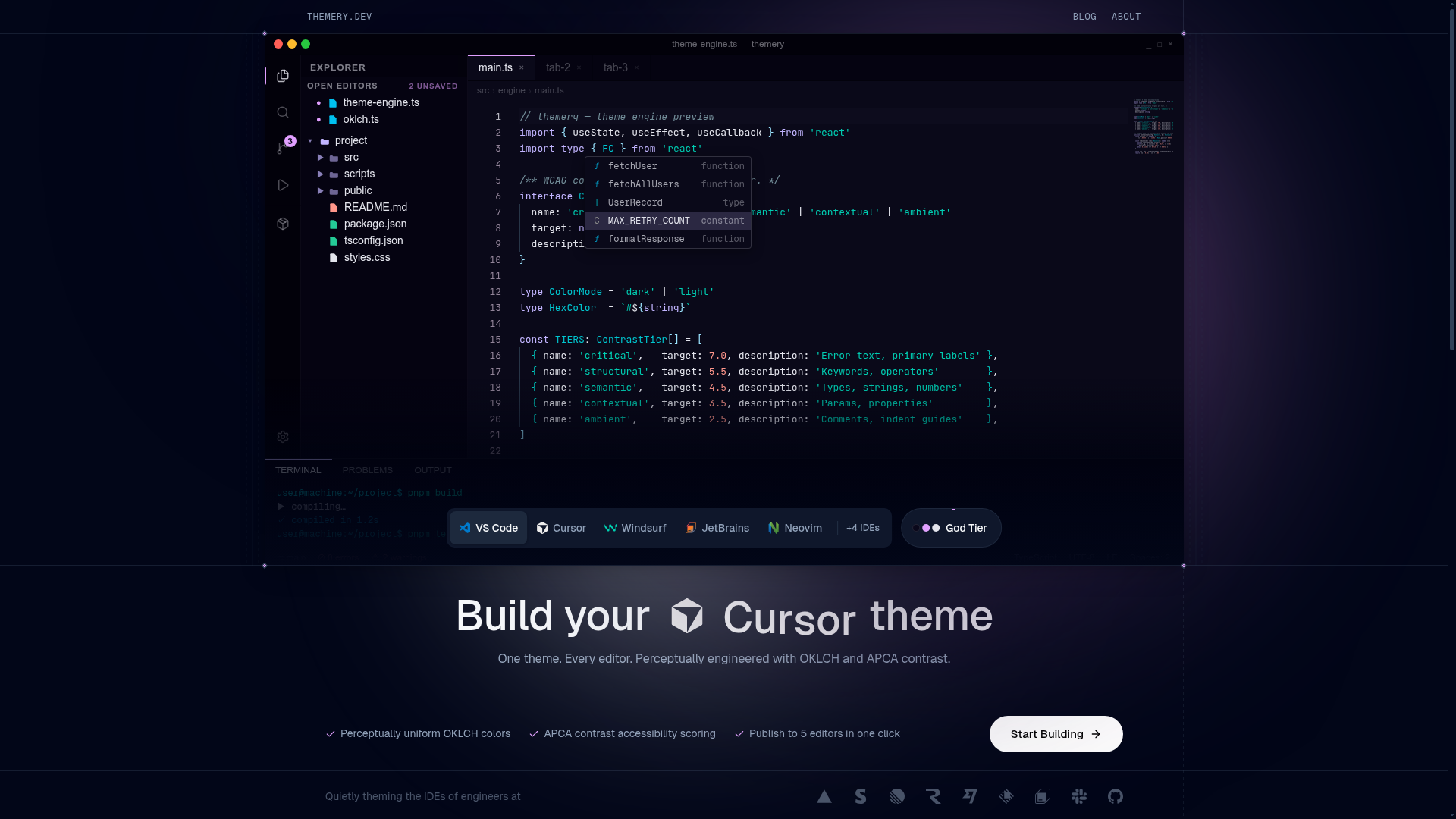
The gap between a theme that photographs well and one that holds up in a real codebase is the core insight behind Themery. Tiago's first version looked beautiful in previews but was exhausting to work in. He rebuilt it twice. This is the problem Themery's design targets: themes that fail not on aesthetics but on usability. The tool's interface reflects this—it's not a color picker with a preview; it's a workspace with contrast tiers, token categories, and accessibility scoring. The message is clear: a theme is not a wallpaper, it's a user interface for code.

OKLCH and APCA: The Science Buried in Your Theme

Themery's key differentiator is its use of OKLCH and APCA. OKLCH is a color space designed for perceptual uniformity—colors that look equally different from each other are actually equally different to the human eye. APCA (Accessible Perceptual Contrast Algorithm) is a contrast metric that goes beyond WCAG's simple ratios. Themery bakes these into the theme engine, with contrast tiers like 'critical' (target 7.0) for error text and 'ambient' (target 2.5) for comments. This isn't just a feature list; it's a philosophy. The tool treats contrast as a hierarchy, not a single number. For developers who spend hours in an editor, this could be the difference between eye strain and comfort.

From Vibe to Palette: The AI Prompt Workflow

Themery's AI starts with a description. You type 'vantablack void, one neon accent' or 'swiss brutalist poster, 1974', and the tool generates a theme. The prompts are vivid—'acid house flyer, faded pink', 'late-night convenience store glow'—suggesting the AI is trained to translate mood into color. You can also drop in an image or an existing theme file. This is where Themery diverges from traditional theme editors: it doesn't ask you to pick colors, it asks you to describe a feeling. The AI then does the heavy lifting, presumably mapping that vibe to OKLCH coordinates and APCA-compliant contrast. It's a workflow that lowers the barrier to entry while maintaining the engineering rigor.

One Theme, Five Editors: The Portability Problem

Themery's headline promise is 'Publish to 5 editors in one click.' The website lists VS Code, Cursor, Windsurf, JetBrains, Neovim, and '+4 IDEs'. This is a direct response to Tiago's pain: porting a theme manually is weeks of work. Themery automates the conversion, handling each editor's token semantics. For a developer who switches between tools—or a team standardizing on a theme—this is the killer feature. It's also a branding statement: Themery isn't a VS Code theme tool; it's a cross-editor theme infrastructure. The name 'Themery' suggests a workshop, a place where themes are crafted, not just generated.

The Name Says It All: Themery as a Workshop

The name 'Themery' is a portmanteau of 'theme' and 'armory' or 'foundry'. It positions the tool as a place of production, not just a utility. The domain themery.dev reinforces this—it's a developer tool, not a consumer app. The tagline, 'Build IDE themes with AI. Fine-tune colors, syntax highlighting, and typography,' is functional but the name carries the personality. It's memorable, specific, and suggests craftsmanship. The risk is that 'Themery' could be mistaken for a WordPress theme shop, but in the context of developer tools, it reads as intentional. The blog, 'Themery journal,' with posts like 'Your favorite dark theme leaks contrast. Here are the numbers,' further cements the brand as an authority on theme engineering.

What Themery Doesn't Tell You Yet

Themery's public materials are strong on vision but thin on specifics. There's no pricing page, no detailed documentation, and no technical blog post deeper than two entries. The site mentions 'hundreds of thousands of developers' using themes, but that's likely referring to the original HackTheBox theme, not Themery itself. The AI's training data, the exact export formats, and the limitations of the APCA implementation are not disclosed. For a tool that promises engineering rigor, this is a gap. Early adopters will need to trust the process. But the foundation is solid: a founder with a proven theme, a tool built on real color science, and a workflow that respects the developer's time. Themery is not just another theme generator; it's an attempt to make theme design as disciplined as code. Whether it succeeds will depend on how well it translates that discipline into every editor it touches.