Tiermaker中文版
A Chinese-language tier list library monetized through templates, AI ranking, and creator exports.
Tiermaker中文版
Submitted by the team
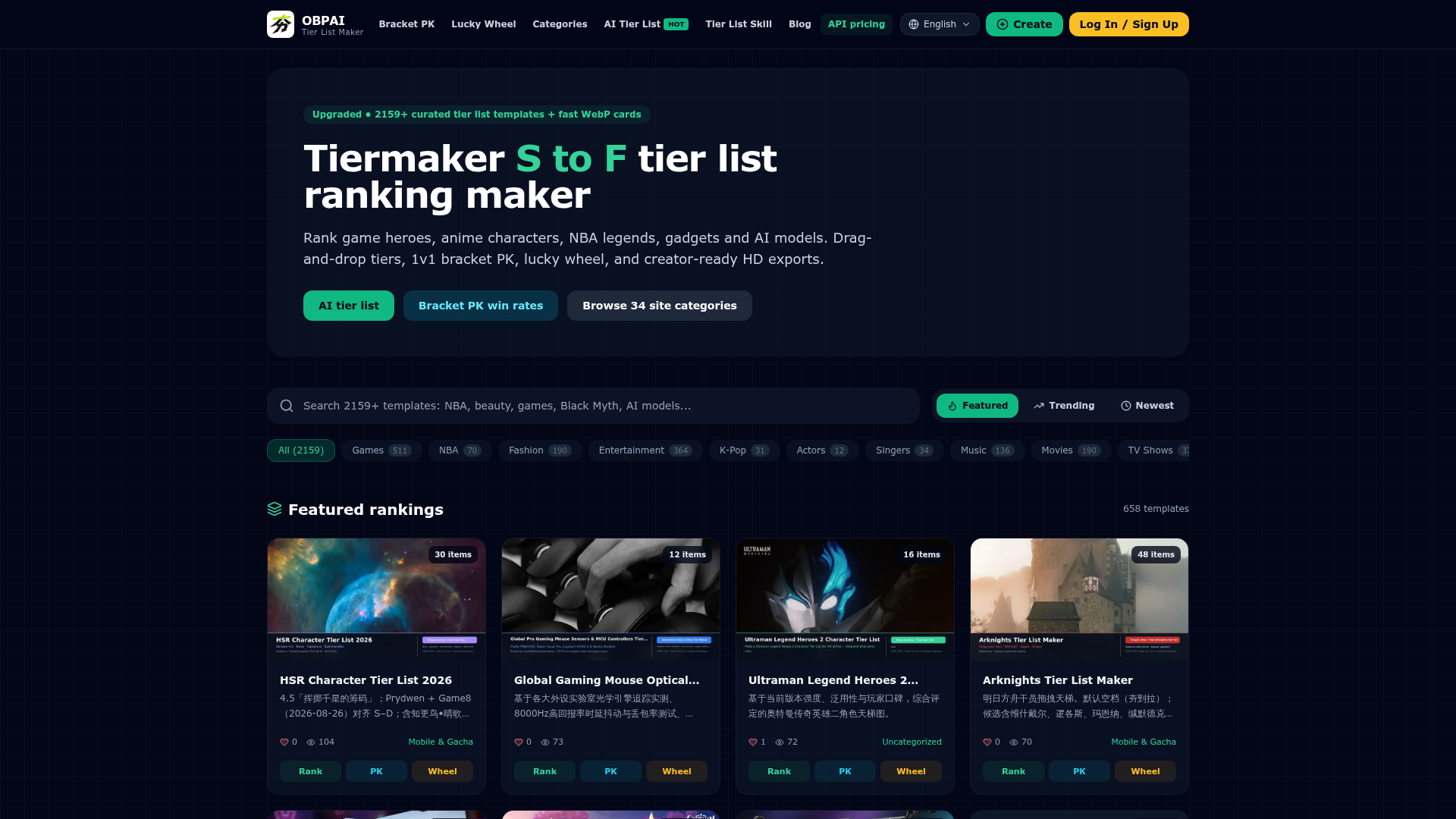
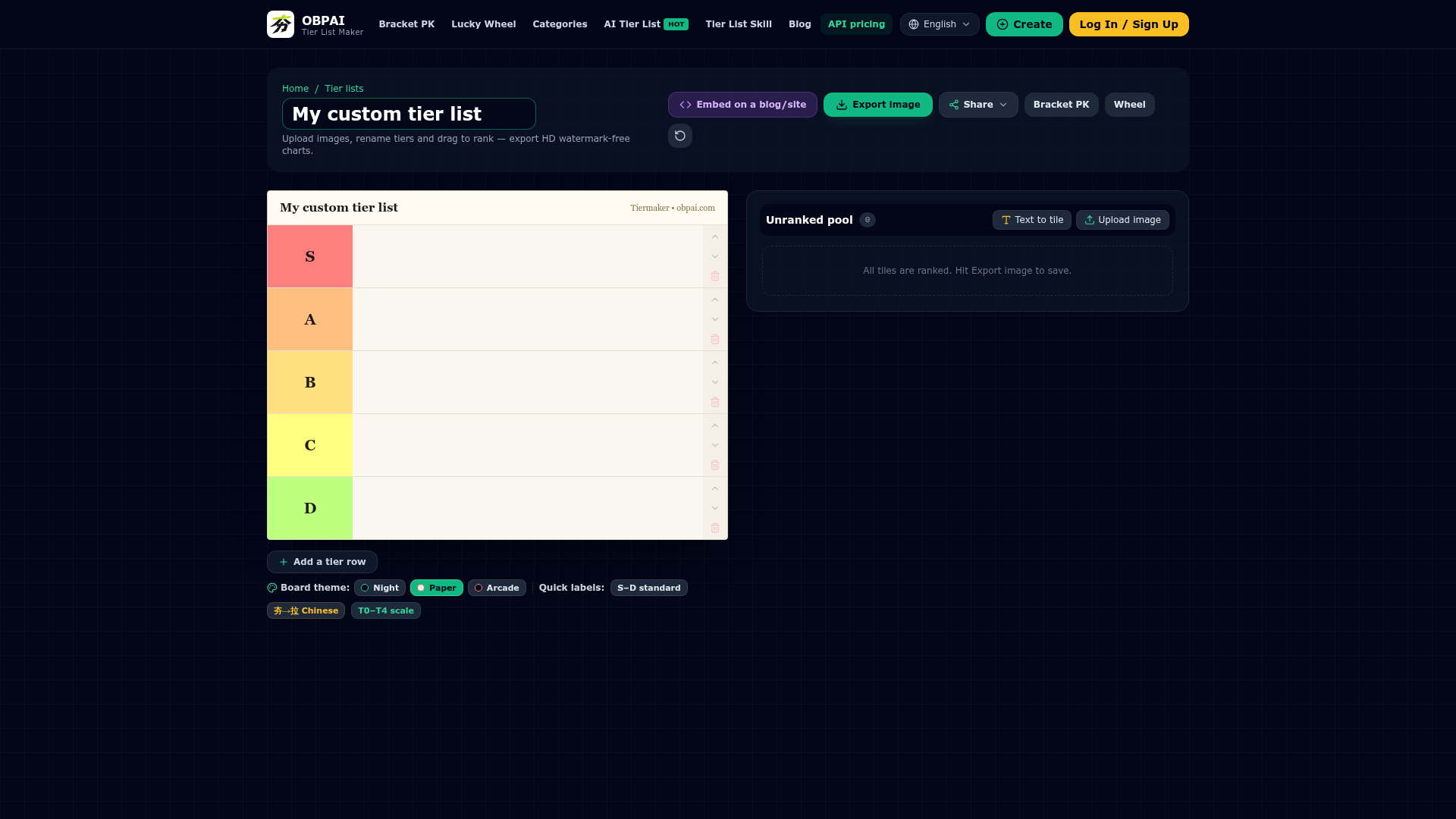
TierMaker.com built a simple, durable product: drag items into S-through-D rows, export an image, share it. It never localized, never built a Chinese template library, and never optimized for the platforms where Chinese creators actually publish. obpai.com — branded as "Tiermaker中文版" — is the arbitrage play on that gap. But the interesting business here is not the editor. It is the 2,159-template library sitting on top of it, and the question of whether a template library is a defensible asset or a scrapable one.
The Real Product Is 2,159 Templates, Not a Drag-and-Drop Editor
Strip away the UI and obpai.com is a content site with a tool attached. The homepage advertises 2,159+ curated Chinese ranking templates across 34 categories, with 658 templates surfaced in the featured index alone. The category distribution is revealing: 511 game templates, 364 entertainment, 207 digital hardware, 190 film, 189 sports, 182 software, 136 Marvel, 133 board games and cards, 129 anime, 105 memes and internet culture, 101 finance, 70 NBA.
That is not a feature list. That is an SEO content inventory. Each template page is a long-tail landing page targeting a specific query — "崩坏:星穹铁道角色天梯榜," "2026年全球机械键盘轴体品牌天梯榜," "集装箱航运排行榜." The descriptions attached to these templates are unusually substantive for a consumer tool: the mechanical keyboard template cites China Electronics Components Association and global peripheral supply-chain shipment data; the protein powder template cites Future Market Insights, Labdoor third-party purity testing, and Euromonitor sales data; the VR headset template cites 2025–2026 global shipment volumes and spatial computing benchmarks.
This is the actual mechanism. obpai.com is not competing on editor quality — drag-and-drop tier lists are a solved interaction pattern. It is competing on the volume and specificity of pre-built, Chinese-language, source-cited ranking canvases that a user can open, drag, and export in under two minutes. The editor is the commodity; the library is the product.
Why Chinese Creators Rank Everything — and Why TierMaker.com Never Served Them
The demand side is structural. Chinese social platforms — 小红书, 微博, Bilibili, Douyin — reward visual, opinionated, screenshot-friendly content. A tier list is the lowest-cost format that satisfies all three: it is inherently visual, it encodes a judgment, and it is designed to be argued with in the comments. The format's virality is built into its structure.
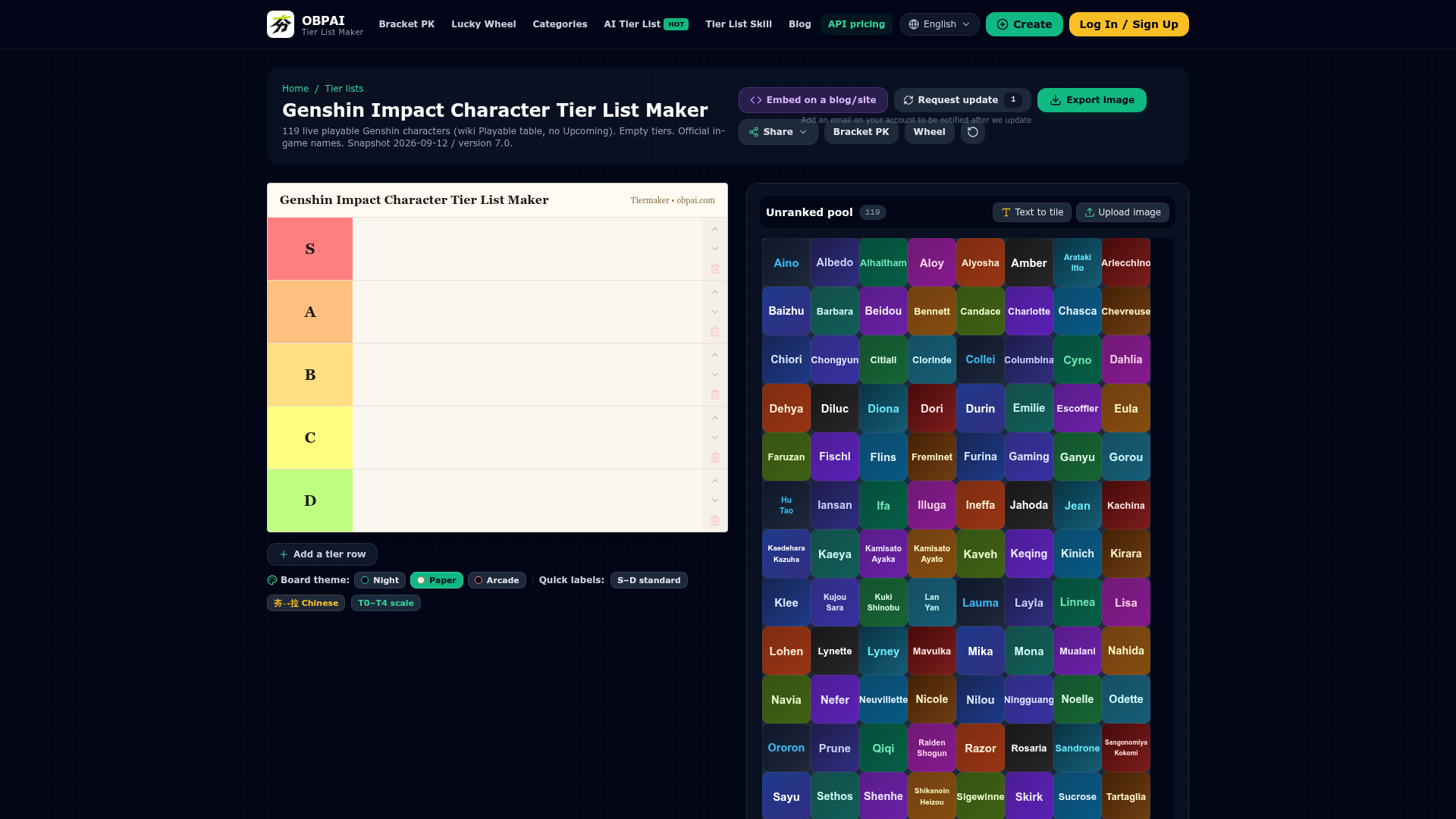
The supply side failed. TierMaker.com is English-first, its template library is Western-centric, and its export pipeline was not built for Chinese platforms. A Chinese creator wanting a 原神 tier list had to either build the candidate pool manually — uploading 119 character images one at a time — or screenshot someone else's ranking and edit it in Photoshop. Both are slow. The first is tedious; the second is plagiarism-adjacent and produces low-resolution output.
obpai.com's 原神 template ships with all 119 playable characters pre-loaded, names aligned to the in-game Chinese/English/Russian localization, snapshot-dated to patch 7.0. That is the wedge: not a better editor, but a pre-populated candidate pool for a specific Chinese audience at a specific game patch. The 崩坏:星穹铁道 template does the same for 30 characters, aligned to Prydwen and Game8 as of a dated snapshot. The operational discipline is in the maintenance — templates have to be updated when games patch, when rosters change, when new hardware ships.
The Wedge: No-Login, WebP Cards, and One-Click Export to 小红书
Three product decisions carry most of the commercial weight.
First, no login. The site explicitly markets 免登录即开即用 — open the page, start dragging. For a tool whose primary use case is a one-off creative impulse ("I want to rank the 无畏契约 狂徒 skins right now"), a registration wall is a conversion killer. Removing it trades account data for top-of-funnel volume, which is the correct trade when your monetization is downstream and your acquisition is SEO-driven.
Second, WebP-optimized cards. The site advertises WebP 极速卡片, and the template covers are served from a derived/w800 path — a resizing pipeline that generates 800px-wide WebP derivatives. For a library of 2,000+ templates each with a cover image, this is not a nice-to-have. Page weight directly determines whether a long-tail SEO landing page ranks and whether it converts a bounce into a session.
Third, platform-fit export. The site markets 高清无水印导出 optimized for 小红书 and 微博. This is the single most commercially important line in the product description. A creator's actual workflow ends at "post the image." If the export is watermarked, low-resolution, or the wrong aspect ratio, the creator goes back to Photoshop. obpai.com's entire value proposition collapses or holds on this one step.
The interaction modes — drag ranking, 1v1 bracket PK, lucky wheel, AI一键排行榜 — are engagement multipliers on top of this core. The bracket mode (淘汰赛 PK) is particularly clever: it converts a ranking task into a series of binary choices, which is faster for large candidate pools and produces a shareable win-rate chart. The wheel is a randomization toy. The AI ranking is the newest and least proven.
Competing With Canva, Photoshop, and the Screenshot-Then-Edit Workaround
The competitive set is broader than TierMaker.com.
- TierMaker.com: The category originator. Strong brand recall in English-speaking markets, weak Chinese localization, no Chinese template library. obpai.com wins on localization and template depth; TierMaker.com wins on brand trust and a larger global template base.
- Canva: General-purpose design tool with tier list templates. Far more powerful, far higher friction. A Canva user builds the tier rows manually and uploads each candidate image. Canva wins on design flexibility and brand credibility; obpai.com wins on speed-to-output for a specific format.
- Photoshop / 稿定设计: The professional workaround. Highest quality ceiling, highest time cost. Used by creators who need a custom look. obpai.com does not compete here and should not try.
- Screenshot-then-edit: The real incumbent. A creator screenshots an existing ranking, crops it, and reposts. Zero cost, zero quality control, legally murky. obpai.com's counter is that its output is higher-resolution, watermark-free, and legitimately generated.
The honest read: obpai.com's competition is not other tier list tools. It is the friction of doing nothing. The product wins when opening obpai.com is faster than screenshotting someone else's work.
Monetization: AI Rankings, API Access, and the VIP Tier Nobody Talks About
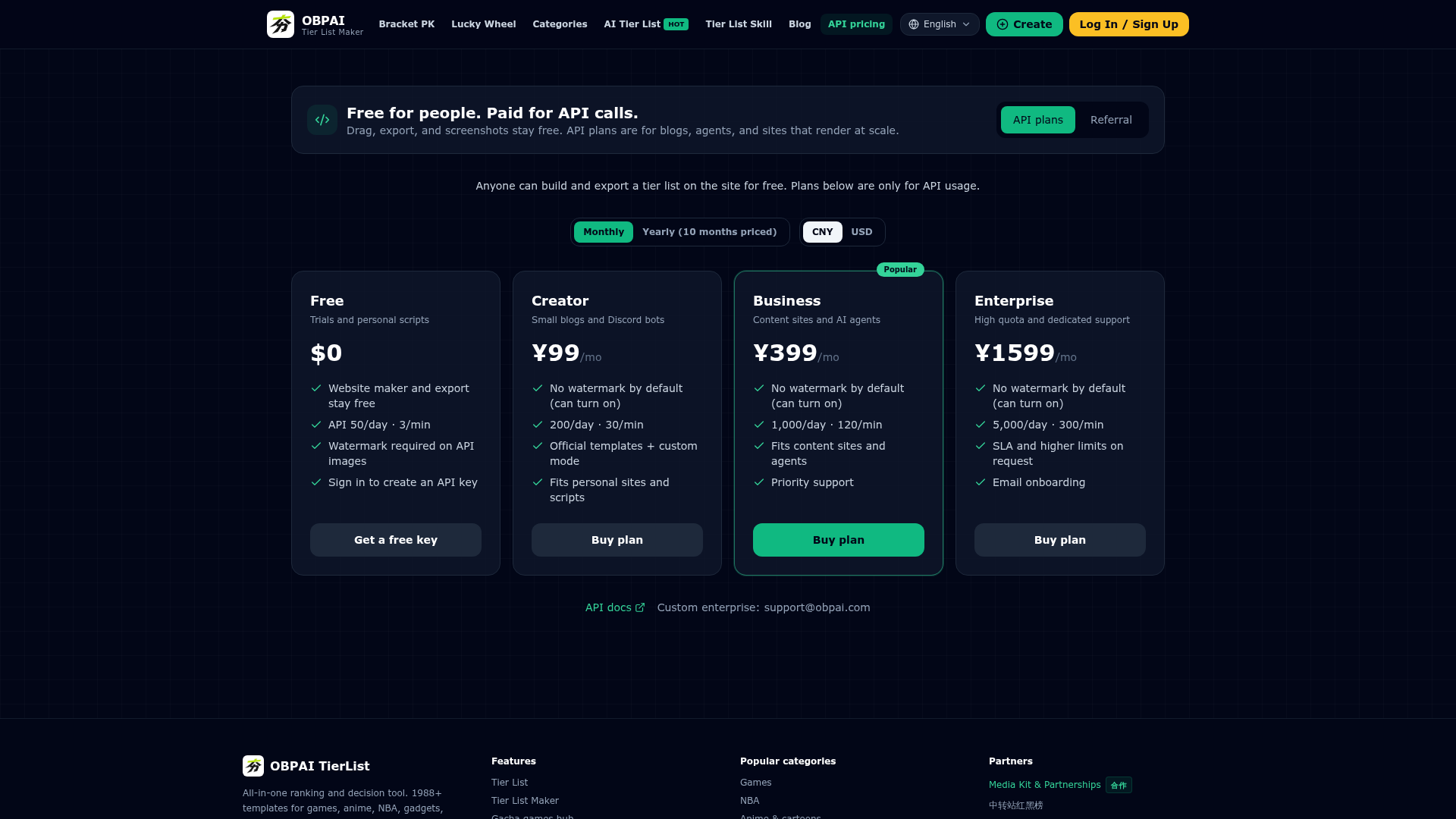
The maker is free. The API pricing page publishes four tiers in CNY: Free at ¥0 for trials and personal scripts (50 calls/day, watermark on achievement cards), Creator at ¥99/month, Business at ¥399/month, and Enterprise at ¥1,599/month, with higher daily caps and watermark removal on the paid plans. Revenue and customer counts are not disclosed. The page structure shows three commercial surfaces:
- API access is a developer motion: scripts, Discord bots, content sites, and agents call the ranking service while the web maker stays free.
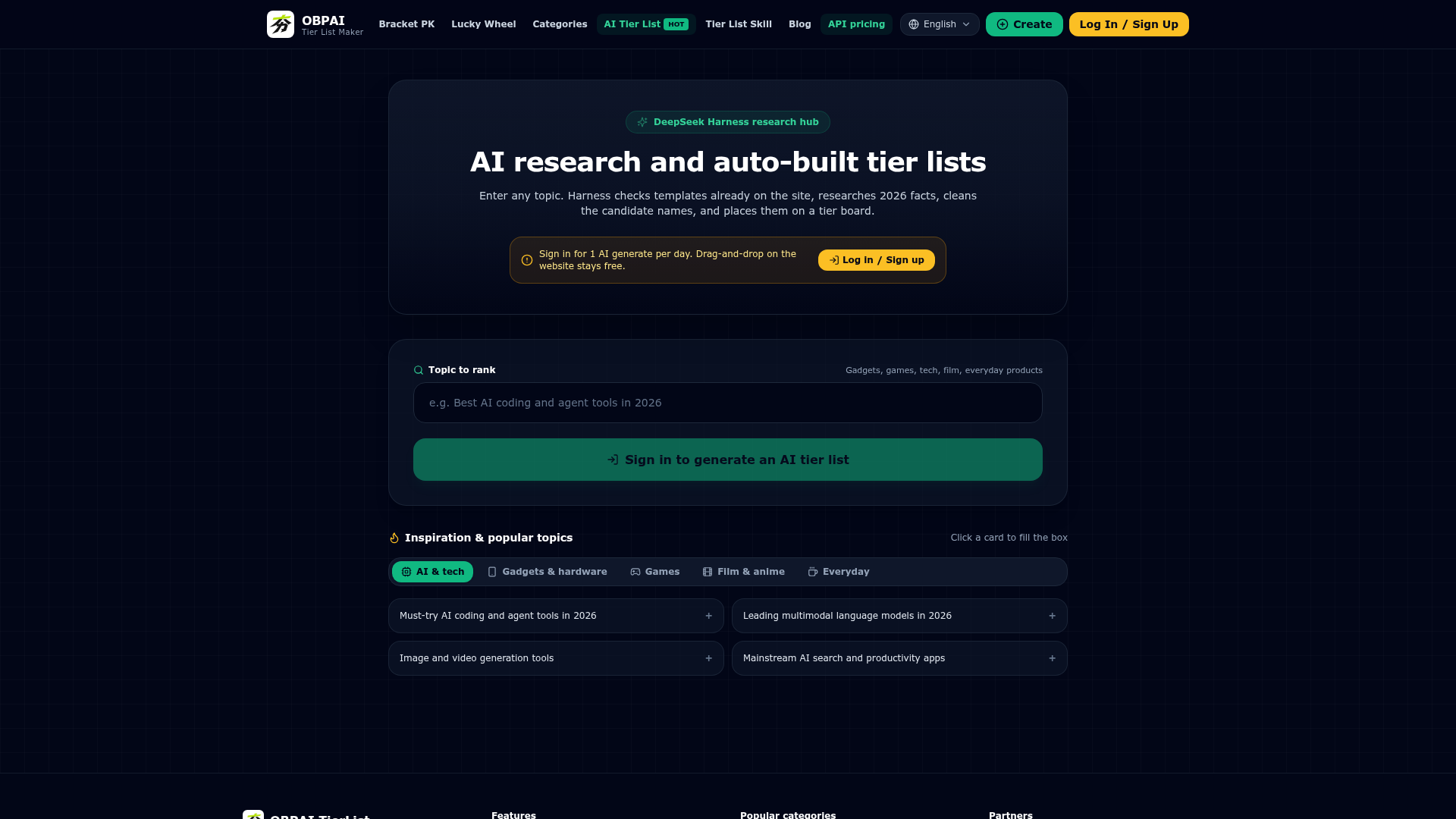
- Paid API tiers are what remove the achievement-card watermark and raise the rate limit. The AI一键排行榜 entry is marked "Hot" in the navigation; the AI page itself says a logged-in account gets one free AI build per day.
- AI ranking is the most interesting and most fragile monetization. It converts a manual drag task into a prompt. But it also invites the obvious question: if a model can rank anything, why does the user need the template library at all?
The answer, for now, is candidate pools. An AI model can rank 119 原神 characters, but it needs to know which 119 exist and what they are called in Chinese. That candidate-pool maintenance is the same operational work that powers the template library. AI ranking does not replace the library; it consumes it.
The Thin Moat Problem: Zero Switching Costs and Scrapable Templates
Here is the uncomfortable structural fact. obpai.com has no switching costs. A user who makes one tier list has no account, no saved history, no reason to return except that the template they want is already there. Retention is a function of library coverage, not product lock-in.
And the library is scrapable. The template names, candidate lists, and cover images are all publicly served. A competitor with a scraper and a weekend could replicate a meaningful fraction of the 2,159 templates. The defense is not legal — it is operational velocity: whoever updates templates fastest when games patch, rosters change, and new hardware ships wins the long-tail search. That is a treadmill, not a moat.
The second risk is AI commoditization. As general models get better at generating structured rankings with images, the value of a pre-built template declines. obpai.com's counter-position is that it owns the Chinese candidate pools and the export pipeline — the unglamorous plumbing that models do not bother with. That is a real but narrow advantage.
The third risk is platform dependency. The product's distribution depends on 小红书 and 微博 continuing to reward image-based ranking content. A platform algorithm shift — toward video, toward native formats — would compress the export use case.
Where This Category Goes When Every Model Can Rank Anything
The tier list format has survived two decades because it is the cheapest way to encode an opinion visually. That will not change. What will change is who produces the ranking.
obpai.com's realistic trajectory over three to five years has two paths. The first is content-library consolidation: become the definitive Chinese-language ranking template index, monetize through API access and creator subscriptions, and accept that the moat is maintenance speed. The second is AI-native: let the model generate the candidate pool, the ranking, and the export in one prompt, and sell the pipeline rather than the templates.
The second path is more defensible but harder to execute, because it requires the candidate-pool data to be structured and current — the same operational discipline that makes the template library work today. The company that wins this category will not be the one with the best editor. It will be the one that keeps 2,000+ Chinese-language candidate pools accurate, patch-dated, and export-ready faster than anyone else is willing to. That is a boring business. It is also the only one here with a real answer to the question of what happens when the ranking itself becomes free.