Tokenless
Automatic model switching that cuts inference costs without cutting quality.
NewName Editorial
Editorial Team

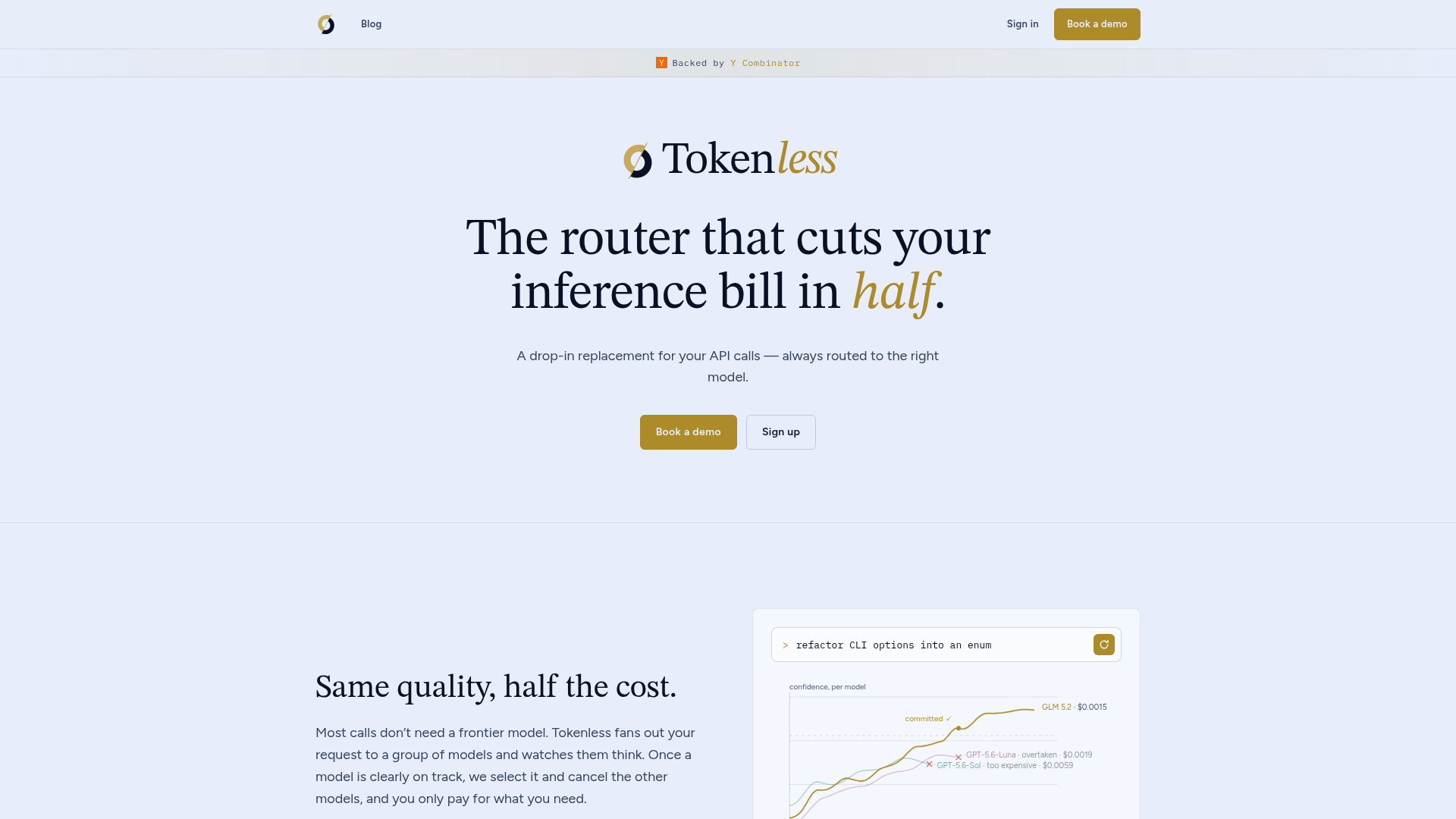
The default assumption in the AI industry is that you need the biggest, most expensive model for every task. Tokenless, a Y Combinator-backed startup, is built on a contrarian bet: most calls don't need a frontier model, and the ones that do can be identified early. Instead of picking a single model upfront, Tokenless fans out your request to a group of models, watches them think, and commits to the one that's clearly on track—cancelling the others before you pay for their tokens. The result, the company claims, is a 50% reduction in inference bills without a drop in quality.
This is not a new idea in theory—model routing has been around since the early days of LLM APIs—but Tokenless's approach is distinct in its execution. By exposing an OpenAI- and Anthropic-compatible endpoint, it positions itself as a drop-in replacement for your existing API calls. You don't rewrite your code; you just point your SDK at Tokenless and let it decide. The company's tagline, "The router that cuts your inference bill in half," is a bold promise, and the site's benchmark table and savings calculator are designed to back it up with numbers, not just marketing.
The hidden tax of always calling the frontier
Every time your application sends a request to GPT-5.6 Sol or Claude Opus 5, you're paying a premium for capabilities you might not need. For a simple classification task or a straightforward code refactor, a smaller, cheaper model like GLM 5.2 or Gemini 3.6 Flash can often do the job just as well. The problem is that you don't know in advance which requests are simple and which are complex. The safe choice is to always use the frontier model, but that's like using a sledgehammer to crack a nut—and paying for the sledgehammer every time.
Tokenless's insight is that you can defer the decision. Instead of choosing a model before the request, you can let several models start working and then pick the one that's most confident. This is the "fan-out and cancel" mechanism: send the request to a group of models, monitor their progress, and as soon as one is clearly on track, select it and cancel the others. You only pay for the tokens consumed before cancellation, which the company claims is a fraction of the cost of a full frontier response.
Fan-out and cancel: how Tokenless picks a winner
The core of Tokenless is a routing algorithm that watches models think. In the product demo, you see a request like "refactor CLI options into an enum" and a real-time display of confidence scores per model. As time progresses, some models fall behind or go off track, and Tokenless eventually commits to one—say, GLM 5.2 at $0.0015—while cancelling the more expensive GPT-5.6 Sol at $0.0059. The billed amount for the request is $0.0093, but the total would have been $0.0194 if all models had completed. The savings: $0.0101, or 52%, never billed.
This is a clever mechanism because it doesn't rely on predicting which model will succeed; it relies on observing which one is actually succeeding. The cost of fanning out is the tokens consumed by the cancelled models, but Tokenless argues that this overhead is more than offset by the savings from not always using the frontier. The company offers three routing modes: tokenless-pro for a balance of quality, latency, and cost; tokenless-max for difficult, high-value tasks; and tokenless-ultra-saver for maximum cost savings. This gives developers control over the tradeoff.
The benchmark table that dares to compare
Tokenless doesn't just claim savings; it publishes a benchmark table that compares its routing modes against the best published runs of frontier models on public agentic benchmarks. On τ³-Banking, for example, Tokenless Pro achieves a 40.2% solve rate, beating GPT-5.6 Sol's 33.0% and Claude Opus 5's 32.8%. The average cost per task is $0.57 for Tokenless Pro, compared to $1.50 for GPT-5.6 Sol and $1.64 for Claude Opus 5. Even Tokenless Ultra Saver, which prioritizes cost, achieves a 30.9% solve rate at $2.25 per task—still competitive with the frontier models.
This is a bold move because it invites direct comparison with the most powerful models on the market. The numbers suggest that Tokenless can match or exceed frontier performance on these benchmarks while costing significantly less. However, the benchmarks are specific to agentic tasks like banking and terminal use, and they represent the best published run of each frontier model, not necessarily the average performance. The site acknowledges this by saying "Measured, not marketed," but it's worth noting that these are cherry-picked results.
The savings calculator: a promise with fine print
The homepage features an interactive savings calculator that lets you input your monthly LLM spend and see what Tokenless could save you. For a hypothetical $40K/month spend, the calculator shows a new monthly bill of $26K, a blended savings rate of 34%, and 42% of requests rerouted. Over the next 12 months, it projects $344K in savings, based on a trend of AI spend increasing 11% per month. The fine print is crucial: estimates use published token prices and editable routing assumptions, and your actual savings depend on your traffic. The trend data comes from the "Ramp AI Index," which is not a standard industry source, so the projections should be taken with a grain of salt.
Still, the calculator is a powerful sales tool. It gives potential customers a concrete number to bring to their CFO, and it demonstrates Tokenless's confidence in its product. The company also offers a demo where they run the numbers on your actual traffic, which is a smart way to build trust.
The name as a thesis: Token less
The name "Tokenless" is a clever play on words. It suggests that you'll use fewer tokens, and thus pay less, but it also implies a world where token counting becomes irrelevant. The logo stylizes the name as "Token less" with the second word in italics, emphasizing the reduction. This is a brand that understands its value proposition: it's not about the models, it's about the cost. The domain, usetokenless.com, is straightforward and memorable, though it doesn't explicitly mention routing or AI. The name could be confused with a cryptocurrency project, but in the context of AI, it's clear and distinctive.
The positioning is also smart: "The router that cuts your inference bill in half." This is a specific, measurable promise that appeals to engineering leaders who are watching their cloud bills balloon. By focusing on cost, Tokenless differentiates itself from other model routers that might emphasize quality or latency.
What Tokenless doesn't tell you yet
Tokenless is still in its early days—it's a YC S26 company, and the blog only has two posts, both from late July 2026. The team is composed of AI researchers from Google DeepMind, Princeton, and UC Berkeley, which lends credibility, but there's no information on funding beyond the YC backing, and no customer names or case studies are listed. The docs are thorough, but they don't provide an interactive playground, and the company hasn't disclosed its pricing model—you have to book a demo to get that.
The biggest open question is whether the fan-out and cancel mechanism works reliably in production. The benchmarks are promising, but they're on specific tasks, and real-world traffic is messier. There's also the risk of latency: fanning out to multiple models could add delay, which might be unacceptable for real-time applications. Tokenless claims to balance latency and cost, but the details are sparse.
Despite these uncertainties, Tokenless is a compelling product for any team that's spending serious money on LLM APIs. The promise of cutting your bill in half without sacrificing quality is too attractive to ignore, and the company's commitment to transparency—through benchmarks and a savings calculator—is a good sign. If the product delivers on its claims, it could become an essential part of the AI infrastructure stack.