Tools Berry
Private, ad-light, 70+ browser tools—now with 2025 OBBBA tax calculators that big incumbents ignore.
NewName Editorial
Editorial Team
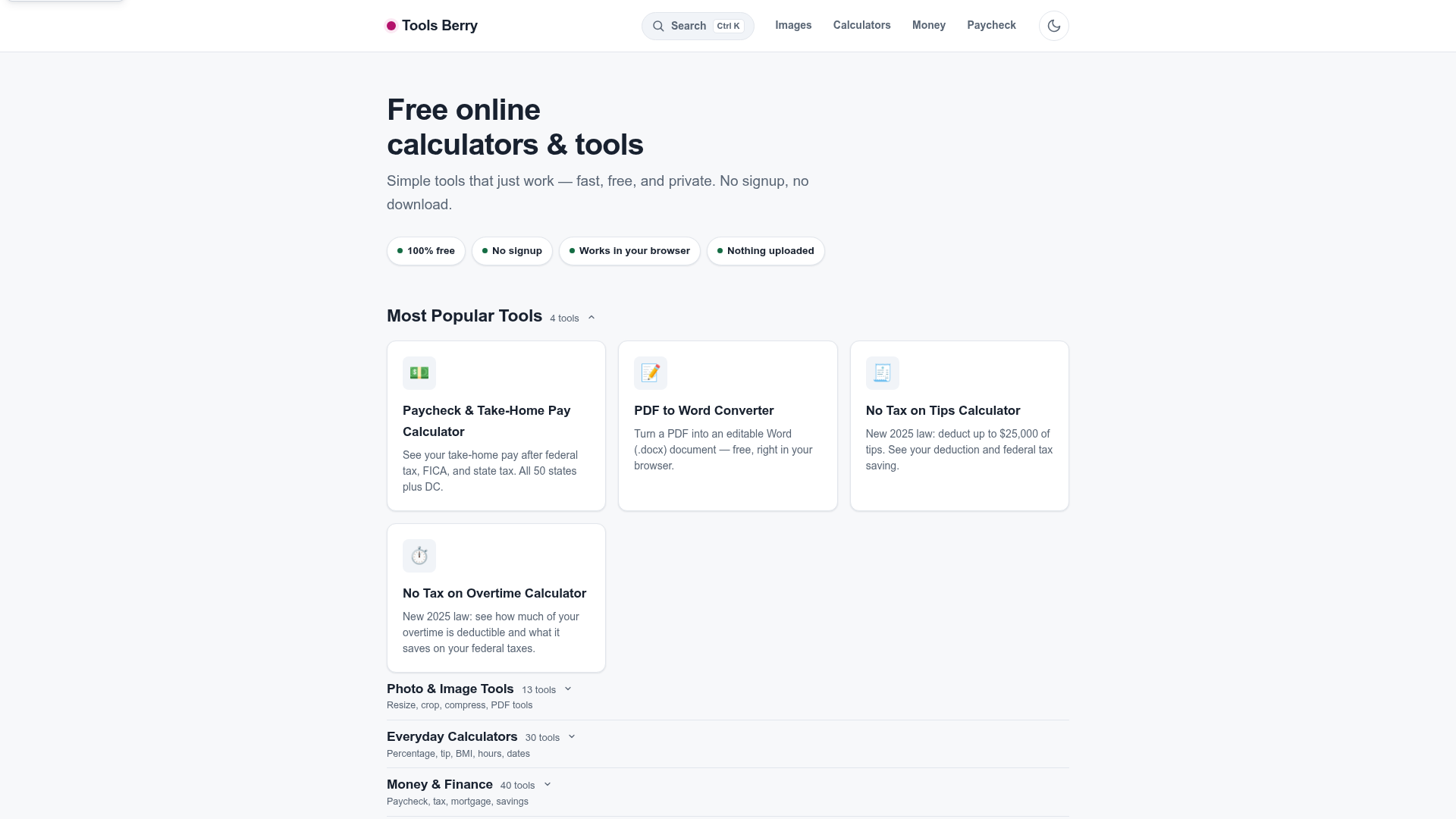
The free online tools market is a graveyard of abandoned side projects and ad-stuffed SEO farms. Every year, thousands of percentage calculators and PDF converters launch, get a few thousand visits, and fade into obscurity. Tools Berry, a collection of 70+ browser-based calculators and converters, looks like another entrant at first glance. But buried in its catalog is a strategic wedge that separates it from the noise: a suite of calculators built around the 2025 One Big Beautiful Bill Act (OBBBA). No-Tax-on-Overtime, No-Tax-on-Tips, Senior Deduction, and SALT Cap calculators, each with sourced per-state conformity data. This isn't just another utility site—it's a bet that specificity and privacy can outmaneuver scale in a commoditized market.
The Free-Tools Graveyard and the OBBBA Wedge
The free tools market is brutally competitive. Google's search results are dominated by a handful of giants: Calculator.net, RapidTables, and a long tail of template-based sites that rank through sheer domain authority and backlink profiles. The barriers to entry are almost zero—a competent developer can clone a percentage calculator in an afternoon. The result is a race to the bottom on features, with monetization through aggressive ads and data collection. Tools Berry's response is to differentiate on two fronts: privacy (100% in-browser, no signup, nothing uploaded) and timeliness (OBBBA-specific calculators). The OBBBA wedge is particularly smart. When a major tax law passes, millions of Americans suddenly need to understand how it affects their paycheck. Big incumbents are slow to update their generic calculators, and government sites are notoriously clunky. Tools Berry has moved fast, creating calculators for the most talked-about provisions: overtime pay, tips, senior deductions, and the SALT cap increase. The site even includes state-by-state conformity data, a level of detail that generic tools rarely offer. This is a classic 'regulatory arbitrage' play—using a legislative event to capture high-intent search traffic.
How a 51-State Paycheck Calculator Becomes a Moat
The centerpiece of Tools Berry is its paycheck calculator, covering all 50 states plus DC. This is not a simple federal tax estimator; it incorporates state-specific tax brackets, FICA, and local deductions. The complexity is a feature. Building and maintaining a 51-state calculator requires constant updates as state tax laws change. That's a moat. A generic percentage calculator can be replicated in minutes, but a state-accurate paycheck calculator requires ongoing legal research and software maintenance. Tools Berry doubles down on this moat with a suite of related calculators: bonus tax by state, W-4 withholding for overtime and tips, Social Security wage base max-out dates, and 1099 vs W-2 comparisons. Each tool is a potential entry point for high-intent users—people who are not just curious but actively trying to plan their finances. The site also publishes data studies, like 'Take-Home Pay by State on $75,000 and $100,000 (2026)' and 'Which States Still Tax Overtime? (2026)', which serve as linkable assets for SEO and PR. This is a classic content-marketing flywheel: detailed data attracts backlinks, backlinks boost domain authority, and domain authority drives organic traffic to the calculators.
The Competitive Field: Incumbents, Aggregators, and AI Chatbots
Tools Berry's competitors fall into three buckets. First, the incumbents: Calculator.net, NerdWallet, and SmartAsset. These have massive domain authority and established trust. However, their calculators are often generic and ad-heavy. NerdWallet's paycheck calculator, for instance, is a lead-gen tool for financial products, not a pure utility. Tools Berry's ad-light, privacy-first approach is a differentiator, especially for users who are tired of being tracked and upsold. Second, the aggregators: sites like Uneed.best that list tools. These are distribution channels, not direct competitors. Tools Berry's presence on Uneed is a smart way to get initial traction. Third, the new threat: AI chatbots like ChatGPT. A user can ask 'How much tax will I pay on $75,000 in Texas?' and get a decent answer. But AI chatbots are not reliable for complex, state-specific calculations, and they often hallucinate tax law details. Tools Berry's edge is accuracy and trust. The site sources per-state conformity data and provides transparent methodology. For a user making a financial decision, a deterministic calculator is more trustworthy than a probabilistic language model. That said, Tools Berry must be careful. If AI chatbots improve their accuracy and gain access to real-time tax data, they could eat into the long-tail search traffic that Tools Berry depends on.
The Economics of Free: Ad-Light, Privacy-Led, and the Value of Trust
Tools Berry is free, with no signup and no data leaving the device. The business model is ad-supported, but the site is 'ad-light'—a deliberate choice to preserve user trust. This is a trade-off: fewer ads mean lower revenue per session, but higher user satisfaction and repeat visits. The site also avoids the dark patterns common in the industry, like fake download buttons or misleading pop-ups. This is a long-term play. Trust is a currency in the free-tools market, and Tools Berry is building a brand that users can rely on. The OBBBA calculators are a potential revenue driver through affiliate partnerships (e.g., tax software) or premium features (e.g., detailed reports). But the immediate focus is on traffic growth. The site's SEO strategy is evident: each calculator has a dedicated URL, and the data studies are designed to attract backlinks. The cost structure is low—a static site with client-side JavaScript can be hosted for pennies. The main investment is time: researching tax laws, updating calculators, and creating content. This is a classic indie-hacker model: high effort, low overhead, and a slow but compounding organic growth curve.
From Tax-Law Spike to Durable Utility: The 3–5 Year Trajectory
The OBBBA calculators are a spike in demand, not a permanent shift. The tax-law news cycle will fade, and search volume for 'no tax on overtime' will decline. Tools Berry's challenge is to convert this temporary interest into long-term loyalty. The site's broader catalog—PDF tools, image converters, everyday calculators—is the answer. Once a user discovers Tools Berry for a tax calculator, they may return for a PDF-to-Word conversion or a cooking measurement converter. The site is building a suite of utilities that cover a wide range of needs, increasing the chances of repeat visits. The 3–5 year trajectory depends on execution. If Tools Berry can maintain its privacy-first stance, keep its calculators up-to-date, and expand its data studies, it can carve out a niche as the 'trusted, no-nonsense' tools site. The risk is that a larger player, like Google or a well-funded startup, launches a similar privacy-focused suite with better distribution. But for now, Tools Berry has a window. The OBBBA wedge is real, the SEO groundwork is laid, and the market for private, ad-light utilities is underserved. The question is whether the site can expand its moat beyond tax law and become a destination for all things calculable.