Tracer
Coordinated open-weight models for better answers at lower cost, from a YC-backed research lab.
NewName Editorial
Editorial Team
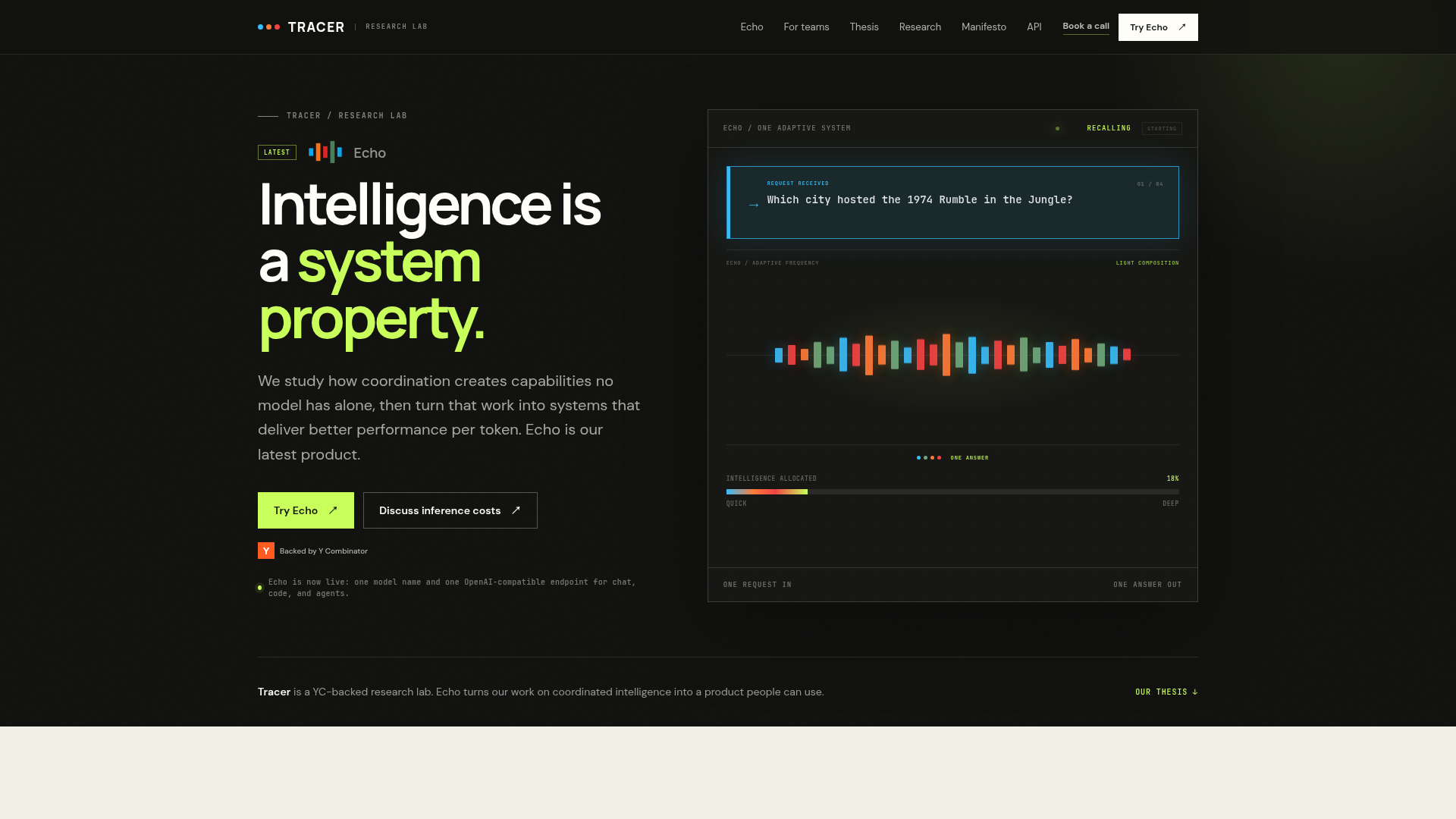
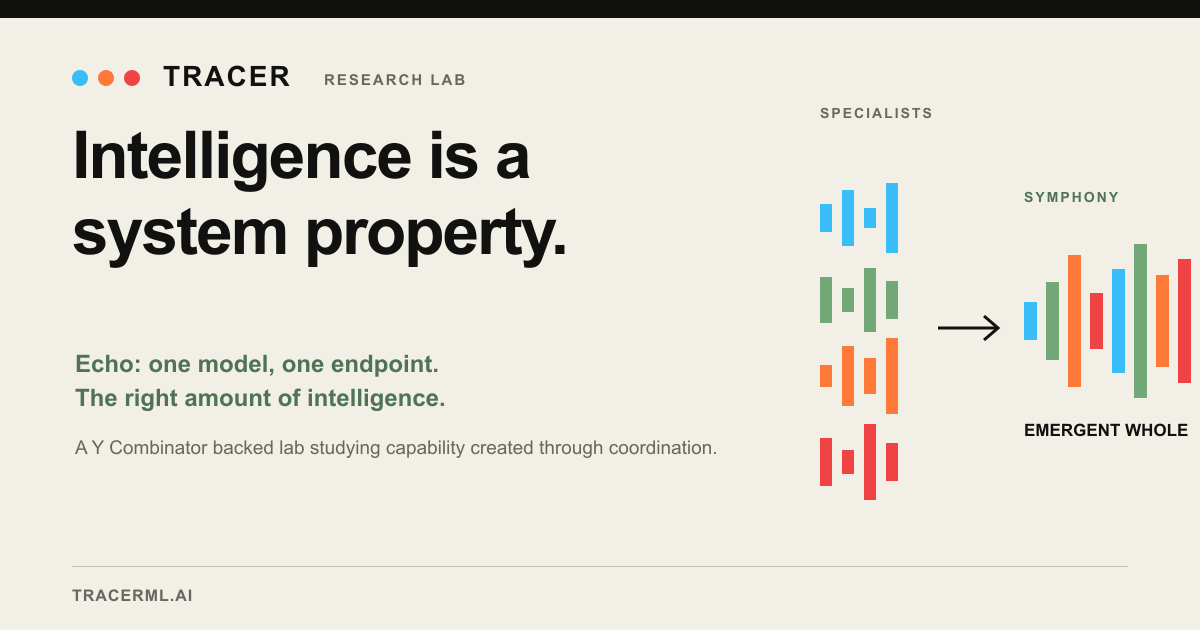
Most AI companies compete by scaling up: bigger models, more parameters, more compute. Tracer, a YC-backed research lab, is betting on a different lever: coordination. Its thesis, stated plainly on the homepage, is that "intelligence is a system property"—that the whole can be more capable than the sum of its parts. The lab's first product, Echo, puts that thesis to work behind a single OpenAI-compatible endpoint, promising "fable-level AI at 1/3 the cost" by adaptively coordinating open-weight models. It's a bold claim, and the evidence is still being gathered, but the approach is worth taking seriously.
The orchestra thesis
Tracer's central metaphor is an orchestra. "An orchestra is not a louder violin," the site reads. "It can do what no instrument can do alone." Just as a symphony emerges from the coordination of violin, cello, horn, and drums, Tracer argues that AI capabilities can emerge from coordinating specialized models. The research question is precise: "when can specialists and coordination create a capability no single model has alone?" This is not a claim that emergence has been achieved—the site is careful to note that "until it does, emergence remains a hypothesis to test." But it frames the entire product roadmap.
Echo: one endpoint, many kinds of work
Echo is the productized version of this research. It presents a single, stable interface—one model name, one OpenAI-compatible endpoint—that handles chat, code, and agents. Under the hood, Echo adapts its execution strategy to each request, allocating computation where it matters. The website shows a visual of "adaptive frequency" and "intelligence allocated" at 18% for a simple question, suggesting that not all requests require the same depth of reasoning.
For developers, the integration story is deliberately frictionless. You keep your OpenAI client, just change the base URL and API key. The API docs show a standard OpenAI Python client pointing at https://echo.tracerml.ai/v1. For agentic workflows, Echo can plug into harnesses like OpenCode, which keeps its tools and loop while Echo adapts inside each model call. This is a smart go-to-market move: instead of asking teams to adopt a new paradigm, Tracer slots into existing infrastructure.
The intelligence allocation playbook
Tracer's blog is a field guide to its economic argument. The core idea is "intelligence allocation": route repetitive, low-stakes traffic to small, near-free classifiers, and defer the nuanced, high-stakes cases to a larger model. The blog posts are practical—customer support ticket triage, sales lead qualification, AI agent tool selection, email reply prioritization. Each one follows the same pattern: identify the clear-cut cases, certify them with a small model, and cut the bill without losing accuracy.
This is not just theory. Tracer's first open-source release, TRACER OSS, is described as "a trace-driven, parity-gated inference system." The paper, published on arXiv, shows how lightweight models can learn recurring decisions while preserving a measured quality gate. The emphasis on "parity-gated" is crucial: Tracer is not asking you to trust that the small model is good enough; it's building a system that verifies it.
The Echo eval observatory
One of the most distinctive aspects of Tracer's approach is its commitment to transparent evaluation. The site mentions an "Echo Eval Observatory"—a read-only resource where the team publishes "frozen comparisons with matched denominators, stored rows, hashes, losses, and explicit limitations." This is a rare level of openness in an industry where benchmarks are often cherry-picked. It aligns with the lab's stated research program on "interpretable orchestration": allocation decisions should be "inspectable, stable, local, auditable, and contestable." For teams evaluating Echo, this observatory is a concrete way to verify the cost-performance claims.
Naming a research lab and its product
The name "Tracer" evokes tracing—following the path of a request through a system, understanding where each token goes. It fits the lab's focus on trace-driven inference and cost analysis. The product name "Echo" is more evocative: it suggests a response that returns, but also a system that reflects and adapts. Together, the names position Tracer as a serious research operation with a practical product arm. The domain tracerml.ai is clean and memorable, though the "ml" suffix is a common convention in the AI space.