Impact-Site-Verification: 41b53a0c-6d04-458b-a457-fe9e29acde1a

AI & Machine Learning··5 min read

TruShot

AI dating photos that pass face verification and get you matches.

NN

NewName Editorial

Editorial Team

TruShot product image 1
TruShot product image 2
TruShot product image 3

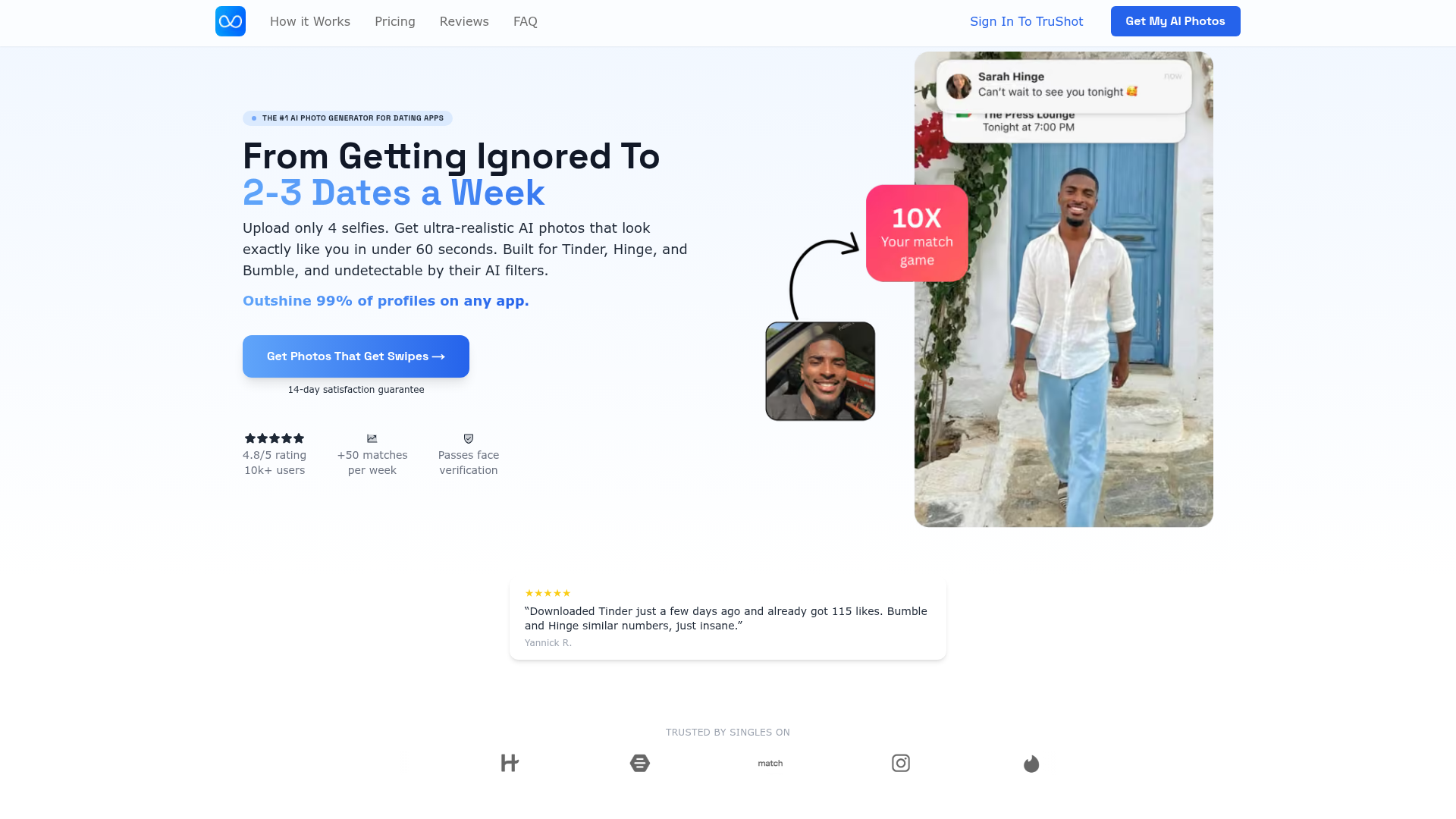
TruShot is not subtle about its pitch. The landing page promises "ultra-realistic AI photos that look exactly like you in under 60 seconds" and, crucially, that they are "undetectable by their AI filters." This is not a tool for creating a fantasy avatar; it's a tool for gaming the system—legally, perhaps, but still gaming it. The entire product is built around a single, high-stakes thesis: that the photos are the bottleneck in online dating, and that AI can remove that bottleneck without triggering the platforms' fraud detectors.

The Undetectability Arms Race

The most striking thing about TruShot is its explicit positioning against the detection algorithms of Tinder, Hinge, and Bumble. The site doesn't just claim the photos look real; it claims they will pass face verification. This is a direct challenge to the platforms' efforts to root out AI-generated content, which they see as a threat to authenticity and trust. TruShot is essentially selling a way to win an arms race, and it's betting that its technology is ahead of the platforms' detection.

This is a risky strategy. If the platforms update their filters, TruShot's core promise collapses. But it's also a clever one, because it addresses a real fear: that using AI photos will get you banned. By making "undetectable" a headline feature, TruShot turns a potential liability into a selling point.

Four Selfies, Sixty Seconds, One Promise

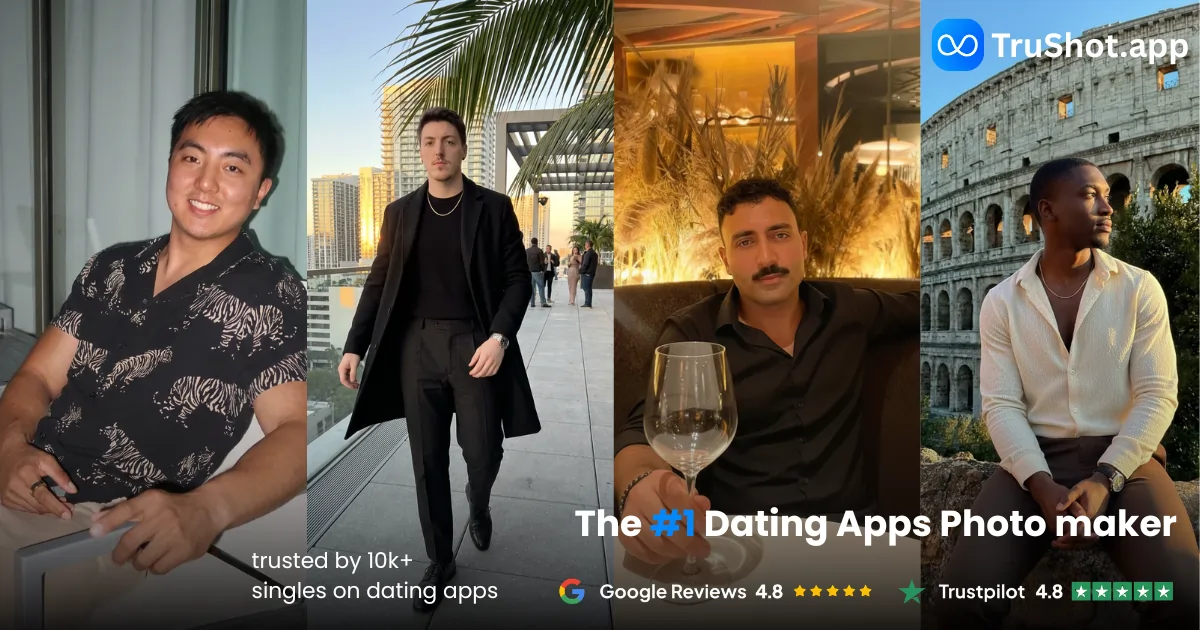
The workflow is deliberately simple: upload four selfies, wait under a minute, receive a set of AI-generated photos. The site emphasizes that these are not random or inconsistent—they look like you. The before-and-after examples show men in casual selfies transformed into polished, confident versions of themselves in various settings: outdoor, professional, relaxed. The promise is that you don't need a photographer, a studio, or even good lighting. Just four photos from your camera roll.

This simplicity is key. The target user is not someone who enjoys the process of taking photos; it's someone who finds it tedious and frustrating. The site's narrative is built around a character named Alex, who "6 months on Hinge. Maybe 1-2 matches a week, never replies." After TruShot, he gets "4 dates first week" and "+100 matches in 24h." Whether or not these numbers are real, they tap into a common frustration: the feeling that your photos are holding you back.

The Male Dating Photo Economy

The site is unapologetically aimed at men. The testimonials are from men, the before-and-after photos are of men, and the copy speaks to "guys" and "introverts, engineers, guys who felt the app was working against them." This is a deliberate choice, and it makes sense. The market for dating profile optimization is heavily skewed toward men, who often struggle to get quality photos. Professional dating photographers charge hundreds of dollars per session, and the results are not guaranteed. TruShot offers a cheaper, faster alternative.

The site even claims that "9 out of 10 men have dating app photos that kill their chances." This is a bold statistic, and while the source is not cited, it speaks to the perceived problem. TruShot is not just selling photos; it's selling hope. It's saying: your lack of matches is not your face, it's your photos.

Why TruShot Isn't Just Another AI Headshot Generator

There are plenty of AI photo generators out there, but TruShot differentiates itself on three fronts: speed, realism, and dating-app optimization. The site compares itself to ChatGPT and other AI tools, which it says produce "random & inconsistent faces," "generic AI blur backgrounds," and "easily detected" images. TruShot, by contrast, claims to produce "real skin, real texture," "sharp, real-life scenes," and "passes app photo verification."

It also offers "+100 Templates & Infinite scenarios," which suggests a level of customization beyond simple headshots. This is not about creating a professional LinkedIn photo; it's about creating a lifestyle. The photos are designed to show you in different contexts—hiking, at a bar, with a dog—that are known to perform well on dating apps.

The Name Says It All: TruShot's Branding Bet

The name "TruShot" is a portmanteau of "true" and "shot," and it encapsulates the product's core promise: a real shot at getting matches. It's a clever name because it works on multiple levels. "Tru" suggests authenticity, which is ironic given that the photos are AI-generated. But it also suggests precision and accuracy—a "true shot" is one that hits its target. The name implies that these photos will get you the results you want, and that they are a true representation of you, not a fantasy.

The domain, trushot.app, is short and memorable, and the .app extension reinforces the tech-forward nature of the product. The branding is consistent across the site, with a clean, modern design and a focus on results. The logo, a simple wordmark, is understated, letting the photos speak for themselves.

The Risks: Verification, Trust, and the Slippery Slope

The biggest risk for TruShot is that its core promise—undetectability—is not guaranteed. Dating apps are constantly updating their algorithms, and what works today may not work tomorrow. If a user gets banned, they may blame TruShot, and the 14-day satisfaction guarantee may not be enough to save the brand's reputation.

There's also a broader ethical question. TruShot is essentially helping users deceive potential partners, at least initially. The photos are designed to look like you, but they are enhanced. This could lead to disappointment when the person shows up and doesn't look exactly like their photos. The site tries to mitigate this by emphasizing that the photos "still look like you," but the line between enhancement and deception is thin.

Finally, there's the risk of market saturation. As more men use AI photo generators, the photos may start to look similar, and the platforms may become better at detecting them. TruShot's success depends on staying ahead of the curve, both technologically and in terms of user trust.

Despite these risks, TruShot has tapped into a real need. Online dating is a numbers game, and photos are the primary currency. If TruShot can deliver on its promise of realistic, undetectable photos that get matches, it could become a staple for single men. But the stakes are high, and the margin for error is slim.