Tsenta
Tsenta: an AI agent that watches 50,000 career pages and applies for you, with receipts.
NewName Editorial
Editorial Team


The job search industry has spent a decade optimizing the resume—better verbs, ATS-friendly formatting, keyword stuffing. Tsenta, a Y Combinator-backed startup, thinks the real bottleneck is something else: speed. Its thesis, stated plainly in the product's origin story, is that the founders applied to 3,000 jobs by hand and built a tool to do it for you. That number—3,000—is the raw material for everything Tsenta does. It is not a resume coach or a job board. It is an application machine.
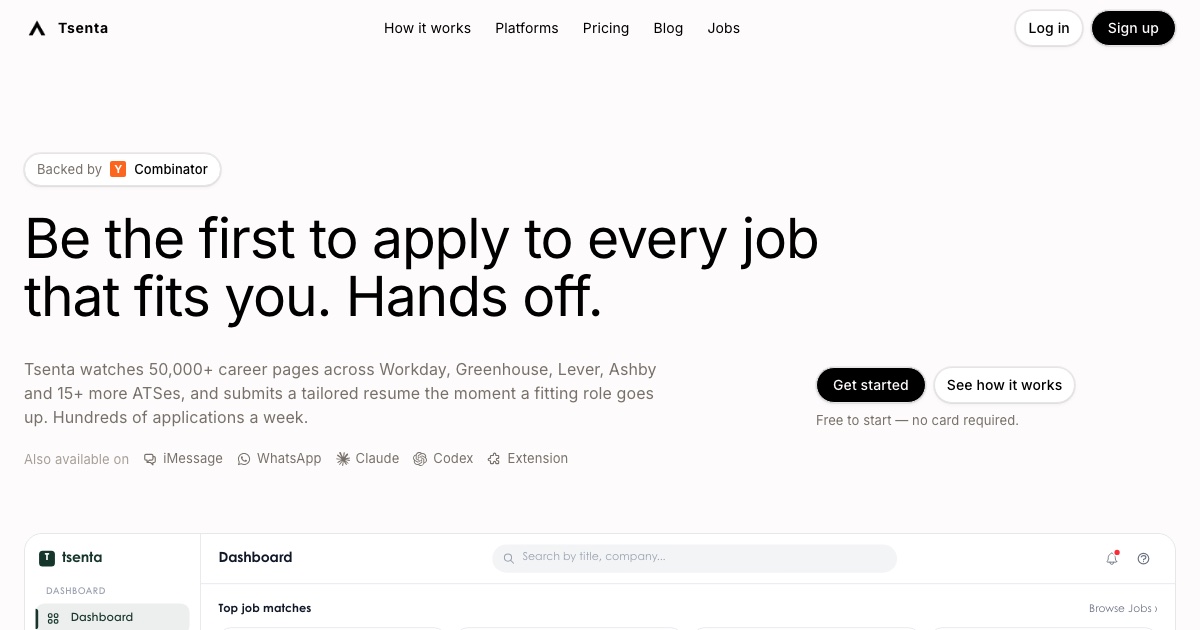
Tsenta's pitch is simple: it watches 50,000+ company career pages across Workday, Greenhouse, Lever, Ashby, and 15+ other ATSes, and the moment a role that fits your profile goes live, it tailors your resume and submits the application—often within seconds. The company's marketing materials claim users are "already in the top 100 applicants" and shows a comparison: via Tsenta, you're applicant #1; via LinkedIn and other channels, you're #1,185. That's the core value proposition—not better applications, but earlier ones.
The 3,000-application origin story
Tsenta's origin story is a classic founder's pain point: the team manually applied to 3,000 jobs and decided to automate the process. That number is not a marketing gimmick; it's the foundation of the product's design. The founders clearly learned that volume matters—that applying to hundreds of roles is a numbers game, and that the bottleneck is not writing a good resume but submitting it before the pile grows too high.
This is a different philosophy from most job-search tools. LinkedIn, Indeed, and even AI resume builders focus on improving the quality of each application. Tsenta's bet is that quality is secondary to speed. The product's entire architecture—from the ATS watcher to the auto-submit pipeline—is built to minimize the time between a job posting going live and your application landing in the recruiter's inbox.
The 3,000 figure also explains why Tsenta is so aggressive about automation. If you've manually filled out 3,000 applications, you know that the open-ended questions, the work authorization forms, and the redundant fields are a huge time sink. Tsenta's goal is to eliminate that friction entirely, so you can apply to hundreds of roles without lifting a finger.
Speed as a feature: watching 50,000 career pages
Tsenta's core mechanism is a crawler that monitors 50,000+ career pages across the major ATS platforms. This is not a job board aggregator; it's a direct feed from the source. When a company posts a new role on Workday or Greenhouse, Tsenta sees it within seconds and matches it against your profile—location, salary, experience, role family.
The product's dashboard shows a live feed of matches, each with a match score (e.g., 92% for a Senior Frontend Engineer at Stripe). The user can then approve or let Tsenta auto-apply. The speed advantage is dramatized in the marketing: "via tsenta 00h 00m" versus "via LinkedIn & co. 16h 45m," with the note that recruiters typically review the first 100 applications.
This is a clever reframing of the job search problem. Instead of telling you to apply within 24 hours, Tsenta makes it possible to apply within minutes. The product's entire value proposition is that you're first in line, and the ATS watcher is the engine that gets you there.
The trust problem: tailoring, approval, and receipts
Automated job applications raise an obvious question: how do you know the AI didn't mess up your resume or submit something embarrassing? Tsenta addresses this with a three-part trust system: tailoring, approval, and receipts.
First, tailoring. Tsenta reads the job description, identifies keywords and must-haves (e.g., React, TypeScript, design systems), and rewrites your resume bullets to match—using only true facts from your uploaded resume. The example shows a generic bullet transformed into a punchy, outcome-oriented one: "Built features for the web app using React" becomes "Shipped distributed React + TS surfaces serving 4M MAU; cut p95 render time 38%." The product claims to preserve your tone while boosting keyword match.
Second, approval. Before anything is sent, Tsenta shows you the changes—a diff view with additions and deletions—and you must approve. This is a critical trust feature. The product is not a black box; it's a transparent agent that asks for permission before acting.
Third, receipts. After submission, Tsenta provides a detailed receipt: the exact fields filled, the answers to open-ended questions, the resume and cover letter that went out, and a confirmation from the ATS. This is the antidote to the fear of automated applications. You can review every application after the fact and flag anything for future changes.
This trust architecture is what separates Tsenta from a simple auto-fill bot. It's designed to make the user feel in control, even though the agent is doing the work.
One agent, many surfaces: iMessage, Chrome, and MCP
Tsenta is not just a web dashboard. It's a multi-surface agent that meets you where you are. The product is available on iMessage, WhatsApp, a Chrome extension, and even as an MCP server for AI assistants like Claude and Codex.
The iMessage integration is particularly clever. You get a text: "New match: Senior Frontend at Stripe — 94%. Apply?" You reply "yes," and the application happens in the background. You get a confirmation: "✓ Submitted. You're applicant #4 of 312." This turns job applications into a casual text conversation.
The Chrome extension adds a toolbar on any job posting, with one-click auto-fill. And the MCP server is a nod to the developer crowd: you can tell Claude Code to "apply to the new Stripe role," and it calls Tsenta's API, submits via Greenhouse, and updates your tracker.
This multi-platform approach is smart. It positions Tsenta not as a website you visit, but as an agent that lives in your messaging apps and browser. It also future-proofs the product: as AI assistants become more common, Tsenta is already integrated with them.
Pricing for volume, not features
Tsenta's pricing model is refreshingly simple: every tier is the full product, and tiers differ only by application volume. Starter is $19/month for 600 applications, Pro is $39/month for 1,500, and Power is $99/month for 4,500. There's also a free tier with 25 applications.
This pricing is a direct reflection of the product's philosophy. Tsenta is not selling features; it's selling volume. The more applications you need, the more you pay. This aligns with the value proposition: if speed and volume are the key to landing interviews, then the pricing should scale with that.
The copy is also candid: Pro is "for the desperate, the laid-off, the OPT-clocked." That's a refreshingly honest description of the target user. Tsenta knows its audience is people who need to apply to hundreds of jobs quickly, and it prices accordingly.
What Tsenta's name and brand signal
The name "Tsenta" is short, invented, and vaguely technical—it sounds like a piece of software or a startup, not a human-centric brand. This is a deliberate choice. Tsenta positions itself as an agent, not a career coach. The name doesn't evoke warmth or personal touch; it evokes efficiency and automation.
The brand is consistent with this: the website uses a clean, dark dashboard aesthetic, with a focus on data—match scores, application counts, pipeline stages. The tagline, "Your AI career agent that applies to jobs & lands you interviews," is functional and direct.
This naming strategy has a tradeoff. It may appeal to tech-savvy users who want a powerful tool, but it might feel cold to job seekers who are anxious and looking for support. The brand leans into the "agent" metaphor, which is accurate but not emotionally reassuring.
The domain, tsenta.com, is a perfect match—short, brandable, and easy to remember. It's a strong choice for a startup that wants to be a verb in the job-search space.
Open questions: quality vs. quantity
Tsenta's biggest risk is that its volume-first approach could backfire. If you apply to 4,500 jobs, many of them will be poor fits, and recruiters may see a pattern of mass applications. Tsenta's match scoring and tailoring help, but they don't guarantee quality.
Another concern is the ethics of automated applications. Some recruiters may view AI-submitted applications as spam, even if they are tailored. Tsenta's FAQ claims there's no automated flag in the submission, but that's a claim that could be challenged.
Finally, the product's success depends on the ATS integrations staying stable. If Workday or Greenhouse changes their API, Tsenta's crawlers could break. The company's 50,000-page watchlist is a moat, but it's also a maintenance burden.
Despite these risks, Tsenta has a clear thesis and a well-executed product. It's a bold bet that the future of job hunting is not better resumes, but faster applications—and it's built a machine to prove it.