Click
Live platform data for AI agents, beyond web search.
NewName Editorial
Editorial Team
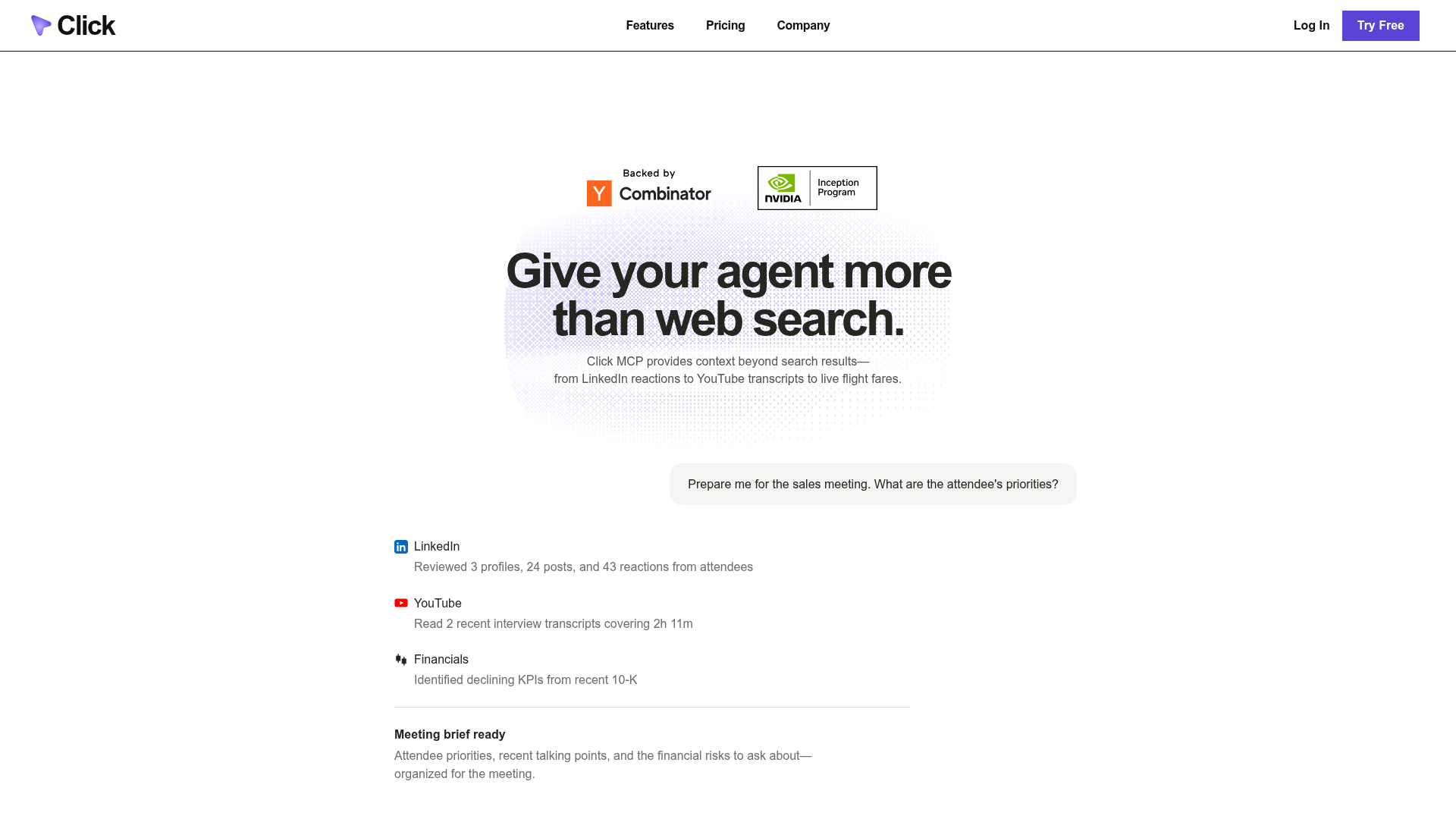

AI coding assistants have become remarkably good at writing code, but they still operate with a blind spot: the web search results they rely on are often shallow, stale, or missing the structured data that lives inside professional and social platforms. Click, a Y Combinator-backed startup, is building a bridge across that gap. Its product, Click MCP, plugs into assistants like Codex and Claude to provide live external context from LinkedIn, X, YouTube, Reddit, Google Maps, flight databases, and financial filings. The pitch is simple: give your agent more than web search.
The company's homepage demonstrates the difference with a series of concrete scenarios. Ask Click to prepare you for a sales meeting, and it reviews LinkedIn profiles, posts, and reactions from attendees, reads recent YouTube interview transcripts, and pulls key financials from a 10-K. Ask it to plan a team trip to a conference, and it evaluates hundreds of flight options, reads hotel reviews, and finds happy-hour activities on Reddit. The output isn't a list of links; it's a synthesized brief, a shortlist, or an itinerary. That's the core editorial thesis of Click: the value isn't in fetching data, it's in turning that data into a decision-ready artifact.
The gap between web search and what agents actually need
Web search is a remarkably powerful tool, but it has structural limitations. It's optimized for finding pages, not for extracting structured facts from a specific platform. If you ask an agent to research a person on LinkedIn, a standard search might return a profile URL, but it won't give you the person's recent posts, their engagement patterns, or the reactions from their network. Similarly, a search for flight options might surface a few travel sites, but it won't compare 214 flight options across carriers and times in a way that's easy to parse.
Click's thesis is that agents need context, not just links. The company's tagline, "Research services inside Codex & Claude," frames the product as a service layer that sits inside the assistant's workflow. The homepage copy puts it bluntly: "Click MCP provides context beyond search results—from LinkedIn reactions to YouTube transcripts to live flight fares." This is a different category from a search API or a web scraper. It's a curated set of connectors that understand the structure of each platform and can extract the signals that matter.
How Click's MCP connectors turn platforms into structured context
The technical foundation is MCP, or Model Context Protocol, an open standard that lets AI assistants connect to external tools and data sources. Click builds on this by offering a suite of connectors for platforms like LinkedIn, X, Meta Ads, Facebook, Instagram, Reddit, TikTok, YouTube, Google Maps, Zillow, flights and hotels, and financials. Each connector is designed to pull structured data—not just raw HTML—so the agent can reason over it.
The homepage shows the connectors in action with quantitative detail. For the sales meeting scenario, Click "reviewed 3 profiles, 24 posts, and 43 reactions from attendees." For the influencer search, it "reviewed 72 recent robotics demos with 100K+ reach" on X and found "14 robotics builders with 1M+ followers" on YouTube. These numbers are illustrative, but they signal a key design choice: Click is built for depth, not just breadth. It's not trying to index the entire web; it's trying to give agents the specific, structured data that lives inside a handful of high-value platforms.
This approach has a practical consequence. When an agent uses Click, it can cite its sources with precision—"Reviewed 3 profiles, 24 posts, and 43 reactions"—which builds trust in the output. For a sales team, knowing that the agent actually read the attendee's recent posts is more valuable than a vague summary. For a marketer, knowing that the influencer shortlist is based on reach data from YouTube and X is a concrete, verifiable claim.
The demo that shows the workflow: from sales prep to conference planning
Click's homepage is built around a series of interactive demos that walk through real use cases. The most compelling is the conference planning scenario, which combines multiple data sources into a single workflow. The user asks: "Plan the VidCon trip next month. Find travel options that fit my schedule. Draft personalized cold emails asking for a coffee meeting with marketing VPs from Fortune 100 companies attending. Find their work emails and review their LinkedIn, X, and company earnings reports for timely personalization."
Click's response is a multi-step process that draws on web search, LinkedIn, X, flights and hotels, and financials. It finds 38 relevant public sources, evaluates 178 listed companies, matches 20 companies to marketing VPs and work emails, reviews 1,147 posts from 132 company leaders, compares 317 flight options, checks 86 nearby hotels, and reads recent earnings reports for 20 target companies. The output is a complete conference plan: travel options, prioritized meetings, work emails, and personalized outreach.
This demo is effective because it shows the product's range. It's not just a research tool; it's an orchestration layer that can handle a complex, multi-step task that would take a human hours. The agent doesn't just fetch data; it makes decisions about what's relevant, synthesizes it, and produces a usable artifact. That's the kind of capability that moves AI from a novelty to a productivity tool.
Why the pricing model signals a shift toward agent-native tools
Click's pricing page reveals a simple model: $49 per month for individuals, with 500 credits per month. The page notes that it works with Codex/ChatGPT and Claude, and that a single installation covers all connectors, with new connectors available automatically. There's also a Business tier, though the details aren't shown in the available evidence.
The pricing is notable for two reasons. First, it's a subscription model, not a usage-based API pricing. This suggests Click is positioning itself as a tool for professionals—salespeople, marketers, researchers—who use AI assistants daily and need reliable access to platform data. Second, the credit system implies a focus on cost predictability. Each query or data pull consumes credits, which encourages users to be deliberate about their research requests.
This pricing model also signals a broader shift in the AI ecosystem. As agents become more capable, they need access to external data that isn't available through standard web search. Click is betting that professionals will pay for that access, just as they pay for LinkedIn Sales Navigator or Bloomberg terminals. The difference is that Click is built for the agent-native workflow, where the assistant does the research and the human reviews the output.
Click's positioning is still early—the website doesn't disclose funding details beyond the YC and NVIDIA Inception badges, and the company's long-term roadmap is unclear. But the product concept is clear: give agents the structured context they need to be truly useful. If Click can execute on that vision, it could become a standard layer in the AI stack, the way search APIs became standard for web apps. For now, it's a promising answer to a question many AI users are starting to ask: why can't my assistant see what I see?