UseWok
A one-time $59 campaign that builds your SaaS presence across search and AI in 14 days.
NewName Editorial
Editorial Team


UseWok is not another SaaS marketing tool. It is a service that sells a single, fixed-price outcome: a public presence for your SaaS across search engines and AI systems, delivered in 14 days for $59. No dashboard to learn, no accounts to create, no content to write. You paste your website URL, and UseWok does the rest. It is a bet that the most valuable marketing asset for a small SaaS team is not a tool they operate, but a campaign they can buy once and forget.
That bet is more interesting than it sounds. UseWok is tapping into a real, growing pain: the web is full of strong SaaS products that are hard to find and harder for AI assistants to describe accurately. The company's pitch is that it solves this by building a 'public presence' — a web of directory listings, original articles, and social posts that help both humans and AI systems understand what your product does, who it serves, and why it matters.
The $59 bet on AI visibility
The price is the first thing that stands out. $59 one-time, no subscription, no renewal. That is cheap enough to be an impulse buy for a founder, yet substantial enough to signal a real service. The pricing page lists a crossed-out $199, making the $59 feel like a deal, but the real message is simplicity: one payment, one campaign, no ongoing commitment.
UseWok's guarantee is even bolder: 'Known by ChatGPT in 90 days — or your $59 back.' The company is staking its reputation on a specific, verifiable outcome: that ChatGPT can accurately identify your SaaS and explain what it does. This is a clever move because it ties the service to a concrete, testable result, rather than vague promises of 'increased visibility.' It also aligns with the growing trend of AI assistants becoming a primary entry point for software discovery.
The $59 price also positions UseWok as an accessible alternative to hiring an agency or subscribing to a suite of marketing tools. For a solo founder or small team, the cost is negligible compared to the time and effort required to manually submit to 40+ directories, write 10 articles, and manage social media. The question is whether the quality of those submissions and articles is high enough to make a real difference.
What 'done-for-you' actually means here
UseWok is explicit about the division of labor. On its site, it contrasts 'Your Work: Nothing' with 'Our Work: Everything.' The list of what UseWok handles is concrete: research and submit to 40+ relevant directories and public profiles, create 10 original articles using an 'AI-optimized content standard,' publish six original social posts across up to three platforms, track every action, and record verified live URLs.
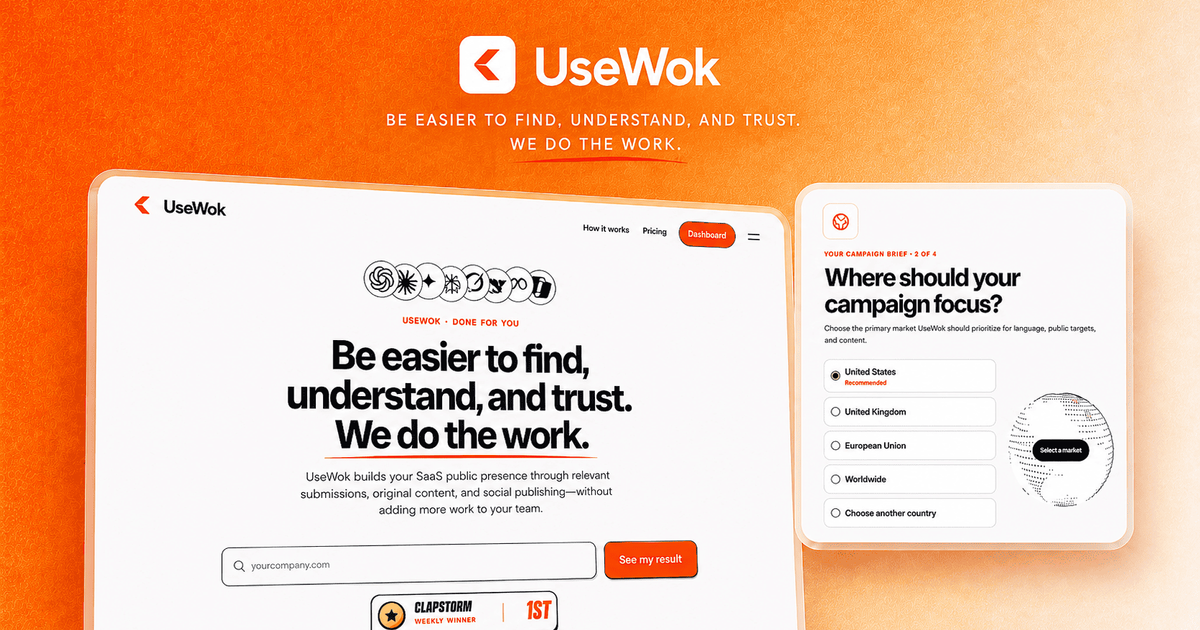
This is not a tool you operate; it is a service you commission. The user's only input is the website URL and some preferences: target countries, audience, positioning, goals, and social channels. UseWok then adapts the campaign to those choices, rather than applying a generic template. This personalization is a key differentiator, as many directory submission services are one-size-fits-all.
The 'done-for-you' model also means there is no learning curve. The site emphasizes 'No onboarding calls,' 'No complex dashboard to learn,' and 'No monthly subscription.' The campaign dashboard is for tracking, not for managing. This is a deliberate design choice: the customer is buying an outcome, not a process.
However, the phrase 'done-for-you' also raises questions about quality. Can a $59 service produce genuinely original, high-quality articles? The site says the articles are 'created using UseWok’s AI-optimized content standard,' which suggests they are AI-generated, possibly with human oversight. The risk is that these articles may be thin or generic, which could undermine the very credibility they are meant to build. UseWok does not disclose the specifics of its content creation process, so the quality remains an open question.
The public proof problem for small SaaS teams
UseWok's value proposition is rooted in a real problem: many SaaS products lack 'public proof.' When a potential buyer or an AI assistant searches for a product, they find a website, maybe a few reviews, and little else. There are no directory listings, no third-party articles, no social presence. This makes the product harder to evaluate and less likely to be recommended.
UseWok's solution is to create a web of signals that collectively serve as public proof. Directory submissions on platforms like Product Hunt, G2, or Capterra (the site mentions '40+ relevant directory and public-profile targets') provide third-party validation. Original articles offer in-depth explanations that can be indexed by search engines and cited by AI systems. Social posts reinforce the brand's positioning and audience.
The company even has a 'Citation Protocol' case study, suggesting it has been cited by ChatGPT. This is a powerful proof point, as it demonstrates that the service can achieve its primary goal. The site also lists badges from numerous startup directories, indicating that UseWok itself practices what it preaches by being present across many platforms.
For a small SaaS team, building this kind of public footprint manually would take weeks of tedious work. UseWok compresses that into a 14-day campaign, freeing the team to focus on product development. The trade-off is a loss of control: you cannot review each submission or article before it goes live. UseWok mitigates this by providing a dashboard with 'verified live URLs,' so you can see what has been published.
Why AI systems are the new first impression
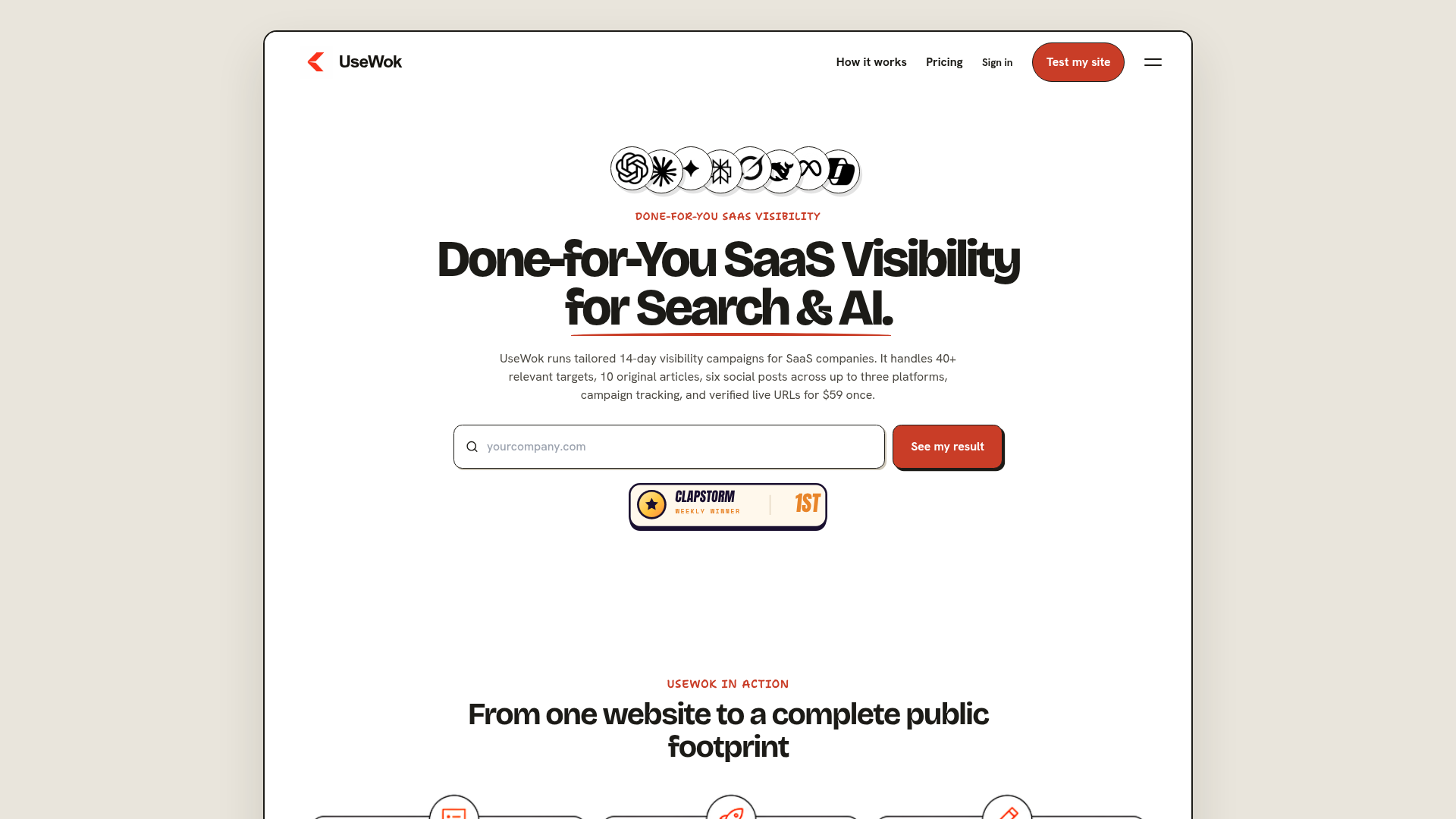
The most forward-looking aspect of UseWok is its focus on AI visibility. The site lists logos of ChatGPT, Claude, Gemini, Perplexity, Grok, DeepSeek, Meta, and Bing, signaling that these are the systems UseWok aims to influence. The tagline is 'Done-for-You SaaS Visibility for Search & AI.'
This is a smart positioning because AI assistants are increasingly used for software discovery. When someone asks ChatGPT 'What is the best project management tool for small teams?' the answer often depends on the AI's training data and the web sources it can access. If your SaaS is not mentioned in directories, articles, or social posts, it is unlikely to be recommended.
UseWok's campaign is designed to create the kind of content that AI systems can easily parse and cite. The 'AI-optimized content standard' likely means articles that are clear, structured, and factual, making them more likely to be referenced. The guarantee that ChatGPT will know your SaaS in 90 days is a direct test of this approach.
However, AI visibility is a moving target. AI systems update their training data and algorithms, and what works today may not work tomorrow. UseWok's one-time campaign may provide a temporary boost, but it does not offer ongoing optimization. The company acknowledges this by not promising long-term results, but it is a limitation to consider.
The name as a literal promise
The name 'UseWok' is unconventional, but it is a clever play on words. It sounds like 'use work,' implying that you use the service to do the work for you. It also evokes the image of a wok, a versatile cooking tool that stir-fries ingredients quickly — a metaphor for the fast, all-in-one nature of the service. The domain usewok.com is clean and memorable, and the brand is consistent across social media handles (@usewok_).
However, the name does not immediately convey what the service does. 'UseWok' could be a cooking app or a productivity tool. It is only through the tagline and website copy that the meaning becomes clear. This is a risk: potential customers may not understand the value proposition at first glance. But for those who do, the name becomes a memorable hook.
The brand's visual identity is minimal, with a simple logo and a clean, modern website. The use of badges from various directories reinforces the message that UseWok is itself a well-connected player in the startup ecosystem. The 'Fairness Pledge' and 'Methodology' pages suggest a commitment to transparency, which builds trust.
What UseWok doesn't promise
UseWok is careful not to overpromise. The FAQ explicitly states that 'No. Each directory and third-party platform controls its own approval, publication, indexing, and removal decisions.' This is an important caveat: not all submissions are guaranteed to be published. Some directories may reject or delay listings, and UseWok cannot control that.
The guarantee is also narrowly defined: 'Known by ChatGPT in 90 days — or your $59 back.' It does not promise rankings, traffic, or conversions. This is realistic, but it also means the service's success is measured by a single metric. If ChatGPT does not mention your SaaS, you get a refund, but you have lost 14 days of potential visibility.
Another limitation is that the campaign is a one-time effort. There is no option for ongoing maintenance or updates. If your SaaS changes its positioning or features, the public presence may become outdated. UseWok does not offer a retainer or subscription, so you would need to purchase another campaign to refresh your presence.
Finally, the quality of the articles and social posts is not guaranteed. The site says they are 'original' and 'AI-optimized,' but it does not provide samples or case studies of the content. The 'UseWok Case Study' is about the company itself, not a client's campaign. This lack of transparency makes it hard to assess the content quality before purchasing.
Who should care (and who should wait)
UseWok is best suited for early-stage SaaS founders who have a working product but no time or expertise for marketing. If you are spending all your time on development and have zero public presence, a $59 campaign is a low-risk way to get started. The done-for-you model is ideal for those who hate marketing busywork.
It is also a good fit for SaaS products that are launching soon. The 'For SaaS launches' page suggests UseWok can help create buzz around a new product. The 14-day timeline aligns with typical launch preparations, and the directory submissions can help get the product listed on platforms like Product Hunt.
However, if you already have a strong public presence or a dedicated marketing team, UseWok may not be necessary. The service is designed for the 'nothing' side of the equation; if you already have content, listings, and social activity, the incremental value is lower. Also, if you need ongoing visibility management, a subscription-based tool or agency might be a better fit.
In summary, UseWok is a bold experiment in commoditizing SaaS marketing. It sells a specific outcome at a fixed price, with a clear guarantee. The focus on AI visibility is timely, and the done-for-you model is refreshingly simple. The main risks are content quality and the one-time nature of the campaign. For a founder with $59 and a desire to be known by ChatGPT, it is a compelling offer. For others, it may be worth waiting to see how the service evolves.