Impact-Site-Verification: 41b53a0c-6d04-458b-a457-fe9e29acde1a

Lifestyle·Not disclosed··6 min read

Veil

Procedurally generated sleep sounds with no loops, hardware-grade control, and a one-time price.

NN

NewName Editorial

Editorial Team

Veil product image 1
Veil product image 2

There is a moment, usually around 2 a.m., when the white noise app you've trusted for months betrays you. The hiss of static hiccups, a barely perceptible seam, and suddenly you're awake, wondering if you imagined it. You didn't. That seam is the loop point, the exact moment when a recorded audio file ends and restarts, and your brain, primed to detect patterns at night, registers it as a cognitive event. It's the dirty secret of the sleep sound industry, and most apps charge you $60 a year for the privilege of hearing it.

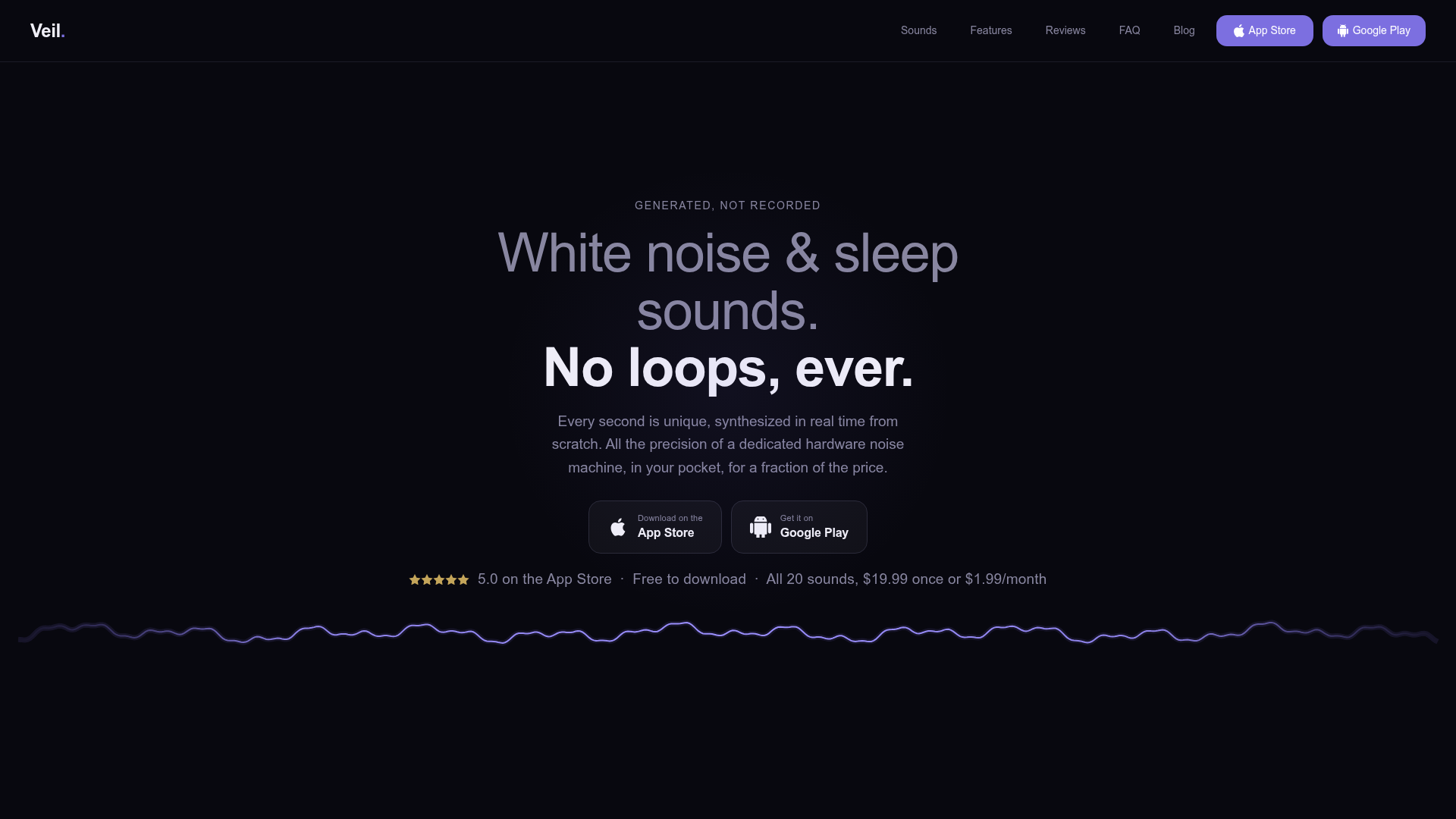
Veil, a new mobile app from an independent developer, doesn't have a loop point because it doesn't have an audio file. Every second of sound is synthesized in real time from white noise and digital filters, the same technique used in professional sound masking hardware. The result is a truly infinite soundscape that never repeats, and it's available for a one-time payment of $19.99. This is not a feature; it's a fundamental rethinking of how sleep sounds should be made.

The Loop Problem: Why Your Sleep App Is Lying to You

The loop is the original sin of the sleep sound category. When you play a recorded white noise track, the file is finite, typically 30 seconds to a few minutes long. To create continuous sound, the app repeats it, and that repetition creates a seam. Even if the seam is inaudible to your conscious mind, your brain is still processing the pattern. As Veil's FAQ notes, "At night, your brain is primed to detect patterns, even subtle ones, and that boundary registers as a cognitive event, enough to pull you out of light sleep or break your focus."

The reviews for major white noise apps are littered with complaints about the loop restarting. Some users notice it after a few nights; others become hyper-aware of the pattern and can't unhear it. The workaround for some has been to buy a dedicated hardware noise machine, which generates sound procedurally and costs $50 to $80. Others have tried streaming pink noise on Apple Music, only to find that the tracks are also looped. Veil's early App Store reviews reflect this frustration: one user, MarkMiller455, wrote, "The same day my 7 day trial ended I had my finger on the button to pay another $50 for pink noise. Luckily this came thru on Reddit and I tried it out. Absolutely what I wanted that even Apple Music couldn't provide."

Procedural Audio: How Veil Generates Infinite Sound

Veil's solution is to generate sound on the fly, not to play it back. The app uses a digital noise generator and a series of filters to create each sound in real time. There is no audio file, no loop boundary, and no repetition. Every second is unique, synthesized from scratch. This is the same approach used by professional sound masking machines, but Veil has packed it into a mobile app that runs entirely on your device.

The technical advantage is twofold. First, it eliminates the loop problem entirely. Second, it allows for a level of control that recorded audio cannot match. Veil's "Noise Tuning" feature gives you four parameters per sound: treble blend, low-pass cutoff frequency, speed, and level. You can make brown noise deeper by lowering the cutoff, or make pink noise brighter by adjusting the treble. No other white noise app offers this level of precision, and it's a direct result of the procedural engine.

The app also includes five synthesized fan sounds, each modeled mathematically to capture the mechanical characteristics of different fan types: blade shape, motor speed, housing resonance. As the FAQ explains, "Real fan recordings contain room noise, microphone artifacts, and a physical loop point. Synthesized fan sounds model the mechanical characteristics of each fan type mathematically... Synthesized beats recorded every time."

Beyond White Noise: The Physics of Pink, Brown, and Grey

Veil's sound library goes beyond the standard white noise to include pink, brown, green, and grey noise, each with a distinct frequency character. White noise distributes equal power across all frequencies, creating a bright, dense hiss that blocks sharp sounds. Pink noise reduces power as frequency increases, producing a warmer, softer sound that matches natural acoustic distribution. Brown noise concentrates energy in the bass, creating a deep, enveloping rumble that many people with busy minds prefer.

The app also includes green noise, which is mid-focused and bass-free, and grey noise, which is shaped to sound even to human ears. Each color has a different effect on sleep and focus, and Veil provides a brief science primer in the app to help users choose. This educational angle is a smart move: it positions Veil as a tool for informed listeners, not just a passive sound player.

The Hardware Comparison: Why Veil Feels Like a $80 Machine

Veil's positioning is explicit: it's the hardware experience without the hardware price. Dedicated noise machines cost $50 to $80, and they do one thing well: generate non-looping noise. Veil does exactly that, on a phone you already own, for $19.99 one time. The comparison table on Veil's website is telling. It lists features like "No loops, ever," "Precision volume," and "Per-sound tuning controls," and shows Veil matching or exceeding hardware machines while other apps fall short.

Precision volume is a key differentiator. Most apps give you a coarse 10-step slider, but Veil offers analog-style continuous control. This allows you to dial in the minimum effective masking volume, which is important because playing noise louder than necessary can actually disrupt sleep. The sleep timer also fades out gradually instead of cutting abruptly, a feature that some hardware machines lack.

Pricing as a Philosophy: Own It, Don't Rent It

Veil's pricing model is as radical as its audio engine. The app is free to download, with white, pink, and brown noise plus a slow fan sound available at no cost. Premium, which unlocks all 20 sounds, mixing, saved presets, and voice control, costs $19.99 one time. There are also subscription options ($1.99/month or $9.99/year) for those who want to try before they buy, but the one-time unlock is permanent and "not going away."

This is a direct challenge to the subscription model that dominates the category. As Veil's FAQ states, "The plans exist because plenty of people quite reasonably want to know whether an app helps them sleep before paying for it permanently. The one-time unlock exists because Veil generates noise on your device: there is no content to maintain and no servers to pay for, so renting it to you forever would be hard to justify." That logic is refreshingly honest, and it's a powerful selling point for consumers tired of recurring charges.

The Name 'Veil': A Brand That Whispers, Not Shouts

The name "Veil" is a deliberate choice. It suggests something soft, enveloping, and slightly mysterious—like a curtain of sound that separates you from the world. It doesn't scream "white noise app" like "SleepFan" or "NoiseMachine" might; instead, it evokes a gentle barrier, which is exactly what the app provides. The domain, veilsleep.app, is clean and memorable, and the app's dark-mode-only interface reinforces the brand's nocturnal focus.

The branding extends to the user experience. The app is designed to be used "with one eye open": no onboarding, no account, no permission prompts. One tap to play, a timer that fades, and voice control via Siri or Google. This minimalist approach is a breath of fresh air in a category often cluttered with ads and upsells. Veil's name and design work together to create a sense of calm and trust, which is precisely what a sleep app should do.

Veil is not for everyone. If you're happy with your looped white noise and don't notice the seam, you might not see the value. But for the light sleeper who has been jolted awake by a loop restart, or the pink noise enthusiast who has been paying $50 for a hardware machine, Veil offers a compelling alternative: infinite sound, precise control, and a price that respects your intelligence. It's a small app with a big idea, and it deserves a place on your nightstand.