Ventilate
A calm, window-by-window guide to cooling your home without air conditioning.
NewName Editorial
Editorial Team
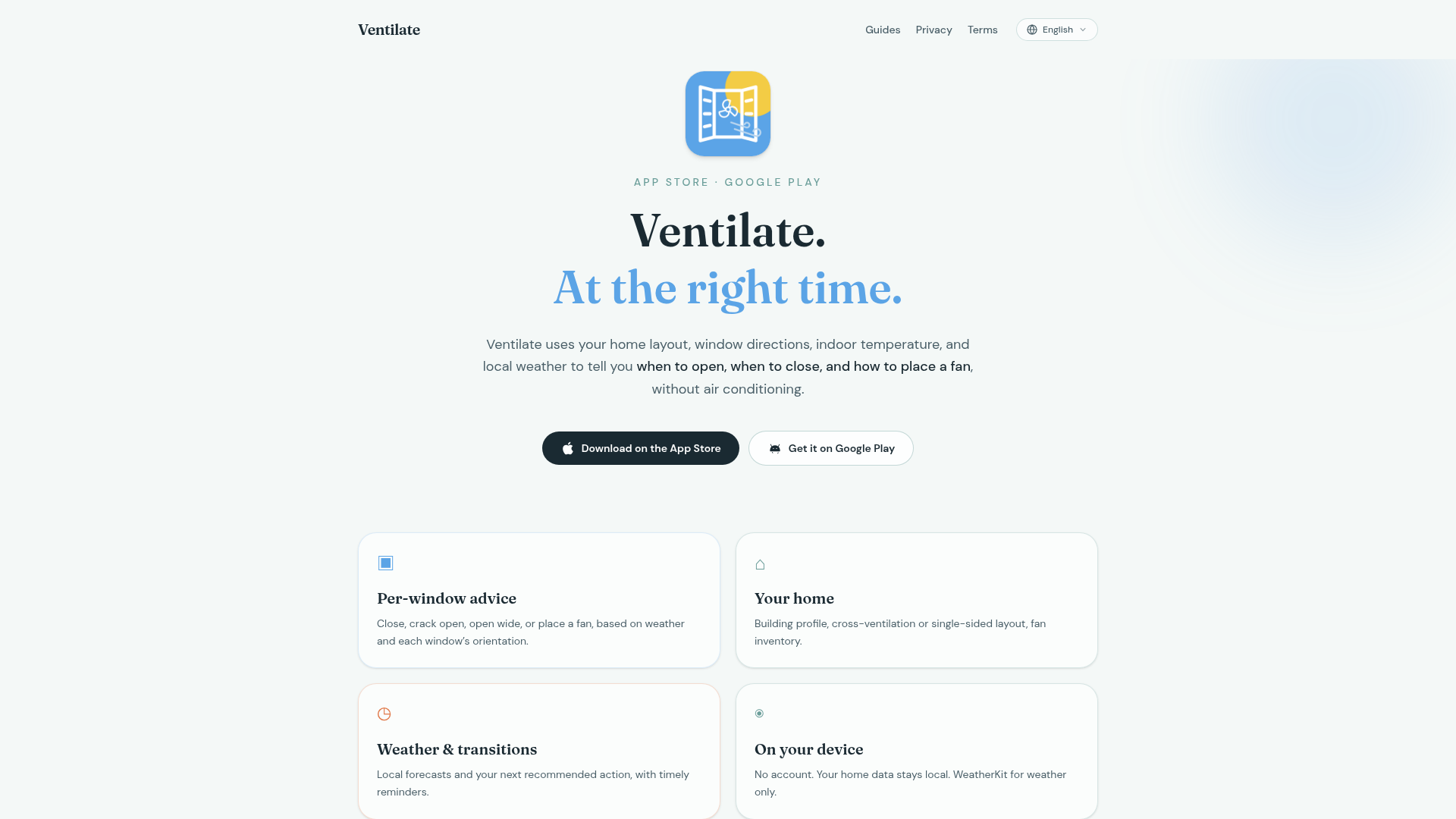

The most interesting thing about Ventilate is that it treats a window as a piece of infrastructure. Not a glass pane, but a device with an orientation, a schedule, and a job to do. In an era of smart thermostats and AI-powered energy dashboards, Ventilate goes the other direction: it gives you a simple instruction — open, close, crack, or fan — and trusts you to act on it.
The app, built by a small studio called Vivace App Studio, launched quietly and has already been featured on Product Hunt and Uneed. Its pitch is refreshingly modest: "Beat the heatwave: when to open, close, and use a fan for fresh air." No promises of smart home integration, no voice control, no machine learning. Just a calm guide for hot days.
The window is the product
Ventilate's core unit is the individual window. Most cooling advice is generic: "open windows at night, close them during the day." But that advice falls apart when you have a west-facing bedroom and an east-facing kitchen. The west window might be a liability in the afternoon, while the east window is already useless by noon.
Ventilate asks you to set up a profile of your home — which rooms have windows, which direction they face, whether you have cross-ventilation or a single-sided layout, and what fans you own. Then it combines that with your indoor temperature and local weather to give per-window advice: close, crack open, open wide, or place a fan.
This is the kind of granularity that a general weather app can't offer. A forecast might say "72°F and clear," but it won't tell you that your south-facing living room will bake until 9 p.m. unless you close the curtains. Ventilate's advice is contextual, not just meteorological.
Per-window logic, not one-size-fits-all
The app doesn't just say "it's hot, open a window." It distinguishes between actions: close, crack, open wide, or fan. That's a meaningful difference. Cracking a window during a heatwave can let in hot air, but it might also create a cross-draft that helps. Opening wide might be right at 2 a.m. but wrong at 2 p.m. Placing a fan in front of one window versus another can change the airflow pattern entirely.
Ventilate's advice is based on the physics of natural ventilation: cooler air comes in at night, hot air rises and escapes through upper windows, and fans are most effective when positioned to pull air from a cooler side. The app translates that into simple, actionable steps.
The site also includes three free heat guides: one for ventilating your home, one for staying cool without AC, and one explaining urban heat islands. These aren't marketing fluff — they're the same advice that ships inside the app, published as long-form articles. It's a smart way to build trust and demonstrate expertise.
Your home, modeled without an account
One of Ventilate's most refreshing choices is that it doesn't require an account. Your home data stays local on your device. The app uses WeatherKit for weather data, but your layout and preferences never leave your phone.
This is a privacy-first approach that feels increasingly rare. Many weather apps want your location, your contacts, your browsing history. Ventilate asks for your window directions and fan inventory, and nothing else. For a product that sits in your home and knows your daily routines, that's a meaningful trust signal.
The tradeoff is that you can't sync your setup across devices or share it with a family member. But for most people, that's a small price for not having to create yet another account.
Weather as a trigger, not a dashboard
Ventilate doesn't try to be a weather app. It doesn't show you radar maps or hourly precipitation. Instead, it uses weather as a trigger for action. "It's going to be 95°F at 3 p.m. — close the west-facing windows by noon." That's the kind of prompt the app excels at.
The app includes "weather & transitions" — it tracks local forecasts and tells you when the next recommended action is, with timely reminders. So you don't have to check the app every hour; it tells you when to check.
This is a subtle but important distinction. Most apps are passive: they show you data and let you decide. Ventilate is active: it tells you what to do. That's a higher bar, but also a more useful one.
The anti-AC positioning and its limits
Ventilate's tagline — "without air conditioning" — is both its strength and its limitation. On one hand, it's a clear positioning statement: this app is for people who don't have AC, can't afford it, or don't want to use it. On the other hand, it's a niche that's shrinking in many parts of the world.
But the niche is still huge. In Europe, where heatwaves are becoming more frequent and intense, AC penetration is still low. In cities like Paris, where the 2019 heatwave killed hundreds, many apartments have no AC and no cross-ventilation. Ventilate speaks directly to that reality.
The app's founder, who goes by Vivace App Studio, mentions in the Uneed listing that they built the app after experiencing multiple heatwaves in Paris. That personal context gives the product authenticity. It's not a startup chasing a trend; it's a tool built out of lived necessity.
That said, Ventilate won't solve the problem of a poorly insulated apartment or a city that stays hot all night. It's a guide, not a miracle. The guides acknowledge this by explaining urban heat islands and what actually cools cities — a nice touch of realism.
A name that says what it does
The name "Ventilate" is almost frustratingly literal. It doesn't hint at AI or smart home tech. It just says: this app helps you ventilate. That's a bold choice in a category where names often signal intelligence or innovation.
But it works. The name is easy to remember, easy to spell, and instantly communicates the core value. The domain, getventilate.app, is functional and clear. The tagline, "At the right time," adds a temporal dimension that hints at the app's smart scheduling.
In a way, the name is a promise: this app will tell you when to ventilate. It doesn't overpromise. It doesn't claim to cool your home. It just says it will help you ventilate, and it does.
Ventilate is not a revolutionary product. It won't change the world. But it might make a hot summer night more bearable for someone without AC. And in a warming world, that's a quiet kind of innovation that deserves attention.