Vestris
AI-native title processing that turns hours of grunt work into minutes of review.
NewName Editorial
Editorial Team


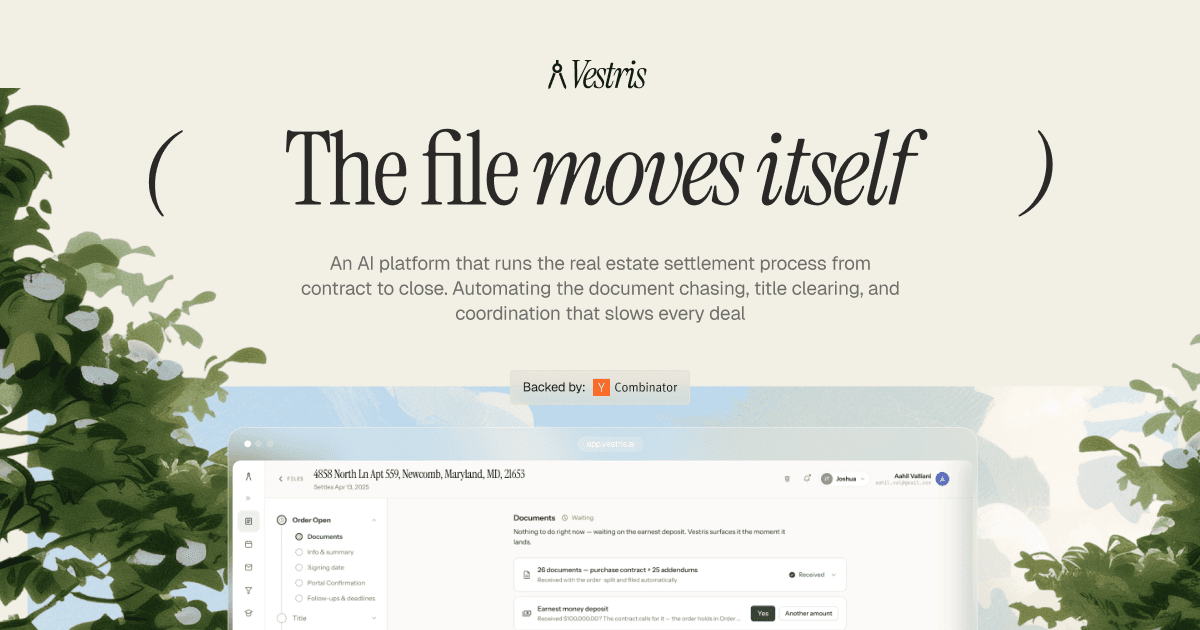
Real estate closings are a paper chase. Title agencies spend hours tracking down documents, comparing PDFs, and coordinating with lenders, realtors, and buyers. Vestris, a YC S26 startup, wants to automate that entire process with AI. The pitch is bold: an "AI-native title processing service" that runs from contract to close, handling document routing, title searches, and even drafting closing documents. But in an industry where a single missed lien can derail a deal, can AI earn trust? Vestris's answer is a careful balance of automation and human oversight.
The unglamorous bottleneck: why title processing is ripe for AI
Title processing is the back office of real estate—essential but invisible. Every deal requires a title search, a review of public records, and a mountain of paperwork. The work is repetitive, error-prone, and time-consuming. Vestris's website claims that title companies using its platform "double their capacity without hiring extra staff," saving "~7 hours per file." That's a significant claim, but it speaks to the inefficiency Vestris aims to fix.
What makes title processing particularly ripe for AI is its document-heavy nature. Contracts, lender changes, HOA documents, and county records are all text-based. AI can read, classify, and extract data from these documents far faster than a human. Vestris's core insight is that the "grunt work"—the chasing, the reentry, the side-by-side comparisons—can be automated, freeing humans for the judgment calls that matter.
The document chase: how Vestris turns chaos into order
Vestris's platform starts with document intake. "Vestris reads every inbound document and routes it," the site explains. Contracts open a new order; everything else routes to the matching order. This is the first step in taming the chaos of a title file, where documents arrive from multiple parties in no particular order.
The next step is automation of the "next step." Vestris highlights that "the next step kicks off the second the last ends," eliminating the lag between tasks. It also compares PDFs automatically, flagging lender changes without manual side-by-side review. Finally, it drafts disclosures and lender notifications, handling the back-and-forth that typically consumes hours.
This is not just about speed; it's about removing the most tedious parts of the job. The website's language—"No more comparing PDFs side by side," "No more repeating yourself"—speaks directly to the pain points of title processors. It's a workflow automation tool, but one that's deeply vertical.
The 30-minute title search: a bold claim with caveats
One of Vestris's most striking claims is that it can complete title searches in under 30 minutes. "We scan land records like a human would—faster," the site says, producing "full property histories normalized" and "title-commitment-ready abstracts." This is a bold promise in an industry where title searches can take days.
But the claim comes with caveats. The website doesn't specify which jurisdictions or counties it supports, nor does it disclose the accuracy rate of its AI. Title search is a complex task that involves interpreting deeds, liens, easements, and other legal documents. An AI that works in one county may fail in another with different record-keeping practices. Vestris's pricing page mentions "custom pricing based on your order volume and the jurisdictions you close in," suggesting that jurisdiction coverage is a factor. Still, the 30-minute claim is a powerful differentiator if it holds up.
Human checkpoints: the safety net that makes automation palatable
Vestris is careful to position itself as a "co-pilot," not a replacement. "Every automated decision includes a human checkpoint," the site states. "Before any abstract is sent to a lender or a commitment is finalized, you review and sign off. Zero autonomous risks." This is a smart strategy for a risk-averse industry. Title agencies are liable for errors, so they won't trust AI to act autonomously. By keeping humans in the loop, Vestris reduces the perceived risk and makes adoption easier.
The human checkpoint also addresses the emotional side of the job. Title processors take pride in their work; they don't want to be replaced. Vestris's messaging—"Vestris doesn't cut headcount - it gives every processor room to take on more"—is designed to reassure. The goal is to make workers more productive, not obsolete.
The name 'Vestris': a quiet nod to the past, a promise for the future
The name "Vestris" is an interesting choice. It's not descriptive like "TitleAI" or "Close.io." Instead, it evokes the Latin "vestris," meaning "yours," or possibly a reference to the Vestal Virgins, who were guardians of sacred things. In a real estate context, it suggests trust and stewardship—fitting for a company that handles the most important transaction in most people's lives.
The domain, vestris.ai, is clean and memorable, though the .ai extension signals a tech-forward approach that might feel at odds with the traditional title industry. The brand is "warm, dependable software," as the site puts it, and the name supports that. It's not flashy, but it's trustworthy—exactly what a title agency wants in a partner.
What's missing: pricing, integrations, and the trust hurdle
Vestris's website is light on specifics. Pricing is "custom" and requires contacting the company. Integrations are listed as a navigation item but not detailed on the main pages. There's no mention of which title software systems it works with, nor any case studies or customer testimonials. For a company in a trust-driven industry, this is a gap.
The biggest hurdle for Vestris is trust. Title agencies are conservative, and they'll want proof that AI can handle the nuances of their local jurisdictions. Vestris's demo sandbox and "try with a sample contract" feature are good first steps, but real adoption will require pilot programs and success stories.
Still, the opportunity is real. Title processing is a multi-billion-dollar industry that has seen little innovation. If Vestris can deliver on its promises—even partially—it could become a valuable tool for title agencies looking to close more deals without adding headcount. The question is whether it can overcome the industry's skepticism and prove that AI can be a reliable co-pilot in the high-stakes world of real estate.