Wealtii
One fund, three asset classes: tokenized gold, tech stocks, and digital assets—verifiable on-chain.
NewName Editorial
Editorial Team
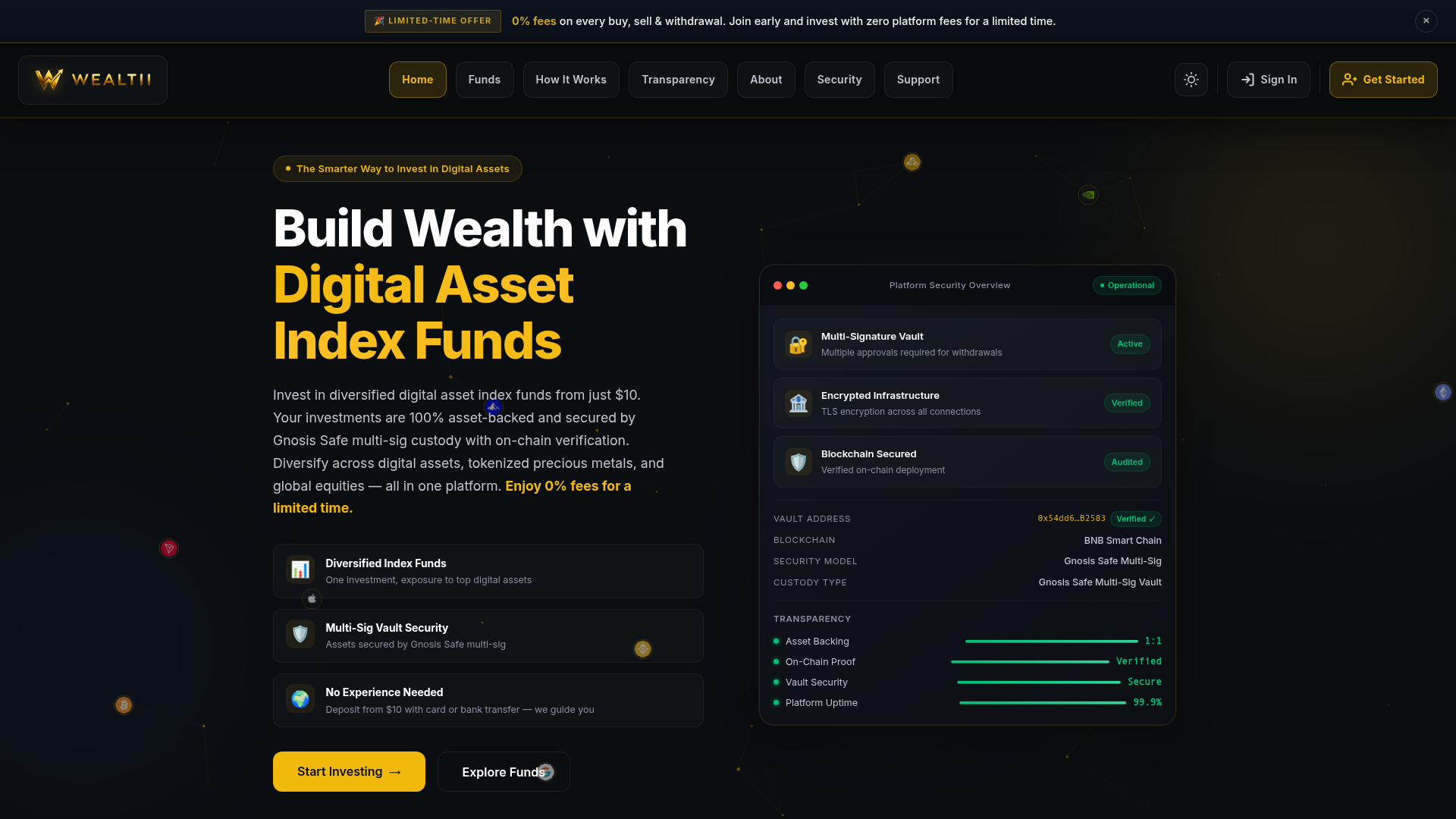

Wealtii's pitch is disarmingly simple: what if you could buy one fund that holds NVIDIA, Bitcoin, and tokenized gold—all in a single tokenized basket? The website's tagline frames it as a thought experiment, but the product itself is a concrete attempt to bridge the cognitive gap between traditional equities and crypto. Instead of forcing investors to juggle a brokerage account and a crypto exchange, Wealtii offers three index funds that blend these asset classes, wrapped in a promise of on-chain verifiability. It's an ambitious thesis, and the platform's design suggests it's aiming for the middle ground—investors who want crypto exposure without abandoning the comfort of familiar tech stocks.
The core idea is not entirely new—tokenized funds exist, and crypto index products have been around for years—but Wealtii's specific combination is unusual. The flagship fund, the Tech & Digital Asset Growth Fund, holds NVIDIA, Alphabet, Apple, and the Invesco QQQ Trust alongside TRON, Bitcoin, and Tether Gold. That's a portfolio that could plausibly be pitched by a traditional financial advisor, yet it's executed entirely on-chain. The Multi-Asset Balanced Allocation Fund goes further, mixing the S&P 500 ETF, iShares Silver Trust, and Tether Gold with TRON, Bitcoin, XRP, and Binance Coin. The Digital Asset Core Index Fund, meanwhile, stays closer to pure crypto, led by Bitcoin and Ethereum. This trio suggests Wealtii is testing whether investors want a spectrum of hybrid exposure, from growth-heavy to balanced to crypto-core.
The one-fund thesis: mixing NVDA, Bitcoin, and tokenized gold
The unifying thesis across all three funds is that asset classes are not mutually exclusive. Wealtii's tagline—"What if one fund held tokenized Gold, tech stocks and digital assets?"—is a rhetorical question that the product answers with a yes. The Tech & Digital Asset Growth Fund is the clearest expression of this: it pairs the stability of large-cap tech with the volatility of crypto, and uses Tether Gold as a counterweight. The fund's top holdings show NVIDIA at 17.60% and Google at 16.30%, with TRON and QQQ close behind. This is not a typical crypto fund; it's a hybrid that could appeal to someone who believes in tech but wants a slice of digital assets without going all-in.
Wealtii's positioning is deliberately accessible. The website emphasizes "no experience needed," and the onboarding flow accepts fiat via card or bank transfer, converting to USDT internally. This removes the friction of setting up a crypto wallet and navigating exchanges, which is a significant barrier for mainstream investors. The platform also highlights that it's "fiat friendly," with step-by-step guidance on deposits and withdrawals. This is a clear attempt to court the traditional investor who is curious about crypto but intimidated by the technical overhead.
Three funds, three risk profiles, one vault
Wealtii offers three distinct funds, each with a different risk profile. The Tech & Digital Asset Growth Fund is the most aggressive, with a heavy tilt toward tech equities and digital assets. The Digital Asset Core Index Fund is pure crypto, concentrated in Bitcoin and Ethereum, with smaller positions in BNB, NEAR, Chainlink, and Zcash. The Multi-Asset Balanced Allocation Fund is the most conservative, aiming for equal weight across equities, precious metals, and digital assets. This range allows investors to choose their comfort level, from crypto-curious to crypto-native.
Each fund has a stated current price and historical performance figures. The Tech & Digital Asset Growth Fund shows a 3-year return of +206.53%, while the Digital Asset Core Index Fund shows +204.12% over the same period. The Multi-Asset Balanced Allocation Fund trails at +165.84%. These numbers are eye-catching, but the website includes a risk disclaimer noting that past performance is not indicative of future results. It's worth noting that these returns are unaudited and based on the platform's own calculations, so investors should approach them with caution.
What '1:1 asset-backed' actually means on BNB Smart Chain
Wealtii's transparency claims are central to its value proposition. The platform states that every fund is "1:1 asset-backed," meaning that when you invest, your money is used to purchase the actual underlying assets. This is verifiable on-chain: the website provides a public vault address on BNB Smart Chain, where users can see the holdings. The vault is secured by Gnosis Safe multi-sig, requiring multiple approvals for withdrawals. This is a meaningful step beyond many crypto platforms that operate as fractional reserve or use synthetic derivatives.
However, "1:1 asset-backed" has nuances. The assets themselves are tokenized versions of real-world assets, such as Tether Gold (XAUT) and tokenized equities. The website does not clarify who issues these tokens or how they are redeemed. Tether Gold is a known product, but the tokenized stocks (e.g., NVIDIA, Alphabet) are not described in detail. The platform's legal disclaimer states that it is not a registered broker-dealer or investment adviser, which raises questions about the regulatory status of these tokenized securities. Investors should be aware that the on-chain verification proves the vault holds tokens, but it does not guarantee the legal enforceability of the underlying claims.
The no-KYC onboarding that lowers the barrier—and raises questions
One of Wealtii's most distinctive features is its "no KYC to start" policy. Users can create an account and invest without submitting identity documents, with verification optional to unlock higher limits. This is a double-edged sword. On one hand, it removes a major friction point for privacy-conscious investors and those in jurisdictions with strict crypto regulations. On the other hand, it raises compliance concerns. The platform's legal page notes that it is not a money services business and does not provide financial advice, but it does not specify how it handles anti-money laundering (AML) requirements in the absence of KYC. This could be a red flag for institutional investors or regulators.
The website's FAQ attempts to address this by stating that KYC is optional and "simply unlocks higher transaction limits." This suggests that Wealtii is operating in a gray area, relying on the fact that it is not a regulated entity. For early adopters, this might be acceptable, but it could limit the platform's ability to scale or partner with traditional financial institutions.
Why the name 'Wealtii' signals accessibility, not institutionality
The name "Wealtii" is a deliberate misspelling of "wealthy," with a double 'i' that gives it a techy, modern feel. It's short, memorable, and easy to type, which is important for a platform targeting mainstream users. The name suggests wealth-building, but the informal spelling signals accessibility rather than institutional gravitas. This is consistent with the platform's branding, which uses bright colors, emoji-like icons, and a friendly tone. The domain wealtii.com is clean and brandable, though it lacks the descriptive clarity of something like "cryptoindexfunds.com." The name is more about the promise of wealth than the mechanics of the product.
This naming choice has implications for positioning. Wealtii is not trying to be a Wall Street heavyweight; it's aiming for the retail investor who wants a simple, friendly way to diversify into digital assets. The name aligns with that, but it also carries a risk: it might be perceived as unserious by more sophisticated investors. The platform's reliance on on-chain transparency and multi-sig security is a counterweight, but the name and branding could undermine trust in a category where skepticism is high.