WishNest
Turn 'what do you want?' into a shareable, AI-curated wishlist in under a minute.
NewName Editorial
Editorial Team
Gift-giving runs on a script that everyone performs but no one enjoys. The giver asks, "What do you want?" The receiver deflects with "Oh, you don't have to." Both sides lose: the giver buys a guess, and the receiver smiles at a gift they'll regift. WishNest, a free wishlist and gift registry, exists to delete that script. It gives people a single, shareable place to say what they actually want—and it does so with a name that quietly promises safety and curation.
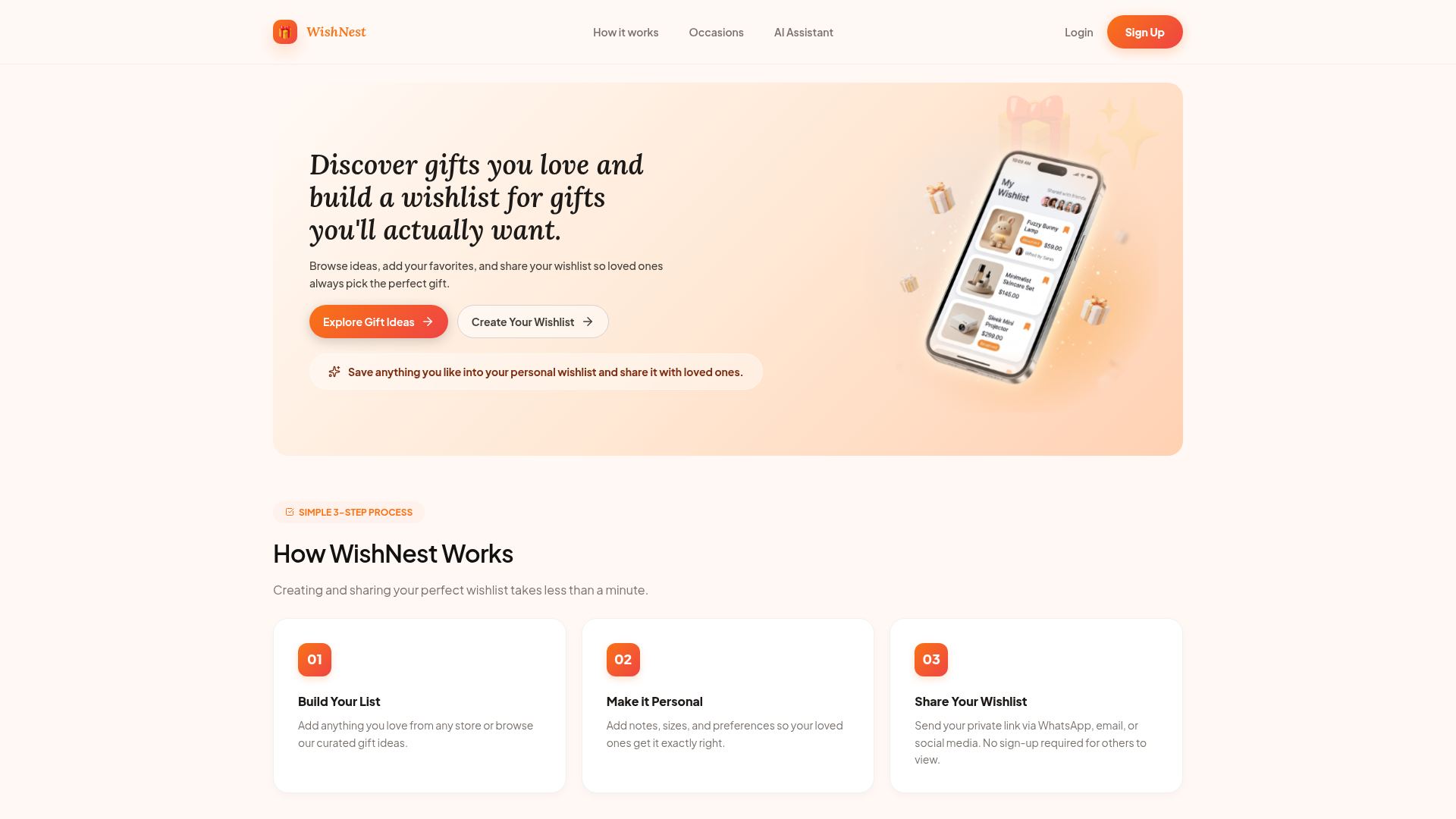
Public materials describe WishNest as an "AI-powered wishlist manager for smarter gifting." The pitch is simple: save items from any website into one list, add notes and sizes, and share a private link via WhatsApp, email, or social media. No sign-up is required for viewers, which removes the biggest barrier to adoption. The site claims the whole process takes less than a minute. That speed is the product's core bet—gifting friction is not about the shopping, but about the asking.
The awkward question WishNest automates
The problem WishNest targets is not new. Wishlists have existed on Amazon for decades, and wedding registries have been a retail staple for a century. But those tools are either locked inside a single retailer or buried in a specific life event. WishNest's wager is that the modern problem is fragmentation: a person's wants are scattered across Instagram shops, niche e-commerce sites, and physical stores. A registry that only works on one platform cannot capture a life that lives on many.
The site's About page frames this as a kindness problem: "Too many gifts come from guesswork." WishNest positions itself as the antidote to that guesswork, a way to make gifting "clearer, kinder, and less awkward." That framing is smart—it avoids the greedy undertone of a wishlist and reframes it as a helpful tool for the giver. The brand wants to be the polite way to say, "Here's what I'd love, no pressure."
A three-step flow that respects the giver's patience
The entire product is built around a three-step flow: Build Your List, Make It Personal, Share Your Wishlist. The first step lets users add items from any store or browse WishNest's curated gift ideas. The second step adds notes, sizes, and preferences—the details that turn a generic item into a thoughtful gift. The third step generates a private link that can be sent anywhere, with no sign-up required for the recipient.
That last detail is the most important. Most wishlist tools force the giver to create an account, which adds friction at the exact moment they are trying to do something nice. WishNest removes that requirement, betting that a frictionless view is worth more than a captured user. It is a consumer-product decision that prioritizes the recipient's experience over the platform's growth metrics—a rare tradeoff in a world of login walls.
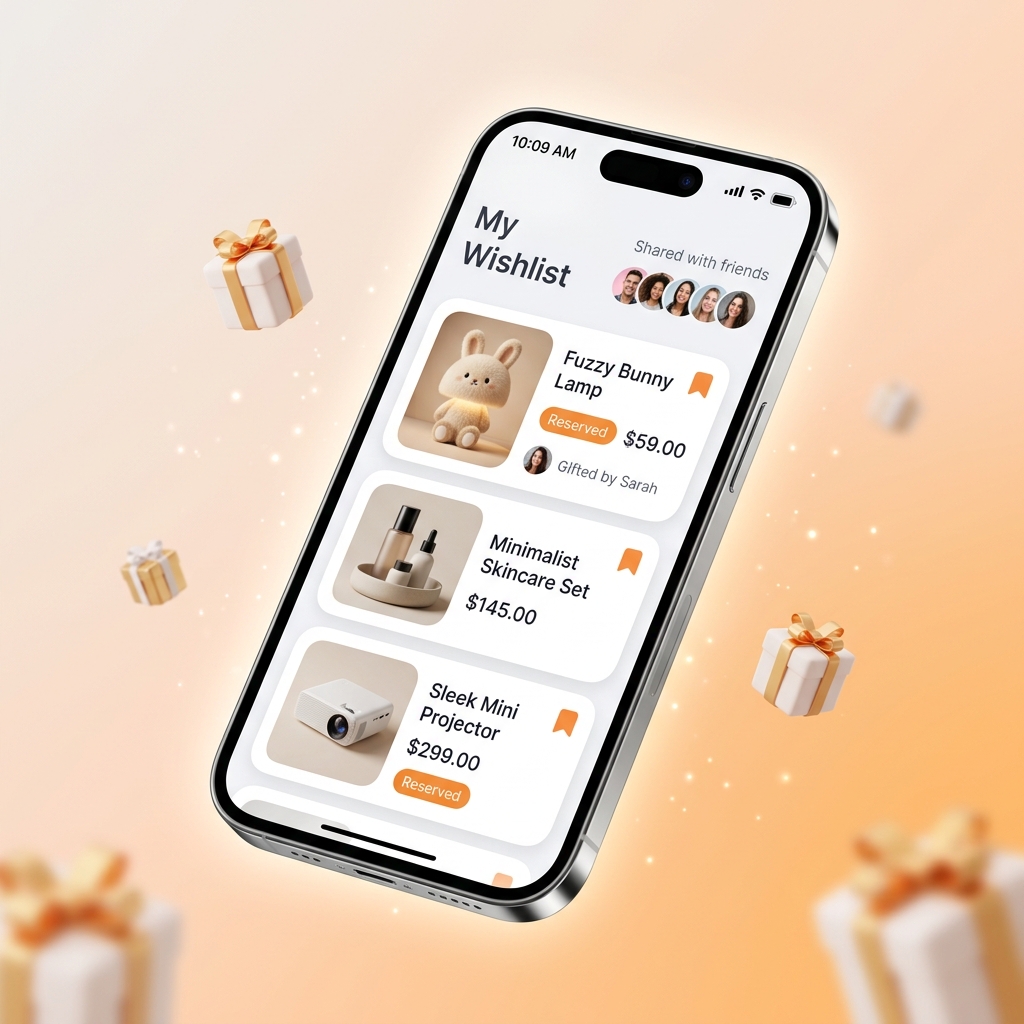
The flow also solves the duplicate-gift problem. The footer promises, "Never receive duplicate gifts again," a claim that is plausible because the list is live. When a giver marks an item as purchased, the list updates. That real-time coordination is the practical value that a static Pinterest board cannot offer.
Occasion pages: the quiet category bet
WishNest does not just let users build lists; it curates them by occasion. The site features dedicated pages for Birthday, Wedding, and Moving In, each with a set of pre-built suggestions. The Birthday page, for example, offers "A soft mix of books, skincare, and little luxuries people can feel good about gifting." The Wedding page promises "a shared list for building a home together, without endless 'what do you need?' messages."
These pages serve two functions. First, they are a discovery surface for users who do not know what to wish for. Second, they are a search engine play—someone searching for "wedding gift ideas" might land on WishNest's occasion page and then create a list. The strategy is to capture demand at the moment of intent, before the user even knows WishNest exists.
The occasion pages also hint at a community layer. The site shows "popular wishlists" from users like "Sarah J." and "Kunal & Meera," complete with items like a Kindle Paperwhite and a linen set. This is a soft social proof mechanism—seeing what others wish for normalizes the act of asking. It is a clever way to reduce the perceived selfishness of a wishlist.
The AI assistant is the differentiator—and the risk
The tagline promises "AI-powered" gifting, and the site delivers on that with a dedicated AI Assistant. The pitch: "Tell us the person and occasion—we'll suggest gifts they'll actually love." The AI narrows the list into thoughtful ideas, turning a blank page into a starting point.
This is the feature that separates WishNest from a simple bookmarking tool. Without it, WishNest is a link collector; with it, the product becomes a recommendation engine. The AI is the reason a user might choose WishNest over a Pinterest board or a shared Google Doc.
But the AI is also the risk. Gift recommendations are deeply personal, and a wrong suggestion can feel worse than no suggestion at all. The site does not disclose how the AI is trained or what data it uses, so the quality of its suggestions is unproven. Public materials are thin on specifics—no examples of AI output, no mention of model accuracy. The feature is a promise, not a proof.
The risk is that the AI becomes a gimmick—a button that users click once and then abandon. For WishNest to succeed, the AI must deliver recommendations that feel genuinely thoughtful, not just algorithmically plausible. That is a high bar, and the site's current evidence does not clear it.
Why 'nest' is the right metaphor for gifting
The name WishNest is a deliberate blend of "wish" and "nest." A nest is where you collect and protect what matters—eggs, hatchlings, or, in this case, the items you hope to receive. It is a warm, domestic metaphor that fits the product's use cases: weddings, birthdays, moving in. The name avoids the clinical tone of "registry" or the transactional feel of "wishlist." It suggests a curated, cared-for collection.
The domain, wishnest.co.in, is a minor stumble. The .co.in extension signals India, which may be intentional—the site's sample users (Kunal & Meera, Naina R.) suggest an Indian audience. But for a product with global ambitions, a .com would be stronger. The name itself is memorable and brandable, but the domain may limit its reach.
The visual identity reinforces the metaphor. The hero image shows a phone mockup, but the copy is full of warm, domestic words: "home," "little luxuries," "soft mix." The brand voice is gentle and reassuring, which is exactly the right tone for a product that asks people to be vulnerable about what they want.
Who should care (and who should wait)
WishNest is a free tool, so the cost of trying it is low. Anyone who has ever dreaded the "what do you want?" question should consider building a list. The product is particularly useful for life events with many givers—weddings, baby showers, housewarmings—where coordination is hard and duplicates are common.
The AI assistant is the feature to watch. If it delivers on its promise, WishNest could become the default way to ask for gifts. If it fails, the product is still a competent wishlist manager, but one that competes with free alternatives like Pinterest or a shared note.
The site does not disclose funding, team size, or user numbers, so it is impossible to gauge traction. Public materials suggest a small, early-stage operation. That means users should expect rough edges and occasional bugs. But for a free tool, the core value is already there: a simple, shareable list that saves everyone from the guesswork.
WishNest is not a revolutionary idea—wishlists are old. But it is a thoughtful execution of an old idea, wrapped in a brand that understands the emotional stakes of gifting. Whether it builds a nest big enough to matter depends on whether the AI can turn a list of links into a moment of genuine delight.