Wondering
Personalized micro-lessons that turn any curiosity into a structured learning path.
NewName Editorial
Editorial Team


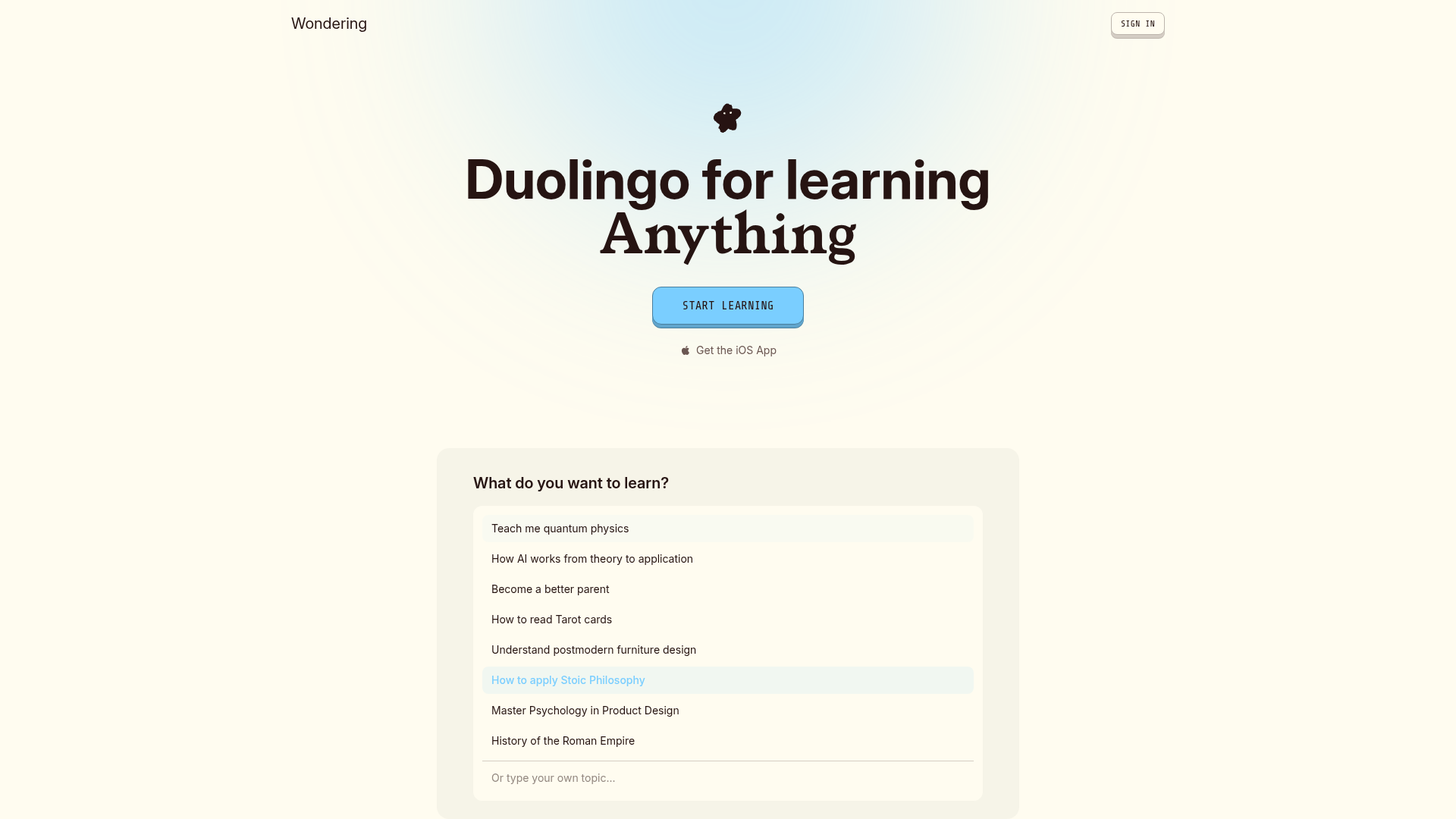
Wondering wants to be the Duolingo for anything. Type in a topic—"Teach me quantum physics," "How to apply Stoic Philosophy," "Understand postmodern furniture design"—and the app promises to break it down into a personalized path of short interactive lessons. The tagline is bold, the ambition is broad, and the execution is surprisingly specific. But the more interesting story is not the AI-generated content; it's the layer of personalization that sits on top, turning a vague curiosity into a structured, time-boxed learning plan.
The Duolingo comparison is both the promise and the trap
Duolingo succeeded by doing one thing exceptionally well: making language learning addictive through gamification, streaks, and bite-sized exercises. Wondering borrows the format—short lessons, interactive quizzes, progress tracking—but applies it to an unbounded set of topics. That's the promise: the same dopamine-driven loop, but for anything you've ever wanted to learn. The trap is that Duolingo's content is standardized and quality-controlled; Wondering's is generated on the fly by AI, which raises questions about accuracy and depth. The site doesn't disclose how lessons are vetted or who reviews them, so the user has to trust the algorithm. For a casual learner, that's fine. For someone wanting to "go deep," it's a risk.
How Wondering turns 'teach me quantum physics' into a 3-week path
The core mechanic is straightforward: you type a topic, and Wondering generates a structured course. The example on the site shows "How to Apply Stoic Philosophy" broken into a guided path with steps like "Identify what is within your power," "Reframe obstacles as opportunities for growth," and "Practice gratitude through negative visualization." Each step is a lesson, and each lesson is designed to be completed in about three minutes. The path is not a random list of videos or articles; it's a sequence with a logical progression, and the app tracks your progress. The site also shows a timeline: "~3 weeks at your pace," suggesting the system estimates how long it will take based on your chosen intensity (casual, regular, intensive). This is a clever way to set expectations and keep users engaged—it's not just "learn Stoicism," it's "finish this path in three weeks."
The personalization prompts are the real product
The most distinctive feature on the site is the personalization panel. Before generating your path, Wondering asks: "Tell Wondering how you learn best." The examples are remarkably specific: "Explain using Batman as an example," "I prefer learning through analogies," "Always add a TLDR before every lesson," "Relate to my high-stress job as a surgeon," "Connect this to my interest in Cognitive Behavioral Therapy (CBT)," "Explain so me and my five year old both understand," "Focus on practical exercises for social anxiety." These are not generic preferences; they're rich, contextual cues that an AI can use to tailor not just the content but the tone, examples, and framing of each lesson. This is where Wondering differentiates itself from a simple search-and-summarize tool. It's not just about what you learn, but how you learn it. The system also asks about your goal (understand basics, go deep, apply practically) and your time commitment (5, 15, or 30+ minutes per day). The combination of these inputs shapes the path's depth, length, and focus areas. This is a genuinely thoughtful approach to personalization, and it's the reason the app might actually work as a learning tool rather than just a novelty.
What the lesson format reveals about the learning model
The lesson examples on the site show a mix of formats: multiple-choice questions, click-and-fill exercises, order-steps activities, and visual diagrams. The Stoic Philosophy lesson includes a comparison table (Stoicism vs. Epicureanism) and a detailed breakdown of the Three Stoic Disciplines with columns for "Discipline," "Focus Area," and "Goal." This is not just a text dump; it's structured content designed for active recall and comprehension. The inclusion of visuals and diagrams suggests the AI can generate or select appropriate images to support the lesson. The interactive exercises are the core of the Duolingo-style experience—they force the user to engage with the material, not just read it. The site also mentions "Refine with feedback" and "Master and retain" as steps in the path, implying a spaced-repetition or review mechanism, though the details are not specified. Overall, the lesson format is well-suited for quick, focused learning sessions, but it remains to be seen how well it scales to complex, nuanced subjects like quantum physics or postmodern furniture design.
The missing pieces: no web app, no community, no verification
As of now, Wondering is available only as an iOS app, according to the site. There's no web version, which limits its accessibility. There's also no mention of a community or social features, which could be a missed opportunity for motivation and accountability—Duolingo's leagues and friend challenges are a big part of its stickiness. More importantly, the site does not disclose any information about content review, expert oversight, or accuracy guarantees. For a product that claims to teach "anything," this is a significant gap. Users are essentially trusting an AI to be correct, and while that's fine for casual learning, it's a risk for topics where misinformation can have real consequences (e.g., medical or financial topics). The site also doesn't mention pricing—it's free to start, but there's no indication of a premium tier or subscription. These omissions don't necessarily doom the product, but they are worth noting for anyone considering relying on it for serious learning.
Wondering is an ambitious experiment in AI-powered education. Its personalization layer is genuinely thoughtful, and its lesson format is engaging. But the Duolingo comparison cuts both ways: it sets a high bar for retention and quality, and it's unclear if Wondering can meet it across every topic. For now, it's a promising tool for curious minds who want a structured way to explore new subjects in short bursts—just don't expect it to replace a university course or a deep-dive book. The real test will be whether users come back day after day, and whether the AI-generated content holds up under scrutiny.