Impact-Site-Verification: 41b53a0c-6d04-458b-a457-fe9e29acde1a

Developer Tools·Seed··6 min read

Agency Tool Company

Robotics infrastructure that treats robots as pets, not cattle: OTA updates and target-hardware CI.

NN

NewName Editorial

Editorial Team

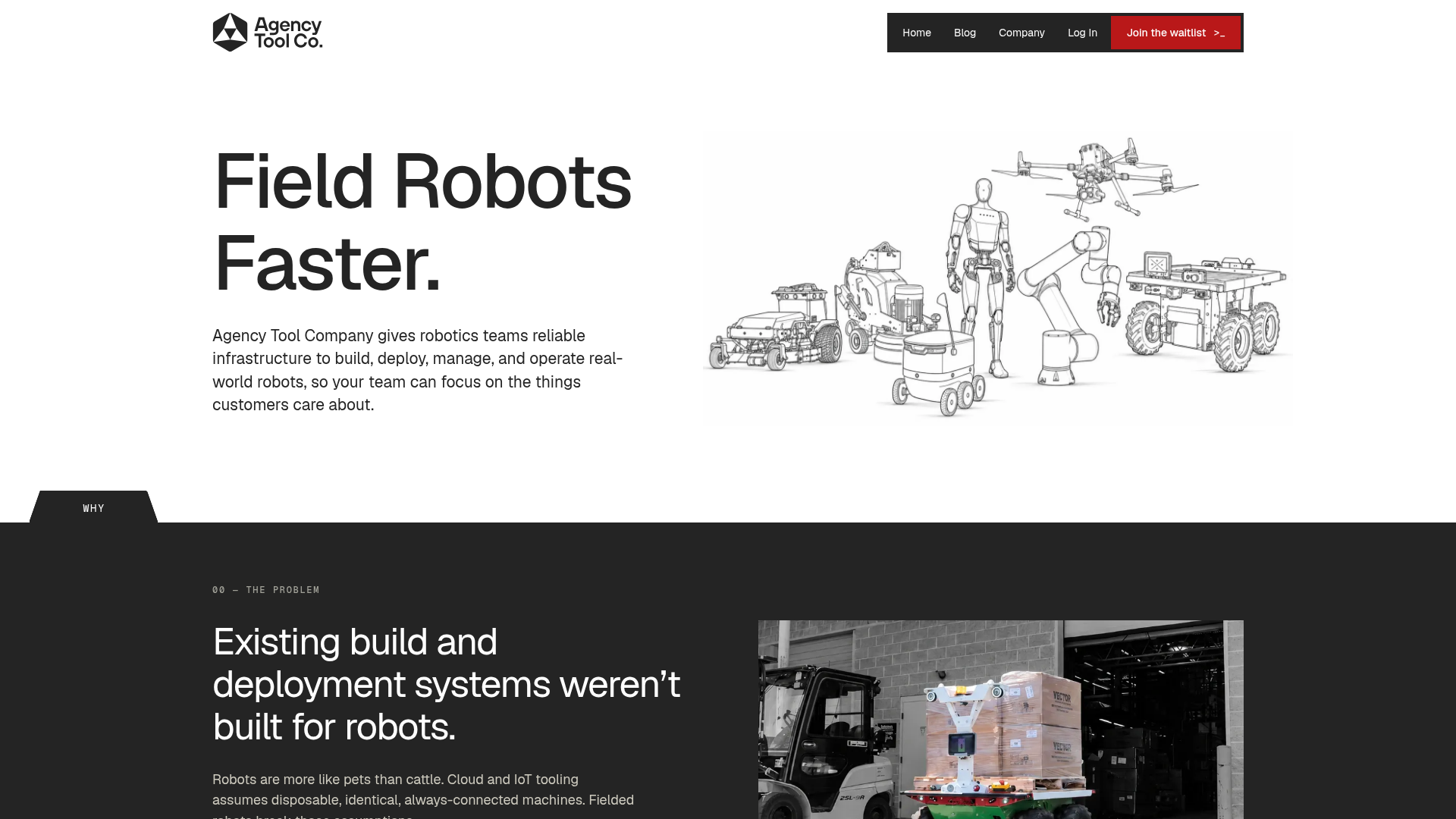
Agency Tool Company product image 1
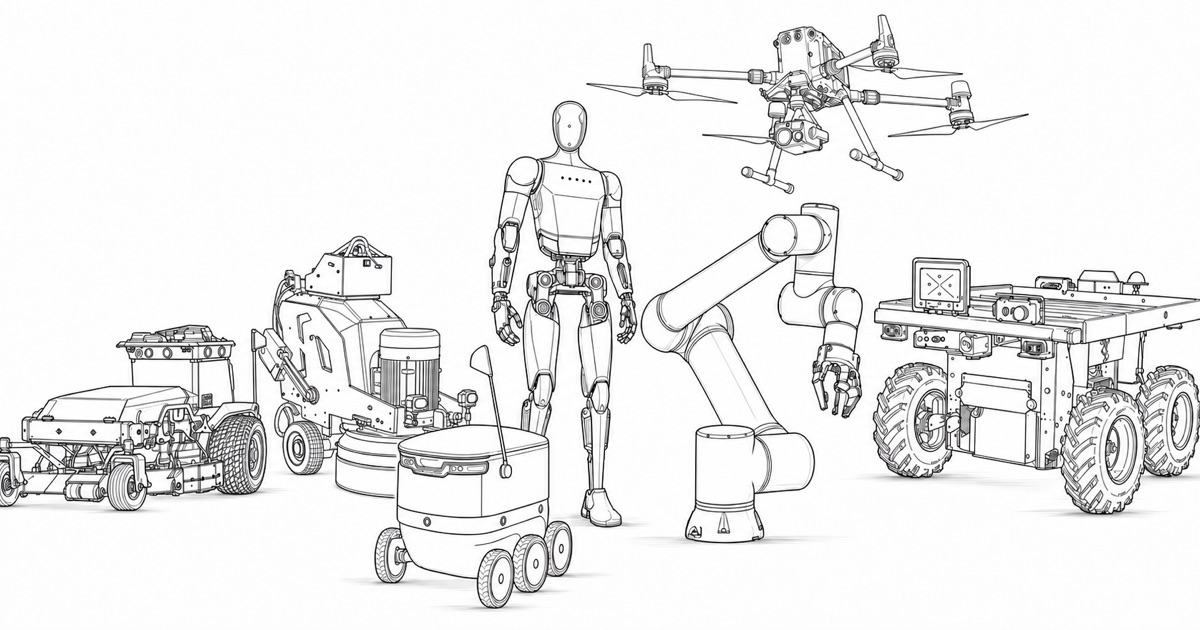
Agency Tool Company product image 2

Agency Tool Company is not trying to be the next great cloud platform. It is trying to be the thing that keeps a robot in a field from becoming a brick when a software update fails halfway through a download. The company's pitch, "Field Robots Faster," is a promise that the infrastructure for shipping code to machines that move, break, and lose connectivity can be as reliable as the infrastructure for shipping code to servers that sit quietly in a data center.

The core insight, stated on the homepage, is that "robots are more like pets than cattle." Cloud and IoT tooling assumes disposable, identical, always-connected machines. A fielded robot is none of those things. It has a name, a serial number, a specific calibration, and a habit of parking in a cellular dead zone. This is the problem Agency Tool Company is built around, and it shapes everything from the product architecture to the company's deliberately generic name.

Why robots are not cattle

The "pets vs. cattle" metaphor is common in DevOps, but Agency Tool Company gives it a literal twist. A server that crashes can be replaced by an identical clone; a robot that fails in the field is a physical asset that must be repaired, recovered, or visited by a technician. The deployment tooling that works for a fleet of cloud instances—immutable images, full pulls, assume a stable network—breaks down when the target is a mower in a field with intermittent LTE.

The website's problem statement is blunt: "Existing build and deployment systems weren't built for robots." The friction is not just technical; it makes operations and customer teams "wary of shipping updates." This is a cultural problem as much as an engineering one. When updates are risky, teams avoid them, and robots run outdated software with known bugs. Agency Tool Company's answer is to make updates so fast and reliable that shipping becomes routine.

ATC Deploy: OTA updates that survive bad networks

ATC Deploy is the company's first product, currently in beta with Burro, Tempo Works, and Gather AI. It is an over-the-air update system that handles application bundles, container images, configuration, and models. The headline claim is a 95% reduction in transfer time compared to a docker pull, enabled by byte-level delta updates and compression. For a 10GB image, that is the difference between a lunch break and a coffee break.

The product is designed for the reality of fielded robots. Downloads are resumable, so a robot that loses connectivity can pick up where it left off. Custom hooks let teams schedule updates around teleoperation or high-priority traffic. Fleets can be segmented by any attribute—hardware revision, site, role—so a heterogeneous fleet can stay on known, intended versions. The web console provides per-robot deployment history, fleet convergence, and health signals, making it possible to answer the question: "What version ran on vehicle 12 when the incident occurred?"

The CLI is built for engineers and agents, with structured output for automation. The web UI is for operations teams who need to approve and monitor rollouts. This dual interface acknowledges that the people who deploy software are not always the people who write it.

ATC Build: CI on the hardware you actually ship

Coming soon, ATC Build is a CI runner backed by hosted NVIDIA Jetson hardware. The pitch is simple: "CI on the hardware you actually ship." Instead of running tests on an x86 cloud instance that approximates your target, you run them on the same Orin Nano, NX, AGX, or Thor silicon that your robots use in production.

The benefit is fidelity. Emulation cannot replicate the behavior of CUDA, NVENC, DLA, or other accelerators. A test that passes on a cloud CPU may fail on a Jetson due to timing, driver behavior, or memory constraints. ATC Build aims to catch these issues before code reaches a robot, reducing the "worked on my machine" surprises that plague robotics development.

The product integrates as a runner for GitHub Actions or GitLab CI, so teams keep their workflows and simply swap the underlying machine. It can run standalone or alongside ATC Deploy, which suggests a modular approach: take the pieces you need, leave the rest.

The name: 'Agency Tool Company' and the art of the generic

The name "Agency Tool Company" is a fascinating choice. It sounds like a 19th-century manufacturer of industrial equipment, not a modern software startup. The website's logo, a graphite or warm white wordmark, reinforces this old-school feel. The company leans into the aesthetic, calling its blog "Field Notes" and using the tagline "Reliable infrastructure to build, deploy and manage real-world robots."

This is a deliberate positioning. By choosing a name that evokes hand tools and workshops, the company signals that it is about the messy, physical reality of robotics, not the clean abstractions of cloud computing. It is a counterpoint to the sleek, futuristic names of many robotics startups. The domain, agencytool.com, is short and memorable, though it does not immediately convey "robotics" to a newcomer. The company seems to be betting that the brand will be defined by the products, not the name.

The risk is that the name is too generic. "Agency Tool Company" could be a staffing firm or a marketing agency. But the company's content and product pages quickly disambiguate, and the name has a certain confidence to it. It suggests that the company is not trying to be cool; it is trying to be useful.

Who needs this now: the waitlist signal

The website is built around a waitlist, with a Typeform link prominently placed in the navigation and repeated throughout the page. This is a classic early-stage go-to-market strategy: generate demand, control supply, and build a community of early adopters. The waitlist also serves as a feedback loop, allowing the team to prioritize features based on real customer needs.

The beta partners—Burro, Tempo Works, and Gather AI—are credible references. Burro makes agricultural robots, Tempo Works makes floor-grinding robots, and Gather AI makes warehouse drones. These are not toy projects; they are companies putting robots into production environments. Their logos on the homepage signal that ATC Deploy is already solving real problems.

Open questions: migration, pricing, and the road ahead

The website is notably thin on details about pricing, migration, and the broader roadmap. The FAQ mentions that migration from Mender or Balena is straightforward, but specific guides are "coming soon." Pricing is not disclosed, and the product is in beta, so it is unclear how the company will monetize. The funding stage is Seed, with backing from Y Combinator, Browder Capital, Pioneer Fund, and NVIDIA Inception, but no amounts are disclosed.

These gaps are not unusual for a seed-stage company, but they are worth noting. The biggest question is whether the market is large enough. The robotics industry is growing, but it is still niche compared to cloud computing. Agency Tool Company is betting that the pain of deploying software to fielded robots is acute enough that teams will pay for a purpose-built solution. The early beta partners suggest that this bet is paying off, but the company will need to expand beyond a handful of high-profile customers to build a sustainable business.

In the meantime, the company's focus on the "reality of robotics" is a refreshing counterpoint to the hype. The website is full of concrete details: the 18-layer download, the 10 Mbps link, the robot parking in a dead zone. These are the problems that keep robotics engineers up at night, and Agency Tool Company is building tools to let them sleep.