Waddle Labs
Waddle Labs: AI agents that turn natural language prompts into robot policies for physical tasks.
NewName Editorial
Editorial Team
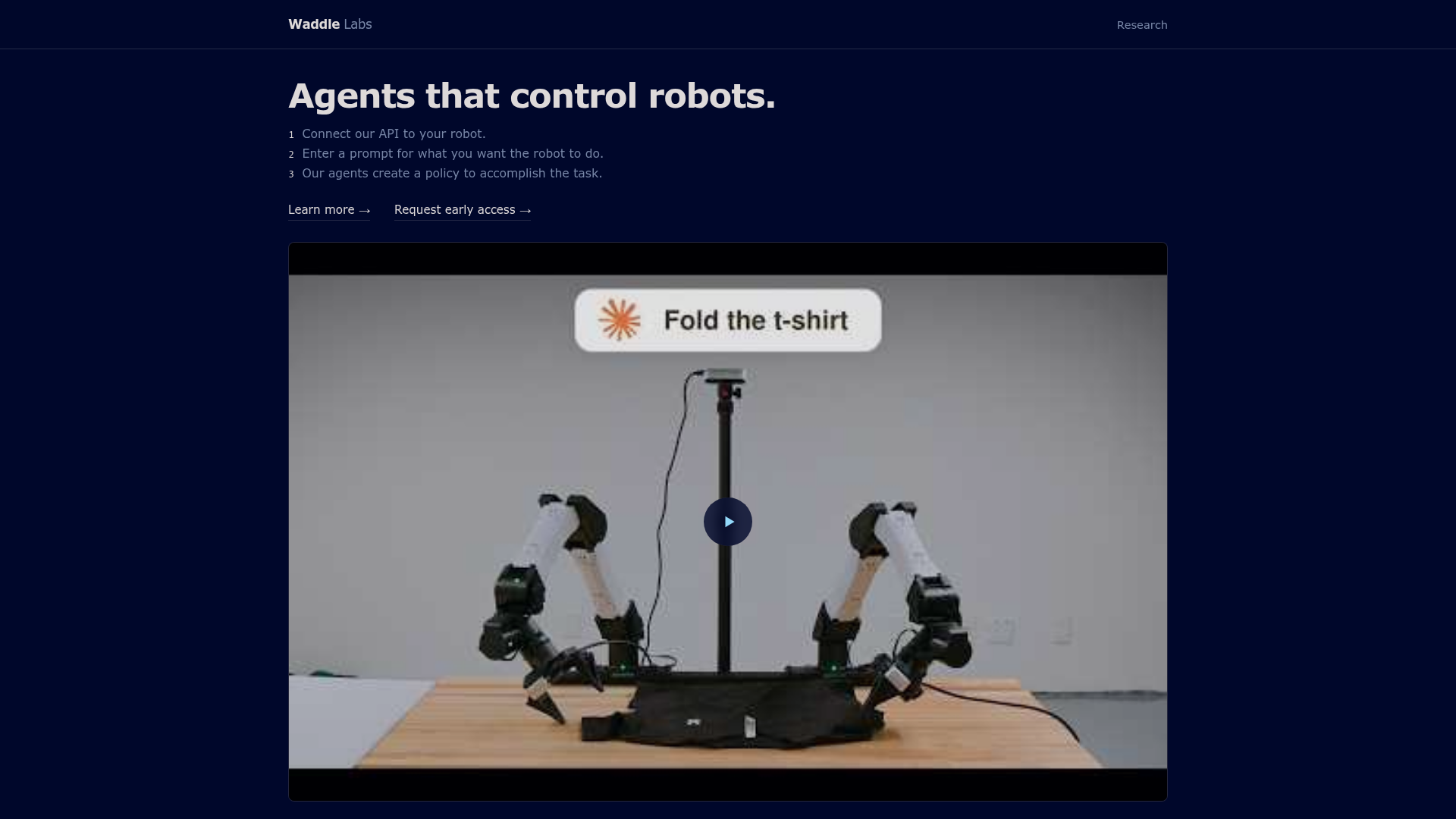
The robotics industry has long promised that anyone can control a robot with natural language. But the gap between a prompt like "pick up the red block" and the actual torque commands that move a robotic arm is vast. Waddle Labs, a seed-stage startup from Y Combinator's latest batch, is attempting to bridge this gap by treating robot control as a code-generation problem. Instead of writing low-level control code, users connect their robot to Waddle's API, enter a prompt, and the company's AI agent autonomously writes, tests, and improves a policy to accomplish the task. It's a bold bet that the same techniques that power coding assistants like Claude Code can be applied to the physical world.
The Gap Between a Prompt and a Physical Task
The core problem Waddle addresses is the chasm between human intent and robot execution. Natural language is ambiguous, and physical tasks require precise sequences of movements, force application, and error recovery. A human can say "gently place the cup on the table," but a robot needs to know the exact trajectory, the amount of force to apply, and how to adjust if the cup slips. Traditionally, this requires a robotics engineer to write code that specifies every detail, or a machine learning expert to collect thousands of demonstrations to train a neural network. Waddle's approach is to have an AI agent handle this translation automatically. The user provides a prompt, and the agent generates a policy—a set of behaviors or rules that the robot follows to achieve the task. This is a significant departure from the typical robotics workflow, which is often bespoke and time-consuming.
Why a Policy, Not a Plan, Is the Right Abstraction
In robotics, there is a distinction between a plan and a policy. A plan is a sequence of actions computed in advance, often assuming a static environment. A policy, on the other hand, is a mapping from observations to actions, allowing the robot to react to changes in real time. Waddle's choice to generate policies is crucial because it enables the robot to handle uncertainty and variability in the real world. For example, if a robot is asked to stack blocks, a policy would allow it to adjust if a block is slightly tilted or if the stack starts to wobble. This is a more robust approach than a fixed plan, which would fail in such scenarios. By framing the output as a policy, Waddle's agents are not just writing code; they are creating adaptive behavior. This is a sophisticated abstraction that aligns with the needs of real-world manipulation tasks.
The Claude Code Analogy: What It Gets Right and Wrong
Waddle's positioning as "Claude Code for robotics" is a clever analogy. Claude Code, a tool from Anthropic, allows developers to delegate coding tasks to an AI agent that can read, write, and test code. Similarly, Waddle's agent can write, test, and improve robot behavior. The analogy works because both tools abstract away the low-level details and let the user focus on intent. However, there are key differences. Code is a purely digital artifact—it can be run, tested, and debugged in a simulated environment. Robot behavior, on the other hand, must be tested on physical hardware, which is slower, more expensive, and subject to real-world physics. Waddle's research page mentions that their agent "autonomously writes, tests, and improves manipulation behavior on real hardware," which suggests they have built a loop that can iterate on physical robots. This is a significant engineering challenge, as each test run takes time and can potentially damage the robot. The analogy is useful for understanding the product, but the underlying complexity is much higher.
The Hardware Abstraction Tradeoff
One of the key decisions Waddle has made is to offer an API that connects to "your robot." This implies a certain level of hardware abstraction. The company is not building its own robot; instead, it provides a software layer that can control various robots. This is a strategic choice that allows them to focus on the AI agent rather than hardware manufacturing. However, it also introduces challenges. Different robots have different control interfaces, sensors, and capabilities. Waddle's agents must be able to adapt to these variations, which requires a robust abstraction layer. The tradeoff is between generality and performance. A highly abstracted interface may not be able to exploit the full capabilities of a specific robot, while a tightly integrated system might not work across different platforms. Waddle's approach seems to favor generality, which is typical for a developer tool. This positions them as a middleware or an operating system for robot control, rather than a robot manufacturer. For developers, this is an attractive proposition: they can use Waddle to add intelligence to their existing hardware without having to become AI experts.
What Waddle's Research Reveals About the Approach
Waddle's research page, specifically the post "Introducing Waddle: agents that control robots," provides insight into how they built the system. The title suggests a focus on the agent's ability to autonomously write, test, and improve behavior on real hardware. This is a key differentiator from other approaches that rely on pre-trained models or simulation. The fact that they are testing on real hardware indicates a commitment to practical, deployable solutions. However, the research page is sparse on technical details, and the website does not disclose the specific algorithms, model architectures, or benchmarks. This is common for early-stage startups, but it means that external observers cannot fully evaluate the robustness of the approach. The public materials suggest that Waddle is still in the early stages, with a request for early access rather than a public launch. The lack of pricing information and customer testimonials also indicates that the product is not yet widely available. This is not a criticism, but rather an observation that the company is still in the research and development phase, and the claims made in the tagline are aspirational rather than proven at scale.
Waddle Labs is entering a complex and rapidly evolving field. The idea of using AI agents to generate robot policies is not entirely new, but the specific framing as a developer tool with an API is a fresh angle. By borrowing the playbook of AI coding assistants, Waddle is making robotics more accessible to a broader audience. The success of this approach will depend on the reliability of the generated policies and the ease of integration with existing hardware. As the company moves from early access to a wider release, the robotics community will be watching to see if the promise of "prompting your robot" becomes a reality.