Assemble
Auditable AI agents for enterprise IT change, from scope to rollback.
NewName Editorial
Editorial Team
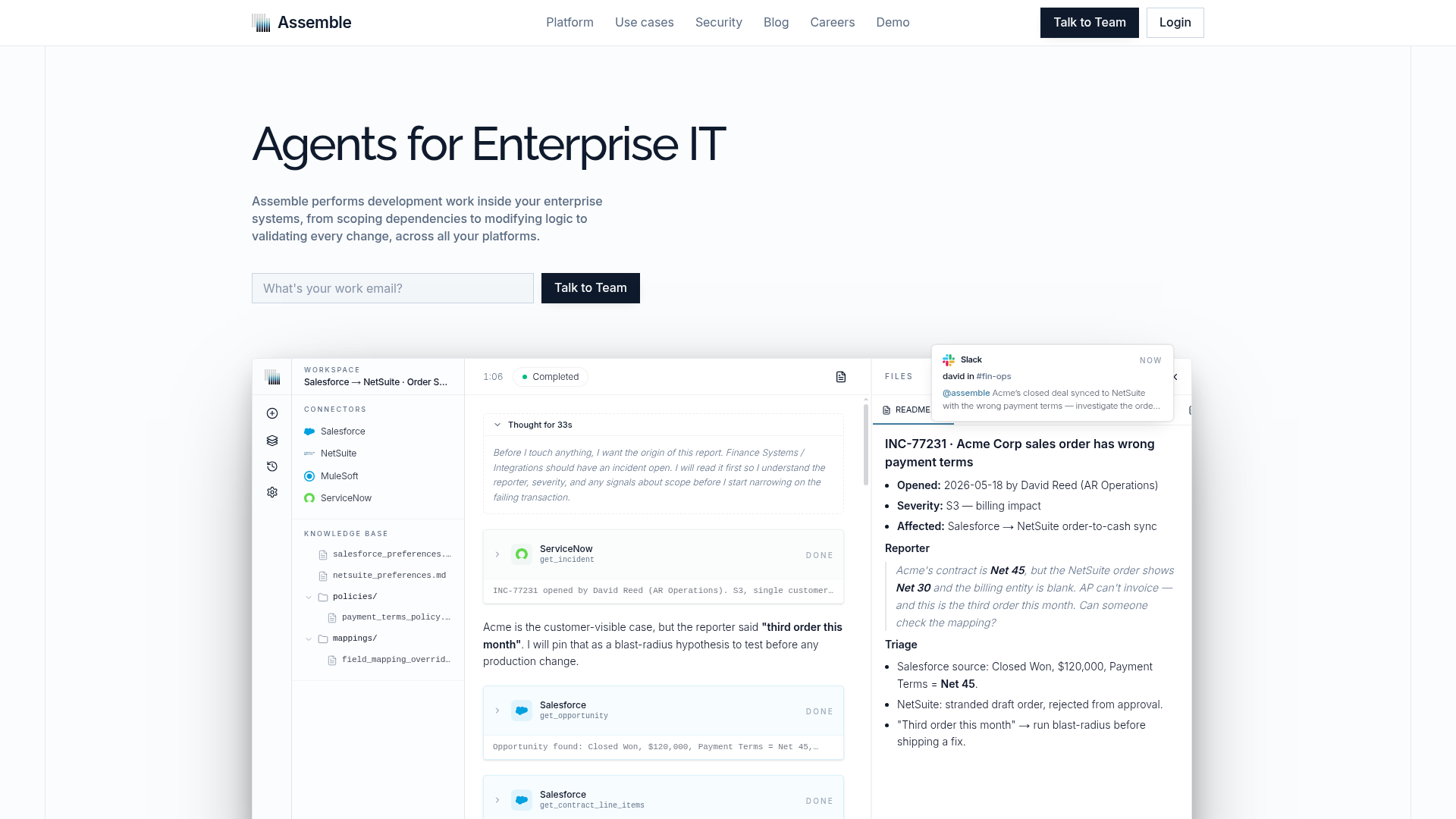

Assemble is not another AI copilot that suggests code snippets. It is a system that performs development work inside enterprise platforms—Salesforce, NetSuite, ServiceNow, MuleSoft—and then proves it did so with a trace you can replay. The company's tagline, "Agents for Enterprise IT," undersells what is actually radical: the promise of auditable, reversible change in systems where a wrong field mapping can stall an invoice for weeks.
The most striking evidence is not a feature list but a single demo trace on the homepage. An incident arrives: Acme Corp's sales order has wrong payment terms. Within 67 seconds, Assemble reads the ServiceNow incident, checks the Salesforce opportunity, finds a stranded NetSuite draft, traces the MuleSoft mapping failure to a deleted field, analyzes the blast radius (18 opportunities affected, 14 orders still wrong), fixes the mapping in sandbox, adds a regression test, replays the transaction, and drafts a CAB-ready change request. It even posts to Slack and gets four acknowledgements. This is not a chatbot. It is a workflow engine with a paper trail.
The demo that defines the product
The Acme order-to-cash repair is the product. It shows what Assemble means by "scoping dependencies, modifying logic, validating every change." The agent does not just fix the immediate bug; it asks questions a senior engineer would ask: Is this the third order this month? What is the blast radius? Is there a stranded draft that would cause a duplicate? It reads the ServiceNow incident, notes the reporter's hint, and tests that hypothesis before touching production.
The demo also reveals the product's true interface: a timeline of actions, each with a connector icon, a tool name, and a status. This is not a chat window. It is an audit log in real time. Every step—get_incident, lookup_customer_and_order, diff_integration_mapping—is visible and inspectable. The final output is not a summary but a set of 18 files, including a README, a blast-radius CSV, and a change request draft. For an enterprise IT team, this is the difference between trusting an AI and approving its work.
Scoping, running, verifying: the three verbs of Assemble
The homepage organizes the workflow into three steps: Scope, Run, Verify. These are not generic process labels; they are the core of Assemble's value proposition.
Scope means understanding how a proposed change ripples through every dependent system. The demo shows this literally: before fixing the mapping, Assemble analyzes the blast radius across 18 opportunities and 14 sales orders. It also checks for stranded drafts and reference data. This is the step that most AI tools skip, and it is why Assemble can claim to be "responsible."
Run is the execution layer. Assemble deploys and operates changes across systems from a single interface, using a "workbench" to assemble modules, customizations, or upgrades. The verb "assemble" is deliberate: the product is about putting pieces together, not generating code from scratch.
Verify is where Assemble differentiates. It generates the tests a change should pass, runs them against a shadow environment, proves parity, and keeps every change in a ledger you can revert. In the demo, the agent adds a regression test that will fail any future MR that drops the payment terms mapping. This is not just testing; it is institutional memory.
The control layer under every agent run
Assemble's security section is titled "The control layer under every agent run," and it lists three primitives: Scope the Blast Radius, System Rollbacks, and Auditable Traces. These are the features that make the product enterprise-ready.
Blast radius scoping is not just a nice-to-have; it is a risk mitigation strategy. The demo shows the agent analyzing the impact of the mapping change before making it, and even proposing an alert to monitor for null terms IDs. System rollbacks are described as "version control for your business systems as a first-class primitive." This is a strong claim: it suggests Assemble can revert any change, not just code, but configuration and data. Auditable traces are the evidence pack that accompanies every run, which is what a CAB (Change Advisory Board) needs to approve a change.
This control layer is what separates Assemble from a generic AI agent. It is not just about doing the work; it is about proving the work was done correctly and safely. For enterprises, this is the difference between a pilot project and a production deployment.
Why 'Assemble' is the right name for a cautious category
The name "Assemble" is a deliberate choice. It evokes assembling parts, building systems, and putting together a solution. It is not a flashy name like "Mirage" or "Genie"; it is a workmanlike verb that suggests methodical construction. This fits the product's positioning: Assemble is not about magic; it is about process.
The domain assemble.ai is clean and memorable, and the tagline "Agents for Enterprise IT" is descriptive but not inspiring. The name works because it aligns with the product's core metaphor: assembling modules, customizations, and upgrades. It also avoids the overused "AI" suffix, which is a plus in a crowded market.
However, the name is generic enough that it could be confused with other products. A quick search for "Assemble" yields many companies. But in the enterprise IT context, the name is distinctive enough, especially with the .ai domain.