Async
Turn institutional knowledge into specialized AI agents for small business workflows.
NewName Editorial
Editorial Team


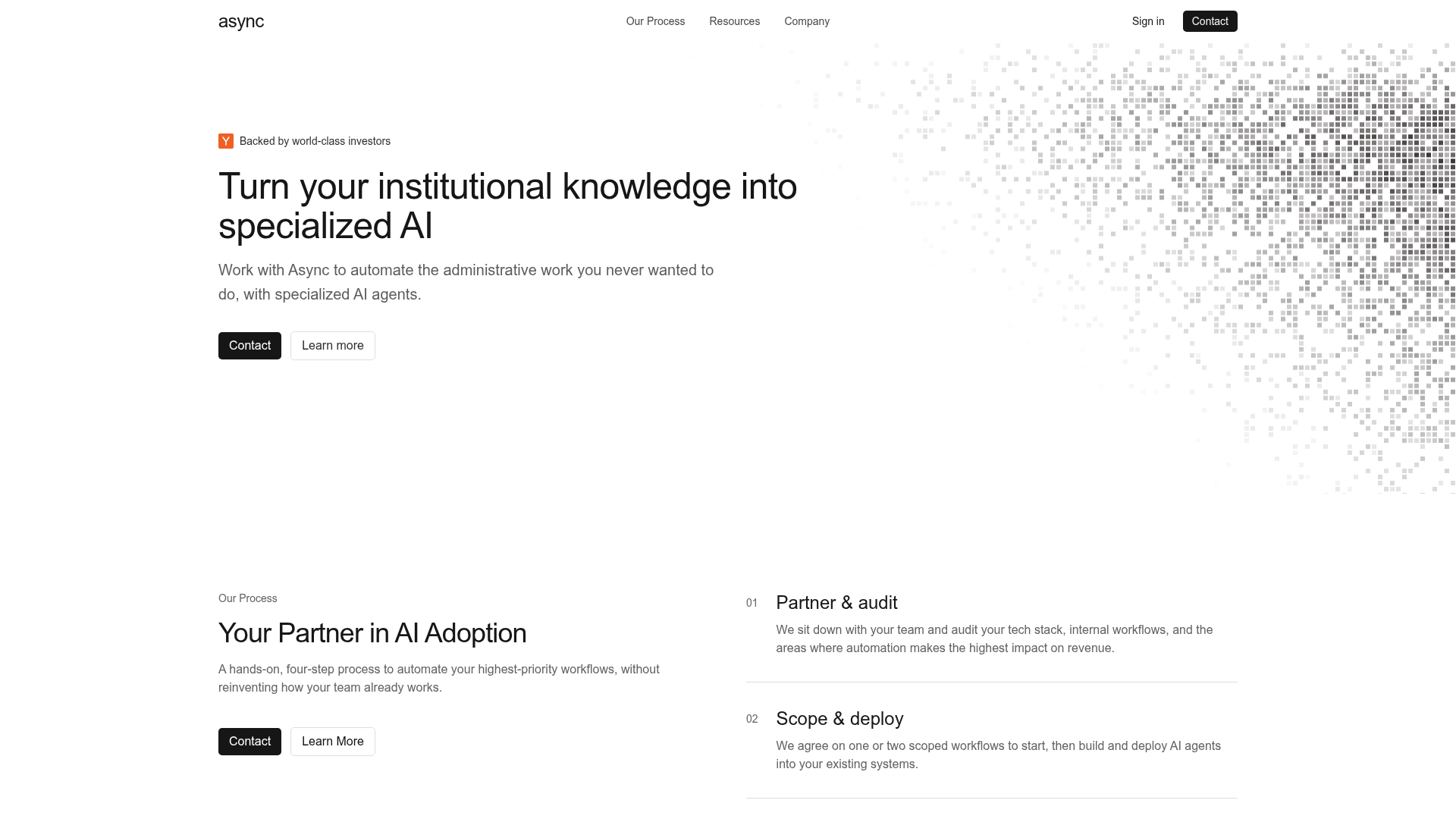
Most AI startups sell software. Async sells a process. The company, backed by Y Combinator and aimed squarely at small businesses, doesn't ask you to adopt a platform or learn a new tool. Instead, it offers a partnership: a four-step engagement that turns your institutional knowledge into specialized AI agents that automate the administrative work you never wanted to do. That framing—process over product, partnership over platform—is the most interesting thing about Async, and it's worth unpacking.
The four-step promise: from audit to AI agent
Async's website lays out a deliberate, almost consulting-like methodology. Step one is "Partner & audit": the team sits down with yours, audits your tech stack, internal workflows, and the areas where automation could have the highest impact on revenue. This isn't a self-serve signup; it's a discovery phase that mirrors what a management consultant might do, but with a very specific deliverable in mind.
Step two is "Scope & deploy." Async doesn't boil the ocean. It agrees on one or two scoped workflows to start, then builds and deploys AI agents into your existing systems. This is a key differentiator: the agents are meant to live inside the tools you already use, not in a separate dashboard you have to remember to open.
Step three is "Prove & expand." Once a deployment delivers, Async earns the right to take on the next high-value workflow. This is a risk-reversal move—it signals that Async is confident enough in its work to let results speak before expanding scope. Step four is "Maintain & compound," where Async maintains and iterates on every deployment, with agents improving with each action.
The process is refreshingly concrete. It acknowledges that small businesses don't have the luxury of a six-month digital transformation. They need something that works now, in a narrow slot, and then grows. The phrase "without reinventing how your team already works" is a quiet promise that Async adapts to you, not the other way around.
Why small businesses trust Async
The website features a testimonial from Adriena Clifton, founder of Clifton Law PLLC, an attorney who admits she is "naturally suspicious of anyone claiming they can make my life easier." Her endorsement is powerful because it comes from a profession that is notoriously risk-averse and time-strapped. "Of all the vendors I have met with and used as a firm owner, Async has consistently gone above and beyond," she says.
That quote is the only customer story on the landing page, but it's telling. It suggests Async targets professional services—law firms, accounting practices, maybe healthcare clinics—where administrative work is a constant drain and where trust is the #1 barrier to adoption. The site also links to a full customer story, implying a deeper case study that likely walks through the audit-to-deployment journey.
For a small business, the pitch is simple: you have knowledge in your head and in your files; Async turns that into an agent that does the work. No need to hire a data scientist or learn prompt engineering. The "specialized" in "specialized AI agents" is key—these aren't generic chatbots. They're built for your workflows, your data, your quirks.
Security as a feature, not a footnote
Async doesn't bury security in a corner. The site has a dedicated security page and highlights three pillars: Zero Data Retention (ZDR), end-to-end encryption, and SOC 2 Type I certification.
Zero Data Retention is a strong claim. It means queries and data can be automatically purged based on your requirements, which is a direct answer to the privacy fears many small businesses have about AI. End-to-end encryption in transit and at rest is table stakes, but Async emphasizes that "your information never leaves your control." That's a bold statement, and it's backed by the SOC 2 Type I certification, which is an independent audit of security controls.
For a small business, this matters. You might be a law firm handling sensitive client data, or a clinic with patient records. The promise of ZDR and SOC 2 is a way to say: you can use AI without exposing your business to liability. It's a smart move to put this front and center, because it removes a major objection.
The name says it: async by design
The name "Async" is a deliberate nod to asynchronous work. In software, async means operations don't block each other—they run in the background, independently. That's exactly what Async's agents do: they handle the administrative work in the background, so your team can focus on the revenue-generating tasks that require human judgment.
The name also carries a sense of calm. It suggests that the work gets done, eventually, without you having to supervise every step. It's a smart counterpoint to the anxiety that AI often provokes. The domain, withasync.com, is clean and easy to remember, and the logo is simple text, reinforcing the no-frills, utility-first brand.
There's a risk, though. "Async" is a common programming term, and for a tech-savvy audience, it might evoke developer tools rather than business automation. But for the target customer—a small business owner who isn't a developer—the name is abstract enough to be intriguing, and the tagline "Turn your institutional knowledge into specialized AI" clarifies the value proposition immediately.
What's missing from the public story
The website is polished but sparse on specifics. There's no pricing, no case study metrics, no mention of which industries it serves beyond the Clifton Law example. The funding stage is listed as "Unknown," though the Y Combinator badge suggests some level of backing. The site does not disclose the number of customers, the size of the team, or the technical architecture behind the agents.
That's not necessarily a flaw—it's a common pattern for early-stage companies that prefer to engage prospects through a conversation rather than a self-serve funnel. But it does mean that a prospective customer can't evaluate Async without booking a call. The process is the product, and the process starts with a conversation.
For now, Async's bet is that small businesses are tired of buying software and want a partner. The four-step process, the security certifications, and the testimonial all point to a company that understands trust is the currency. If the agents deliver on the promise, Async could become the go-to for small businesses that want AI without the headache. If not, the name might be the only thing that's truly asynchronous.