Impact-Site-Verification: 41b53a0c-6d04-458b-a457-fe9e29acde1a

Other··7 min read

Atomarine

Floating nuclear data centers that skip the grid queue and cool with seawater.

NN

NewName Editorial

Editorial Team

Atomarine product image 1
Atomarine product image 2

The AI industry has spent the last two years hunting for GPUs. The next two will be spent hunting for megawatts. Atomarine's answer is to stop hunting entirely and tow the power plant to the compute, on a barge, in the middle of the ocean.

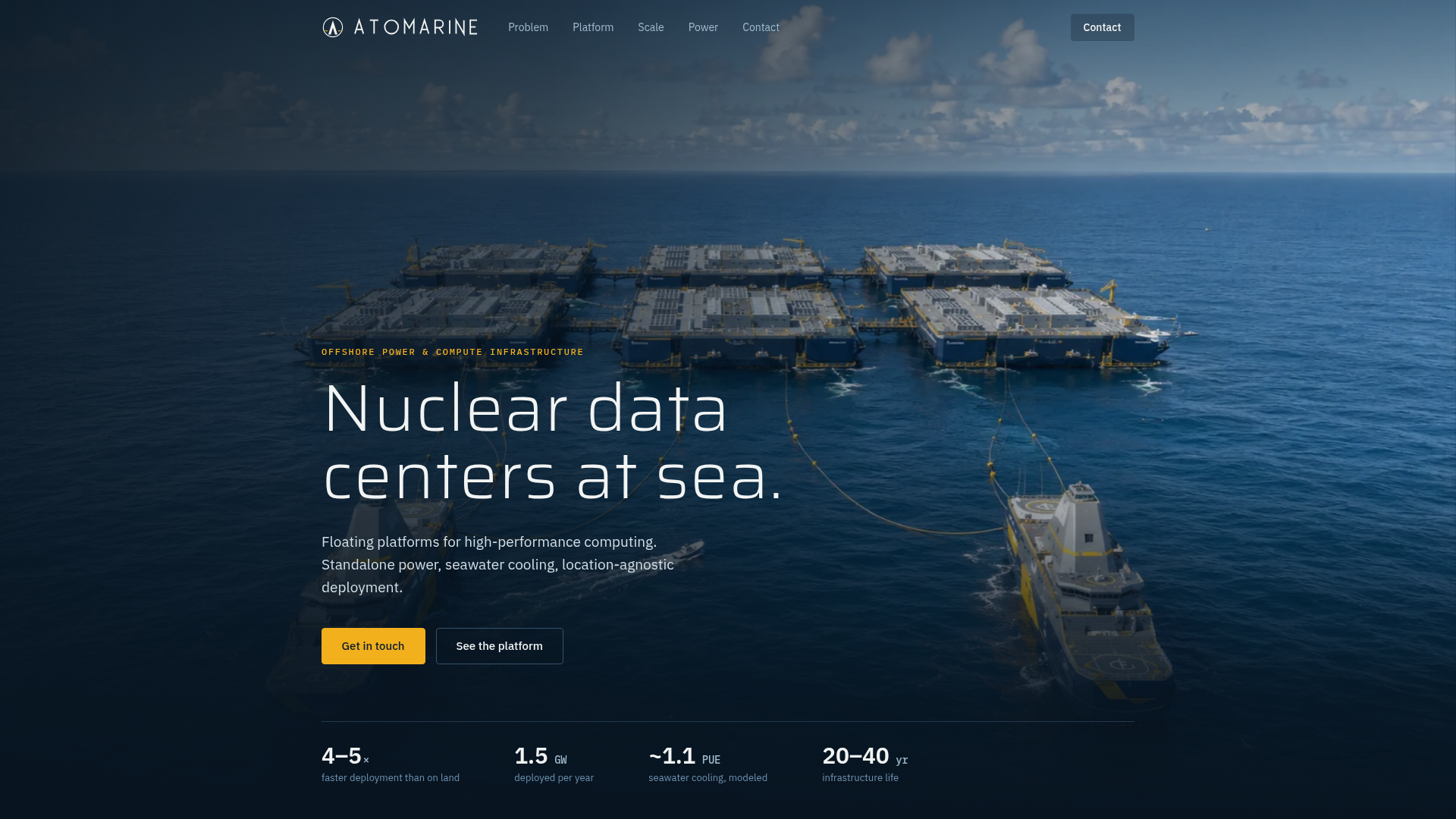
The company, backed by Y Combinator and MIT, is not trying to build a better chip or a more efficient cooling system. It is trying to sidestep the entire land-based infrastructure that has become AI's real bottleneck: the grid interconnection queue. A grid connection takes four to seven years, the company notes, while new chips install in months. Atomarine's pitch is that floating platforms can be deployed 4–5x faster than land-based data centers, with a modeled PUE around 1.1, and powered by gas today and nuclear tomorrow.

This is a bet on a very specific future: that AI's growth will be constrained not by silicon but by electrons, and that the most pragmatic way to deliver those electrons is to float the whole data center on water.

The grid queue is the new chip shortage

Every hyperscaler has hit the same wall. You can order a thousand GPUs, but you cannot order a substation. The grid interconnection queue in many regions stretches years, and firm power is projected to fall 35 to 49 gigawatts short by 2030. Atomarine's entire thesis rests on this gap.

On land, a data center is a real estate project first and a compute project second. You spend years securing permits, water rights, and a grid connection, often in a location chosen for its queue position rather than its proximity to users. Atomarine flips this: the compute platform is built in a shipyard, towed to a site, and moored. There is no grid connection to wait for because the power is generated on site. No cooling towers to build because the ocean is the heat sink. No zoning board because the site is international water.

The company's numbers are aggressive: 1.5 GW deployed per year, a 20–40 year infrastructure life, and a 4–5x faster deployment than land. These are not proven metrics, but they are the promise that makes the entire venture plausible. If you can deploy a 75–100 MW compute platform in a fraction of the time it takes to build a land campus, the queue becomes irrelevant.

A data center that arrives by tow, not by truck

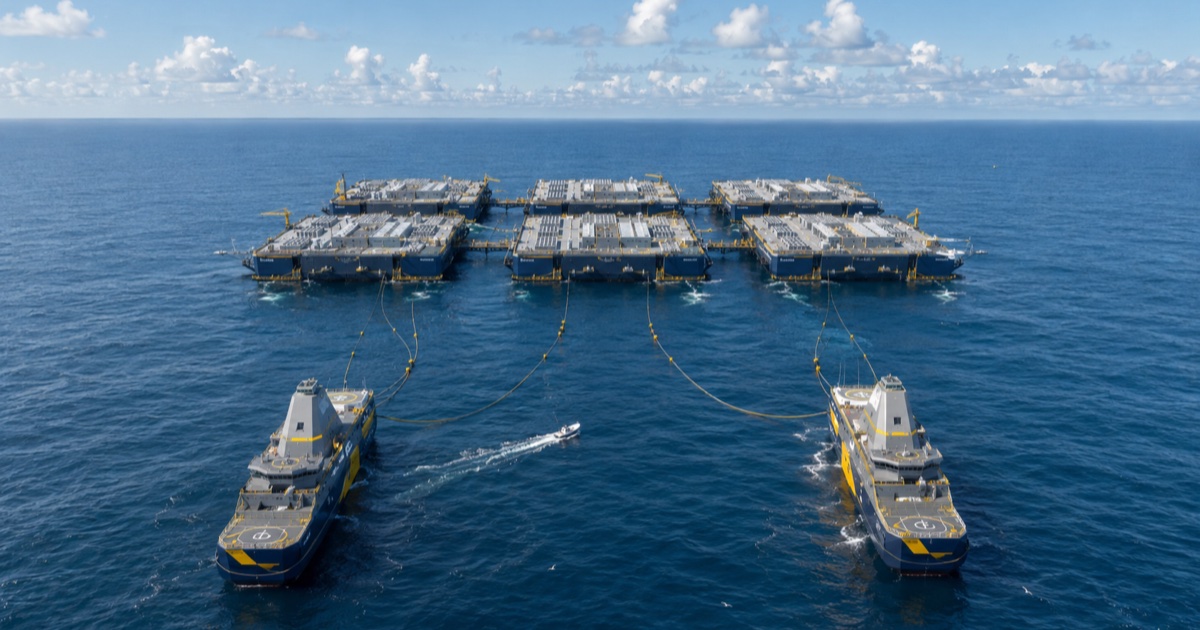
Atomarine's unit is a standardized compute barge, rated at 75–100 MW, built in a shipyard and towed to its mooring site. The campus grows by adding more barges, each one identical to the last, until the site reaches 450 MW. This is a manufacturing model, not a construction model.

The implications are significant. Shipyards are built to produce large, complex vessels on a schedule. They have the cranes, the dry docks, and the supply chains for steel and electrical systems. A data center is, at its core, a large electrical load with a bunch of servers. If you can standardize the design, you can mass-produce it in a facility that already knows how to build floating structures.

This also changes the economics of scale. A land campus locks billions into a single site, chosen for queues and zoning rather than demand. Atomarine's model allows capacity to follow demand, at least in theory. If a customer needs 150 MW in one location and 300 MW in another, you tow the barges to different sites. The platform is the product, and the site is just a mooring.

The catch is that you need a body of water and a way to connect to the terrestrial network. Subsea cables are not trivial, and the latency of an offshore site may not suit every workload. But for batch processing, training runs, and other latency-tolerant workloads, the tradeoff could be acceptable.

The 1.1 PUE that seawater buys

Cooling is one of the largest operational costs for a data center, especially in hot climates. Atomarine's design uses a closed seawater loop, eliminating cooling towers and the associated water consumption. The company models a PUE around 1.1, which would put it in the top tier of efficient data centers.

Seawater cooling is not new; it has been used for decades in coastal facilities. But combining it with a floating platform means you are not limited to a specific coastline. You can place the data center anywhere there is water, including offshore where the water is deeper and colder. The closed loop also avoids the environmental concerns of once-through cooling, though the discharge of warm water is still a consideration.

The 1.1 PUE is a modeled figure, not a measured one. But if it holds, it gives Atomarine a significant operational advantage. Lower PUE means less energy wasted on cooling, which means more of the generated power goes to compute. For a facility that generates its own power, this is doubly important.

Why the power vessel is the real product

The most interesting part of Atomarine's design is not the compute barge; it is the power vessel moored alongside it. The company's plan is to start with gas turbines, which are proven and available today, and later swap in compact marine reactors as they come online. The data halls never change; only the power source does.

This is a clever hedge. Nuclear power is the long-term goal, but it is not ready for prime time in a floating format. Gas turbines are a known quantity, but they are not carbon-free. By decoupling the power source from the compute platform, Atomarine can start delivering capacity now and transition to nuclear later without reworking the data center.

The power vessel also solves the interconnection problem in a different way. Instead of waiting for a grid connection, you bring the generator to the load. This is essentially a floating power plant, and the technology is not new; naval vessels have used gas turbines for decades. The innovation is in pairing it with a commercial data center.

There are obvious challenges. Gas turbines are noisy and produce emissions, which may be a concern for marine environments. Nuclear reactors on barges raise regulatory and safety questions that are not fully addressed in the public materials. But the design acknowledges these issues by starting with gas and positioning nuclear as a future upgrade.

The shipyard as a factory for compute

Atomarine's centralization of manufacturing is its most underappreciated advantage. By building standardized platforms in shipyards, the company can leverage an existing industrial base that is already optimized for large-scale production. This is in stark contrast to land data centers, which are typically bespoke projects with long construction timelines.

The company claims 4–5x faster deployment than land. If true, this is transformative. A 75–100 MW data center on land can take three to five years to design and build. Atomarine suggests it can deliver a floating platform in a fraction of that time, because the design is done once and the shipyard can produce multiple units in parallel.

This also changes the risk profile for customers. Instead of committing to a multi-year construction project, they can order a barge that will be delivered on a shipyard schedule. The standardization means that lessons learned on one unit can be applied to the next, improving reliability and reducing costs over time.

The flip side is that the shipyard model requires a large upfront investment in the first platform. The company does not disclose pricing or funding details, but the capital intensity of this business is enormous. It is a bet that the demand for AI compute will be large enough to justify the upfront cost of building a fleet of floating data centers.

What Atomarine does not say

The public materials are thin on several critical details. There is no information on the cost per megawatt, the timeline for the first deployment, or the regulatory framework for operating nuclear reactors at sea. The company lists Y Combinator, MIT, The Engine, and Cleantech Open as supporters, but does not disclose funding amounts or revenue.

The 1.5 GW per year deployment target is ambitious, but it is not clear how many shipyards would be needed to achieve it. The 450 MW campus size is mentioned, but there is no indication of how many campuses are planned or where they would be located.

There are also unanswered questions about connectivity. A floating data center needs a high-bandwidth link to the shore, and subsea cables are expensive and slow to deploy. The company does not address this in its materials, but it is a critical dependency.

Despite these gaps, Atomarine's core insight is compelling: the grid is the bottleneck, and the ocean is a workaround. Whether the company can execute on its vision remains to be seen, but it is asking the right question.