Axal
One team for PCB design, sourcing, assembly, and testing—delivering verified boards in days, not months.
NewName Editorial
Editorial Team
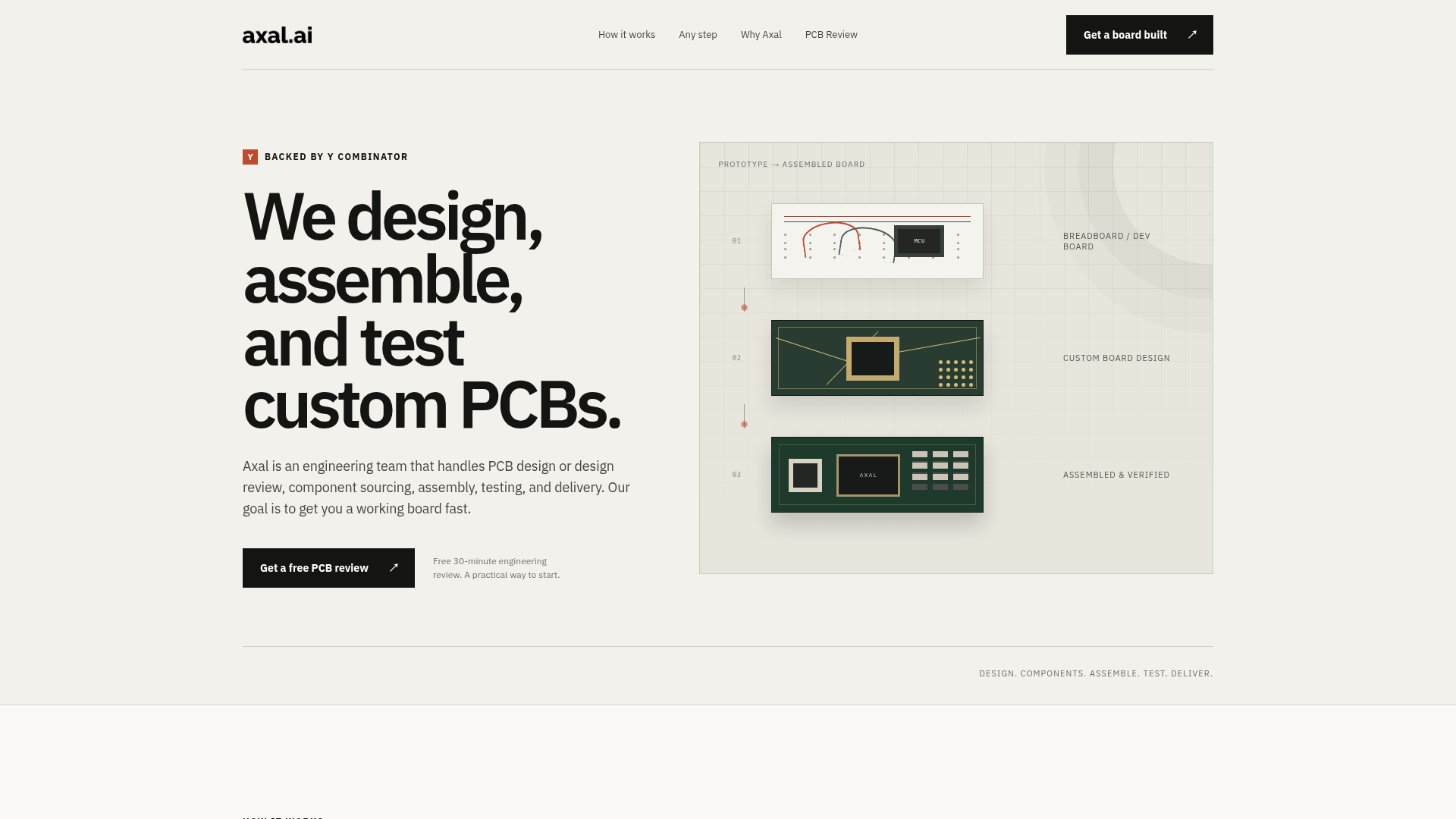
For every hardware startup that has tried to get a custom PCB built, the pain is familiar: a schematic here, a layout there, a BOM that needs five suppliers, an assembler in Shenzhen who replies once a day, and a test engineer who is only available next week. The process is not just slow—it is structurally fragmented. Each handoff between design, component sourcing, assembly, and testing introduces delays, miscommunication, and defects that only surface when the board arrives and doesn't work. Axal, a Y Combinator-backed startup, is attacking this fragmentation by doing what few others in the PCB services space have attempted: vertically integrating the entire workflow under one roof, from design review to in-house assembly and testing, with a promise to deliver working boards in days.
The Hidden Cost of a Four-Vendor PCB Workflow
The traditional PCB prototyping path is a relay race where each runner speaks a different language. A hardware team typically hires a design consultant or uses an in-house engineer to create schematics and layout, then sends the Gerber files to a fabrication house, sources components from a distributor like Digi-Key or Mouser, and finally hands everything to an assembly service—often in China—that may or may not have the right stencils or pick-and-place files. Each step is a separate company with its own inbox, its own timeline, and its own incentives. The result is a process that can take months and is riddled with "late surprises": a part that is out of stock, a footprint that doesn't match the datasheet, or a board that fails testing because the assembler substituted a component without asking.
Axal's core thesis is that this fragmentation is the real enemy, not the technical difficulty of PCB design. By offering a single team that handles design or design review, component sourcing, assembly, testing, and delivery, Axal eliminates the coordination overhead. The website explicitly states that assembly happens in-house, not handed off to an outside assembler, which means design intent and build reality stay connected. This is a direct response to the common failure mode where a design looks perfect on screen but fails in manufacturing due to DFM issues or poor component selection.
Vertical Integration as the Antidote to Design-to-Assembly Drift
Vertical integration is not just a marketing claim; it is a structural advantage. When design and assembly are under the same roof, feedback loops shorten dramatically. An engineer who spots a potential layout issue during design can immediately check with the assembly team about stencil tolerances or reflow profiles. A component that is long-lead can be swapped for an alternative before the BOM is finalized, rather than after the board has already been ordered. This is what Axal means by "design intent and build reality stay connected."
The workflow is straightforward: a team brings an idea, a working prototype on an Arduino or Raspberry Pi, an existing PCB, or finished design files. Axal picks up at any point. If the customer has files, Axal reviews them for manufacturability and component issues before a single dollar is spent on fabrication. If the customer only has a concept, Axal designs the schematic and layout. Then Axal sources components, assembles in-house, tests with methods like X-ray inspection and electrical testing, and ships verified boards with documentation. The entire process is designed to compress the traditional multi-week or multi-month cycle into days.
This model is particularly powerful for hardware teams that are iterating rapidly—agriculture tech, smart glasses, medical devices, robotics—where a two-week delay in a prototype can mean missing a funding milestone or a customer demo. Axal's positioning as "hardware teams moving at software speed" is not hyperbole; it is the direct benefit of eliminating the four-vendor relay.
Competing Against China EMS Giants and Local Prototype Shops
Axal's competitive landscape is bifurcated. On one end are Chinese EMS giants like PCBWay and JLCPCB, which offer cheap fabrication and assembly but with significant drawbacks: long lead times, limited design feedback, and a communication gap that often results in boards that are manufactured correctly but do not meet the original intent. On the other end are local US prototype shops that offer faster turnaround but typically focus on one step—design or assembly—and lack the integrated testing and verification that Axal provides.
Axal's tagline, "Designing and Getting PCB's in China is Dead," is a direct jab at the China outsourcing model. The company is betting that US hardware teams are willing to pay a premium for speed, communication, and verification over the cost savings of shipping to Shenzhen. The free 30-minute engineering review is a key differentiator: it provides immediate value to a potential customer while also serving as a lead generation tool. No other service in this space offers a free, no-sales-pitch engineering review as an entry point.
However, Axal is not competing on price. The website does not list pricing, and the service is likely enterprise-quoted, which means it will be more expensive than a JLCPCB board. The value proposition is not cost; it is time-to-working-board and reduced iteration cycles. For a startup where engineering time is the most expensive resource, paying Axal to compress a 6-week cycle into 2 weeks can be easily justified.
The Free Review as a Land-and-Expand Funnel
The go-to-market motion is cleverly designed around the free PCB review. A 30-minute call where Axal engineers look at a customer's design or prototype and give direct engineering feedback. This is not a sales pitch; it is a genuine engineering consultation. The goal is to build trust and demonstrate competence. If the customer leaves with a clear next step—whether that is a full design engagement or just a component sourcing and assembly contract—Axal has won a foothold.
This land-and-expand approach is particularly effective in the hardware space, where trust is built on demonstrated expertise. A startup that is still on a breadboard prototype may only need assembly services initially, but as they iterate, they may need design revisions, and eventually, they may hand over the full PCB process to Axal. The free review also serves as a qualification mechanism: Axal can filter out projects that are not a good fit, saving time and resources.
The unit economics are not disclosed, but the model is likely to be a mix of project-based fees and hourly engineering rates. The in-house assembly capability suggests a capital investment in pick-and-place machines, reflow ovens, and testing equipment, which means Axal needs a steady volume of projects to amortize that cost. The Y Combinator backing provides initial runway, but the long-term viability depends on repeat customers and word-of-mouth referrals.
Where Axal's Model Breaks Down (and Where It Wins)
Axal's vertical integration is not without limitations. The most obvious constraint is scale. In-house assembly means Axal can only handle a limited number of boards at a time, which makes it unsuitable for high-volume production. The company is clearly targeting prototypes and low-volume runs, not mass manufacturing. This is a deliberate choice, but it means Axal will always be a niche player in the broader PCB market.
Another risk is the "one team" promise. If Axal's engineers are not truly experienced across all disciplines—design, layout, DFM, assembly, testing—the integration could become a bottleneck rather than an advantage. The website claims the team includes hardware-minded founders and engineers from Amazon and Microsoft, which lends credibility, but the execution will depend on the actual talent and processes in place.
Despite these risks, Axal's model is well-positioned for the current hardware renaissance. The rise of AI-powered devices, robotics, and smart hardware has created a surge in demand for custom PCBs, and the traditional outsourcing model is failing to keep up. Axal is offering a service that is faster, more reliable, and less stressful for hardware teams. If they can deliver on their promise of "working boards in days," they will have found a durable niche in the PCB services market—one that the China EMS giants cannot easily replicate because their entire business model is built on low-cost, high-volume manufacturing, not on engineering partnership.
The next 3-5 years will likely see Axal expand from a service provider to a platform, potentially offering software tools for PCB design review or a network of vetted manufacturing partners for high-volume runs. But for now, the bet is simple: hardware teams are tired of the fragmented, slow, and opaque PCB process, and Axal is offering a better way. The free review is the hook, and the working board is the proof.