BinSentry
AI-powered bin sensors that turn feed inventory into a live, actionable workflow for producers and mills.
NewName Editorial
Editorial Team
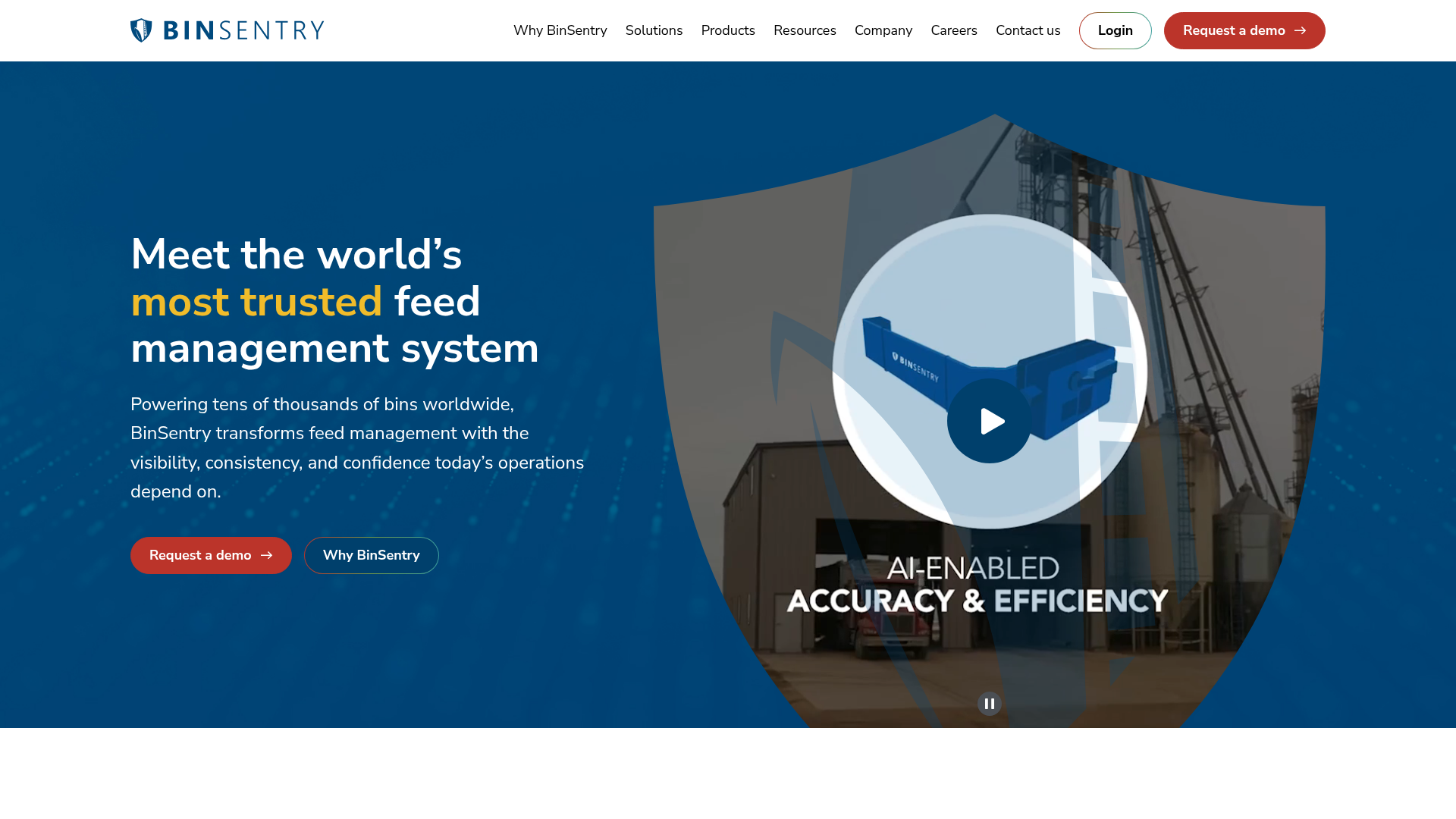

Animal agriculture runs on feed, yet the most critical inventory in the system is often the least visible. A broiler barn or sow farm might have dozens of bins holding thousands of pounds of feed, and for decades the only way to know what's inside was to climb up, knock on the side, and guess. BinSentry is built to replace that guess with a continuous, 3D view of every bin, but the more interesting story is not the sensor itself. It's what happens to an operation when feed inventory stops being a blind spot and becomes a live data feed.
The last blind spot in animal agriculture
Feed is the largest variable cost in most animal production systems, and out-of-feed events are not just an inconvenience. When a bin runs dry, animals miss meals, growth slows, and in the worst cases health suffers. The traditional mitigation is to over-order feed and over-deliver, padding inventory to avoid the cost of an outage. That padding has its own price: wasted feed, extra truck miles, and the labor of manual checks.
BinSentry's pitch is that this entire tradeoff is obsolete. The company's sensors create detailed, 3D images of the feed surface from inside the bin, feeding real-time data into dashboards that show precise levels, consumption trends, and delivery status. The website's language is telling: "See every bin. Miss nothing." That's not just a slogan; it's a description of a new operational baseline. Instead of checking bins on a schedule, managers can see exactly when a bin will run low and schedule deliveries accordingly.
Machine vision where ultrasonic sensors failed
BinSentry's core technology is machine vision, and that choice is significant. The feed bin environment is harsh: dusty, dark, and filled with irregular surfaces. Older approaches, like ultrasonic sensors, measure distance to the nearest object, but they struggle with the uneven topography of feed as it piles and settles. A single point measurement can be wildly inaccurate, leading to false alarms or missed outages.
BinSentry's sensors use machine vision to build a 3D surface map of the bin's contents. This is not a single distance reading but a detailed model of the feed's shape and volume. The company claims this provides "detailed, 3D images of the surface from any angle," which suggests a more robust view of what's actually in the bin. The shift from a point measurement to a volumetric understanding is the difference between knowing that a bin is 'about half full' and knowing that it has exactly 4.2 tons of feed remaining, with a consumption rate that predicts when it will hit empty.
This technical choice also explains why BinSentry positions itself as an AI company rather than a sensor vendor. The hardware is the delivery mechanism; the intelligence is in interpreting the images and turning them into actionable data. That's a harder problem to solve, but it's also a harder system for a competitor to replicate.
From bin level to delivery logistics
The most immediate payoff for BinSentry's customers is not the dashboard itself but the logistics that the data enables. The website highlights "reduce delivery miles and feed returns" as a primary benefit. When a feed truck arrives at a farm only to find the bin is still half full, that's a wasted trip. When a bin runs out before the next scheduled delivery, that's an emergency call and a premium price for expedited service. Both scenarios are common in an industry that has historically operated on fixed schedules and gut feel.
With real-time bin levels, deliveries can be triggered by actual need rather than calendar dates. A feed mill can consolidate deliveries, route trucks more efficiently, and avoid the cost of last-minute orders. The system also alerts on late or missed deliveries, turning a silent problem into a visible exception that can be managed. This is where BinSentry moves from being a monitoring tool to being a supply chain optimization platform. The data from the bins becomes the input for better decisions about when to order, how much to order, and where to send the truck.
Two products, one inventory problem
BinSentry's product line reflects the two distinct environments where feed inventory matters. The first is the on-farm feed bin, the familiar white or galvanized silo next to a barn. The second is the ingredient bin at a feed mill, where raw materials like corn, soybean meal, and premixes are stored in much larger volumes. The company offers two products: Prosense Feed for barns and Prosense HD for commercial silos and large-scale grain environments.
The distinction is not just about size. On-farm bins are typically smaller, more numerous, and spread across multiple sites. The challenge is visibility across a distributed network. At a feed mill, the challenge is more about managing a high-throughput operation where ingredient outages can halt production. The website describes mill monitoring as providing "total inventories, capacity and bin activity at a glance," with the ability to "spot potential ingredient outages, reduce shrink and respond quickly to issues such as last-minute truck arrivals." Shrink — the loss of material between purchase and use — is a significant cost in milling, and better inventory data can directly reduce it.
By addressing both ends of the feed supply chain, BinSentry creates a more complete picture. A producer who buys feed from a mill could theoretically share data with the mill, aligning production schedules with actual consumption. The company's customer list includes feed mills, integrators, and producers, which suggests that the platform is already being used to bridge these traditionally separate operations.
Why the moat is operational, not technological
The obvious question for any hardware-plus-software startup is: what stops a larger player from copying the sensor and undercutting the price? BinSentry's answer appears to be that the technology is only part of the value. The real moat is the operational workflow that the data enables. Once a producer has reorganized their delivery schedules, reduced feed returns, and prevented outages, the cost of switching back to manual checks is not just the price of the hardware. It's the loss of the efficiency gains that the system has baked into their daily operations.
The company also benefits from a classic network effect, though it's not a traditional one. As BinSentry monitors more bins across more operations, it accumulates data on feed consumption patterns, seasonal variations, and regional differences. That data can be used to improve the accuracy of the machine vision algorithms and to provide benchmarking insights to customers. The website mentions "60,000+ assets monitored daily," which is a substantial installed base. While the company does not disclose the exact breakdown, the scale suggests that BinSentry has moved beyond early adoption and into the mainstream of large-scale protein production.
That scale is also a barrier to entry. A new competitor would need to match not only the hardware but also the software platform, the customer relationships, and the accumulated data. In AgTech, where sales cycles are long and trust is hard to earn, that is a formidable combination.
BinSentry's story is a reminder that in agriculture, the most valuable technology is often not the flashiest but the one that solves a mundane, expensive problem with relentless precision. Feed inventory is not a glamorous topic, but it is a place where small improvements in visibility and logistics translate directly into dollars saved. By turning the humble feed bin into a source of real-time data, BinSentry is not just selling sensors. It is selling a new way to run a feed operation, and that is a much stickier product.