Conifer
Local-first routing that cuts AI token costs by keeping most requests on your hardware.
NewName Editorial
Editorial Team


The cloud has a pricing meter that never stops ticking, and for AI teams, every token is a coin dropped into that meter. Conifer, a new entrant from the Y Combinator launch roster, proposes a simple but radical fix: don't send all your requests to the cloud. Instead, route most of them to your own hardware, where the marginal cost is effectively zero. The company's tagline—'Stop paying cloud prices for every token'—is a direct appeal to every team that has watched its inference bill balloon as usage scales.
Conifer's pitch is quantitative: 'We route 80% of requests to your hardware at no cost.' That number is the crux of its value proposition. It suggests that the vast majority of AI workloads don't need the cloud's elasticity or scale—they can run perfectly well on commodity GPUs or even CPUs sitting in a server closet. The cloud becomes an overflow valve, not the default destination. This is a contrarian stance in an industry where 'cloud-first' is dogma, and it's worth unpacking.
The Token Bill Is the New Cloud Bill
In the early cloud era, the cost of compute was a line item that grew with usage, but it was predictable. With AI, the cost is tied to tokens—the atomic units of input and output that models process. Every API call to a hosted model like GPT-4 or Claude incurs a per-token fee, and those fees add up quickly, especially for applications that handle high volumes of requests, such as chatbots, copilots, or data pipelines. The result is a new kind of sticker shock: teams that prototype with a few thousand tokens a day suddenly face thousands of dollars in monthly bills when they scale.
Conifer's answer is to treat the cloud as a premium resource, not a default. By routing 80% of requests to local hardware, it aims to slash that variable cost. The remaining 20%—presumably the most complex or bursty requests—go to the cloud, where they can leverage the latest models or handle spikes without provisioning for peak load. This is a cost optimization play, but it's also a philosophical shift: it challenges the assumption that AI must be consumed as a fully managed, cloud-hosted service.
How Conifer Routes Around the Meter
The mechanism is 'least cost routing,' a concept borrowed from telecommunications and cloud cost management. In telecom, least cost routing (LCR) automatically selects the cheapest path for a call. Conifer applies the same logic to AI inference: it evaluates each request and decides whether to serve it locally or in the cloud, based on cost, latency, and perhaps model capability. The 'local-first' label is key—it means the default is to serve from your own hardware, and only when necessary does it escalate to the cloud.
This is not a new idea in the abstract, but Conifer's focus on AI tokens is timely. The company's website doesn't detail the technical implementation—how it decides which requests are local-eligible, how it handles model versioning, or how it manages the failover when local hardware is insufficient. But the concept is clear: a smart router that sits between your application and the AI providers, making cost-based decisions in real time.
The Hybrid Reality: Cloud as Overflow, Not Default
For many teams, the choice between cloud and on-premises is binary. Cloud offers scalability and managed services; on-premises offers control and lower marginal costs. Conifer's model blurs that line, creating a hybrid where the cloud is used only for what local hardware can't handle. This is a pragmatic approach that acknowledges the reality of AI workloads: they're not uniform. Some requests are simple, repetitive, and can be served by a fine-tuned open-source model running locally. Others require the latest frontier model or a burst of compute that local hardware can't provide.
This hybrid model has implications beyond cost. It also affects latency—local inference can be faster for requests that don't need the cloud's round trip—and data privacy, since sensitive data never leaves your infrastructure. For industries like healthcare or finance, where data residency is a compliance requirement, this is a significant advantage. Conifer's positioning as a 'local-first' system speaks to these concerns, even if the website's copy focuses primarily on cost.
Security as a Side Effect of Staying Local
The security angle is subtle but present. Conifer's tags include 'Security,' and the local-first approach inherently reduces the attack surface: if data doesn't leave your network, it's not vulnerable to interception or exposure during transit. This is a compelling narrative for enterprises that are wary of sending proprietary data to third-party APIs. The website doesn't elaborate on encryption, compliance certifications, or other security features, but the architectural choice of local-first is itself a security statement.
In an era of high-profile data breaches and increasing regulatory scrutiny, the ability to say 'your data stays on your hardware' is a strong selling point. Conifer's name—evoking an evergreen tree that stays rooted and resilient—reinforces this idea of stability and self-sufficiency. It's a subtle branding choice that aligns with the product's philosophy.
The Name Says It: Conifer, Evergreen and Rooted
The name 'Conifer' is a botanical metaphor. A conifer is a tree that retains its needles year-round, symbolizing endurance and constancy. In the context of AI infrastructure, it suggests a system that is always on, reliable, and self-sufficient. The domain, conifer.build, is clean and memorable, with the .build TLD hinting at a developer-focused tool. The name is distinctive and evocative, avoiding the generic 'AI' or 'Cloud' suffixes that clutter the space.
But the name also carries a risk. 'Conifer' doesn't immediately communicate 'AI routing' or 'cost optimization.' It's a soft, natural name that requires explanation. In a market where names like 'Cloudflare' or 'Datadog' are more literal, Conifer's metaphor is a gamble. It works if the brand becomes synonymous with local-first AI, but it could also be a hurdle in a crowded category where clarity often wins. The tagline helps, but the name alone might not convey the value proposition to a first-time visitor.
What Conifer Doesn't Tell You Yet
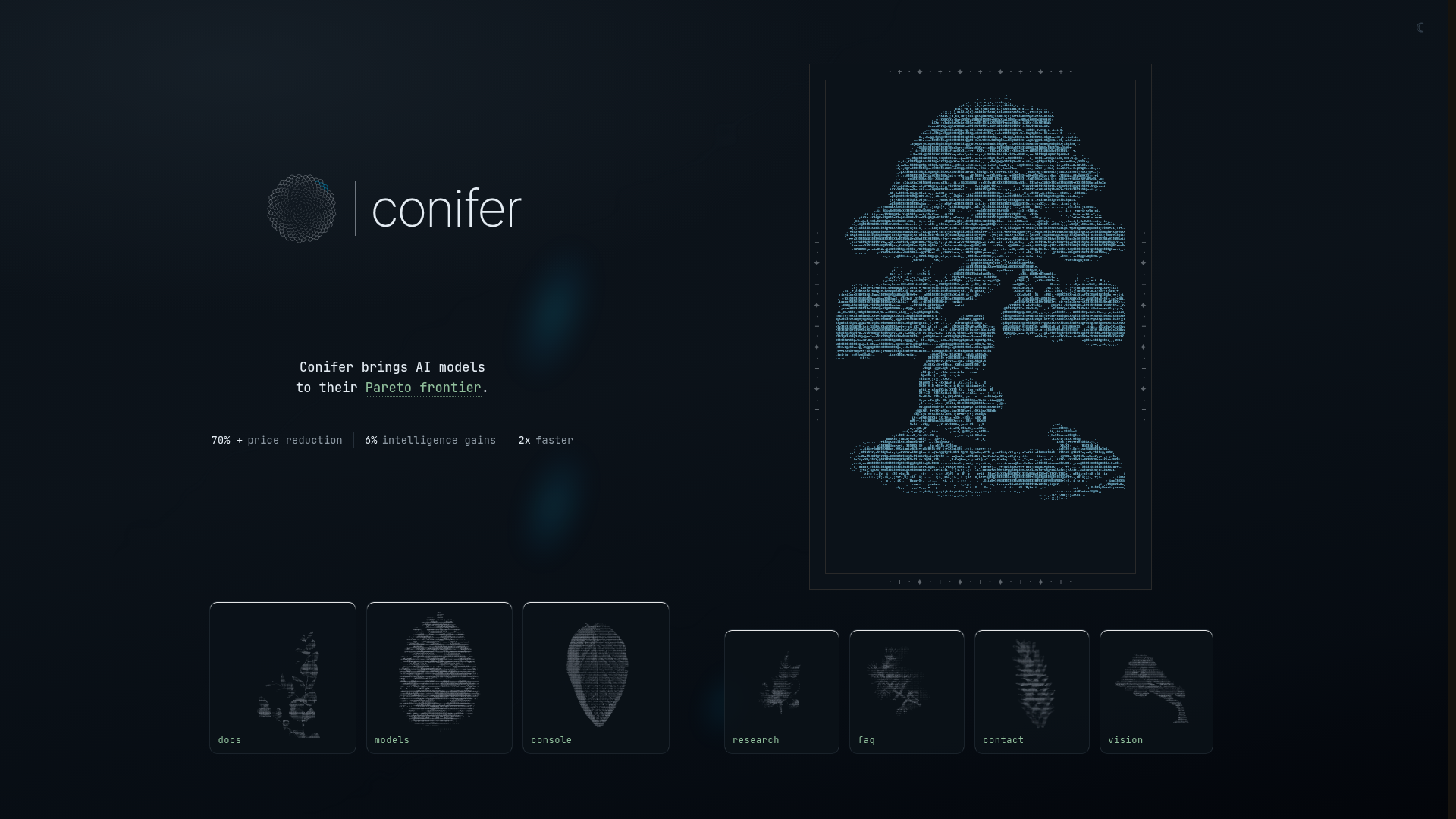
The website is sparse on details. There's no pricing, no technical documentation, no customer testimonials, and no information about the team or funding. The public materials are limited to the launch listing and a visually striking ASCII art rendering of a conifer tree, which is more of a design statement than a product demo. This suggests Conifer is in an early stage, possibly pre-product or in private beta.
This opacity is both a limitation and an opportunity. For potential users, the lack of specifics makes it hard to evaluate the product's maturity or performance. For competitors, it leaves room to counter Conifer's claims—80% is an ambitious number, and it's unclear how it's measured or what types of workloads it applies to. The company will need to provide more evidence to build trust.
For now, Conifer stands as a promising concept with a clear thesis: the cloud is too expensive for every token, and local hardware is an underutilized resource. If it can deliver on its routing promise, it could be a valuable tool for cost-conscious AI teams. The name and branding are thoughtful, and the local-first angle is a differentiator in a market that often defaults to cloud. The open question is execution—and whether the 80% figure holds up in practice.