ctrlc.ai
Discover AI-generated visuals and copy the exact prompts behind them—a curated prompt library for creators.
ctrlc.ai
Submitted by the team
The Prompt Economy's Missing Discovery Layer
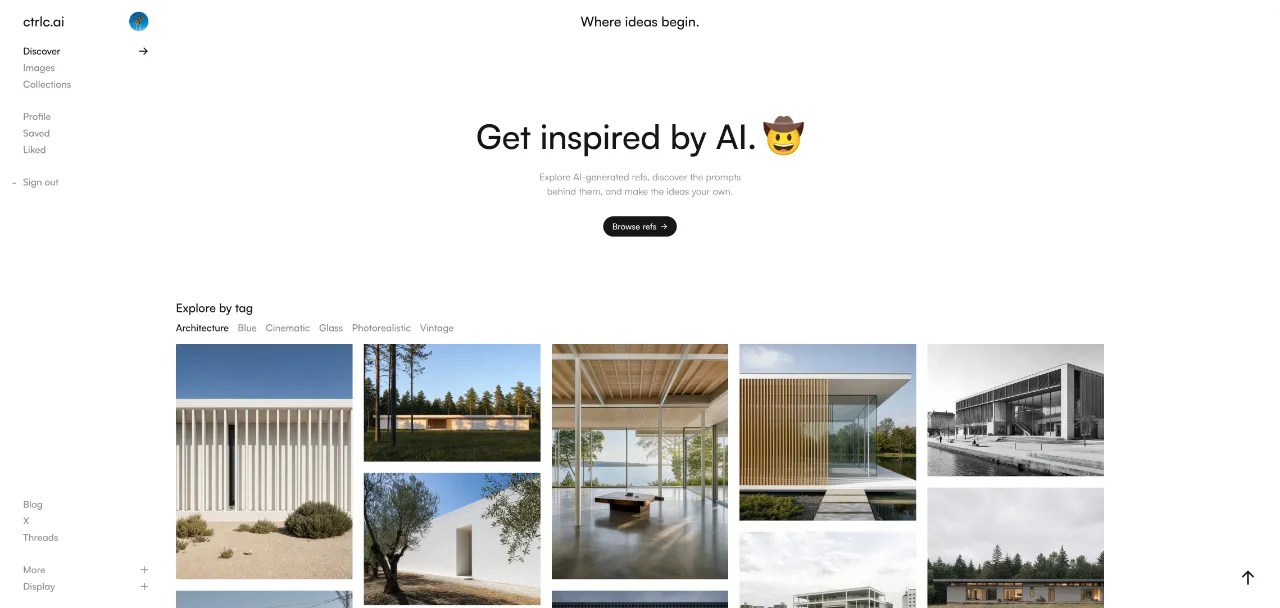
The generative AI boom has created a paradox: the models are becoming more capable, but the skill of prompting them remains opaque and largely undocumented. While Midjourney, DALL-E, and Stable Diffusion churn out millions of images daily, the prompts that produced the best ones are often locked in private Discord servers, buried in Twitter threads, or sold piecemeal on marketplaces. This fragmentation is the structural inefficiency ctrlc.ai exploits. It positions itself as the discovery layer for the prompt economy—a place where creators can browse AI-generated references, copy the exact prompt behind each image, and apply that knowledge to their own work. In essence, it's a searchable, curated library of prompt-output pairs, designed to demystify prompt engineering and accelerate creative iteration. The platform's tagline, 'Get inspired by AI,' captures its ambition: to become the default starting point for anyone who wants to generate high-quality visuals without starting from a blank text box.
How ctrlc.ai Works: A Copy-Paste Shortcut as a Business Model
The core mechanic of ctrlc.ai is elegantly simple: each image in its gallery is paired with the exact prompt that generated it, and a single click copies that prompt to the user's clipboard. This 'Ctrl+C' functionality is the product's namesake and its primary value proposition. The site organizes images into a browsable gallery with tags and curated collections, such as 'White Minimalist Architecture' or 'High-Fashion Lookbook in Dense Hong Kong Alleys.' Users can like, save, and download images, building personal collections. The workflow is straightforward: a user finds an image that matches their aesthetic, copies the prompt, pastes it into their preferred AI image generator, and iterates from there. This eliminates the trial-and-error phase of prompt crafting, which can be the most time-consuming part of AI image generation. For architects, fashion designers, and digital artists, the platform acts as a creative reference library, similar to how Pinterest serves as a mood board repository, but with the added dimension of executable prompts. The platform's current focus on architecture and fashion collections suggests a deliberate targeting of professional creatives who need consistent, high-quality visual outputs.
Curation as Moat: Fighting the 'Sea of Slop' with Human Taste
The biggest challenge for any AI image aggregation platform is the sheer volume of low-quality, generic outputs—often referred to as 'AI slop.' ctrlc.ai's answer is human curation. The site's curated collections, such as 'White Minimalist Architecture: Single-Family Concrete Homes' and 'Reimagined 00s Skatewear Lookbook,' demonstrate a deliberate editorial eye. These are not random galleries; they are cohesive visual narratives that reflect specific aesthetics and trends. This curation is a significant differentiator. While prompt marketplaces like PromptBase offer a searchable database of prompts, they lack the visual-first, editorial presentation that ctrlc.ai provides. The platform's tag-based exploration further enhances its utility, allowing users to filter by style, subject, or mood. This combination of curated collections and granular tagging creates a structured discovery experience that is more akin to browsing a high-end design magazine than scrolling through a chaotic feed. The challenge, however, is scaling this curation. Human curation is labor-intensive and does not scale as easily as algorithmic aggregation. ctrlc.ai will need to decide whether to rely on community contributions, AI-assisted curation, or a hybrid model to maintain quality as the library grows.
Competitive Crossfire: Prompt Marketplaces, Search Engines, and Model Makers
ctrlc.ai operates in a crowded and evolving competitive landscape. The most direct competitors are prompt marketplaces like PromptBase and PromptHero, which allow creators to buy and sell prompts. These platforms have a transactional focus, whereas ctrlc.ai is a free, inspiration-first library. This distinction is crucial: ctrlc.ai is not trying to be a marketplace; it's trying to be a discovery engine. Another set of competitors are AI model platforms themselves. Midjourney has its own community showcase, and OpenAI's DALL-E is integrated into ChatGPT, where users can browse and share generations. These platforms have the advantage of owning the generation pipeline, but they lack the cross-model, prompt-centric focus that ctrlc.ai offers. Additionally, traditional search engines like Google are increasingly surfacing AI-generated images, but they do not provide the structured prompt-output pairs that ctrlc.ai does. The platform's unique value lies in its explicit pairing of image and prompt, which is not a standard feature on most competitors. However, the threat from AI-native search is real: as tools like Perplexity and Google's Gemini become more sophisticated, they could easily integrate prompt discovery features, potentially making standalone platforms like ctrlc.ai redundant. To survive, ctrlc.ai must deepen its value proposition beyond simple prompt copying, perhaps by offering prompt optimization tools or integration with multiple generation models.
Monetization Dilemma: Why Free Prompt Libraries Struggle to Convert
ctrlc.ai's current model is free and ad-free, with no visible premium tier. This is a common strategy for early-stage platforms seeking user adoption, but it raises the question of long-term sustainability. The platform's costs are not trivial: hosting high-resolution images, maintaining a fast search experience, and curating collections all require resources. The most obvious monetization path is a freemium model, where advanced features like unlimited saves, higher-resolution downloads, or access to exclusive collections are paid. Another option is affiliate revenue, where ctrlc.ai earns a commission when users click through to a generation platform like Midjourney or DALL-E. This aligns with the platform's workflow, as users are naturally funneled to these services after copying a prompt. However, the challenge is that users can easily copy a prompt and leave, making conversion to paid accounts difficult. The platform could also explore sponsored collections, where brands pay to have their aesthetic featured. This is a common model in the design world, where platforms like Pinterest and Dribbble offer sponsored content. The key is to balance monetization with the user experience, ensuring that the platform remains a trusted source of inspiration rather than a billboard. Public materials do not disclose any revenue figures or funding, indicating that ctrlc.ai is likely in its early stages, prioritizing growth over revenue.
The 3-5 Year Horizon: From Prompt Library to AI Creative Network
The future of ctrlc.ai depends on its ability to evolve from a passive library into an active creative network. The platform's current features—likes, saves, and collections—are the building blocks of a social community. By adding user profiles, the ability to share collections, and perhaps even a feed of prompts from followed creators, ctrlc.ai could transform into a community-driven platform where prompt engineering is a shared skill. This would create network effects: more users contribute prompts, which attracts more users seeking inspiration, which in turn attracts more contributions. The platform could also integrate with generation tools directly, allowing users to generate images without leaving the site. This would make ctrlc.ai a full-fledged creative tool, not just a reference library. However, the platform faces significant risks. The prompt economy itself may be ephemeral: as AI models become more intuitive and able to understand natural language descriptions, the need for carefully crafted prompts may diminish. If generating an image becomes as simple as describing it in plain English, the value of prompt libraries could evaporate. Additionally, the legal landscape around AI-generated images is uncertain, with ongoing debates about copyright and fair use. ctrlc.ai's reliance on user-uploaded prompts and images could expose it to legal challenges. Despite these risks, the platform's focus on curation and its early positioning in the market give it a chance to become a key player in the AI creative ecosystem. The next few years will be critical for ctrlc.ai to establish a sustainable business model and defend its niche against both incumbents and new entrants.