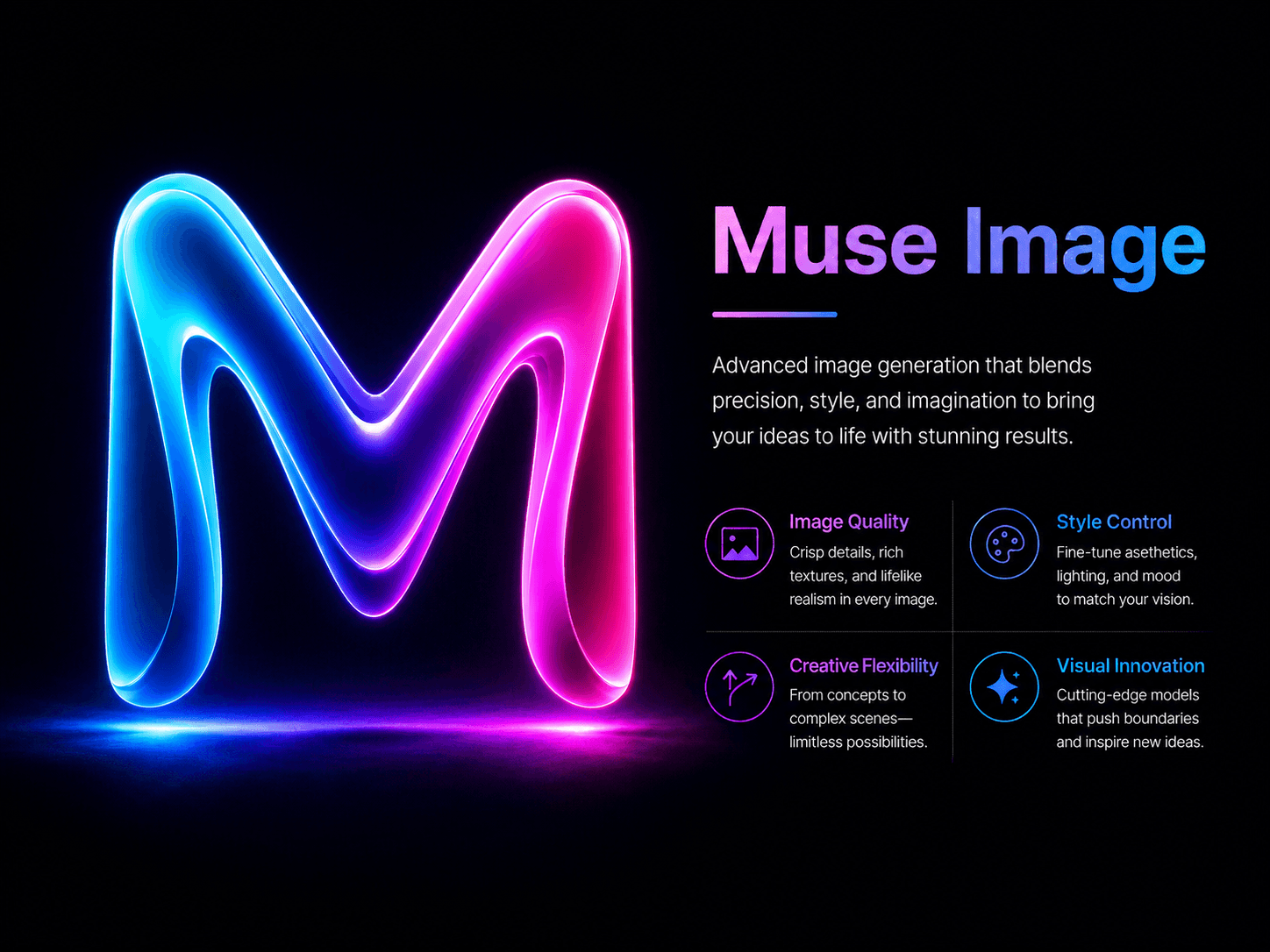
Muse Image
Agentic AI image generator that plans, edits, and composes with search-grounded context for professional creative work.
NewName Editorial
Editorial Team

The Agentic Wedge: Why 'Prompt-to-Pixel' Is No Longer Enough
The first generation of AI image generators sold a simple promise: type a prompt, get an image. That promise broke the moment professionals tried to use the output—text came out garbled, compositions collapsed under the slightest edit, and references were ignored or blended into mush. The market responded with workarounds: inpainting masks, upscalers, and endless prompt engineering. But the underlying architecture remained passive—a model that maps text to pixels without understanding the intent behind the request.
Muse Image enters this landscape with a different premise: that generation should be an agentic process, not a single forward pass. The platform claims to 'plan and reason through your request before it generates,' positioning itself as a tool that understands the job, not just the prompt. This is a meaningful shift. In practice, it means Muse Image can handle multi-reference composition—blending a person, a product, and a style reference into one coherent image—without the user manually masking or layering in Photoshop. It also means precision editing: changing one detail while preserving the original composition, lighting, and surrounding pixels. For creative professionals, this is the difference between a toy and a tool.
The commercial thesis is clear: as AI image generation becomes commoditized, the differentiator is control and context. Muse Image is betting that professionals will pay for a system that reduces iteration cycles and produces usable output on the first or second try, not the tenth.
Inside the Workflow: From References to Coherent Composites
Muse Image's workflow is designed around the reality of creative production: you rarely start from a blank page. You have a photo of a model, a product shot, a style reference, or a sketch. The platform's core capability is turning these disparate inputs into a single, coherent visual. The website highlights 'multi-reference composition' as a native feature, contrasting it with competitors that offer limited or style-only reference support. This is not just a feature list—it's a workflow advantage. In a typical campaign, a designer might need to place a product into a lifestyle scene, match the lighting, and incorporate brand colors. With Muse Image, the user can feed in the product photo, a scene reference, and a color palette, and the system handles the composition.
The platform also integrates search-grounded context, which is a rare capability. This means the model can access current facts, landmarks, or brand details when generating. For example, a prompt about a specific landmark or a recent trend can be grounded in real information, reducing the risk of outdated or hallucinated visual details. This is particularly valuable for marketers creating trend-based content or educators building infographics.
Another differentiator is 'code-aware details'—the ability to generate QR scenes, diagrams, charts, and structured graphics with stronger visual accuracy. This is a niche but telling capability: it suggests the model has been trained or fine-tuned to handle structured, rule-based visuals, which are notoriously difficult for diffusion models. For a marketer needing a scannable QR code embedded in a poster, or a teacher creating a labeled diagram, this could be the feature that wins the sale.
The workflow culminates in self-refinement: the system reviews and improves its own drafts, with provenance in mind. This is an automated version of the human feedback loop, and it addresses a common pain point—the need to regenerate multiple times to get a usable result. By building this into the platform, Muse Image reduces the cognitive load on the user and increases the likelihood of a satisfactory output on the first pass.
Competitive Field: Muse Image vs. GPT Image, Nano Banana, and Midjourney
The AI image generation market is crowded, but the competitive set is clear. On one end, Midjourney has built a loyal following among artists and hobbyists for its aesthetic quality, but it lacks native editing and reference composition. On the other end, GPT Image (from OpenAI) and Nano Banana (from Google) are pushing the boundaries of text fidelity and editing, but they are often general-purpose tools without a focus on professional creative workflows.
Muse Image positions itself as a specialist. The website includes a comparison table that claims an Arena Ranking of #2, just behind GPT Image and ahead of Nano Banana and Midjourney. While the ranking source is not disclosed, the implication is that Muse Image competes on quality while offering features the others lack: regional editing, multi-reference composition, agentic search, and no watermark. This is a classic differentiation strategy—compete on the features that matter to the target buyer, not on raw aesthetic quality alone.
But the competitive landscape is not static. GPT Image and Nano Banana are backed by companies with massive R&D budgets and distribution channels. OpenAI's image generation is integrated into ChatGPT, giving it a huge user base and constant feedback loops. Google's Nano Banana benefits from Google's search and cloud infrastructure. Muse Image, a smaller player, must win on focus and speed. Its advantage is that it is purpose-built for the professional creative workflow, not a side feature of a larger AI assistant. This allows it to iterate faster on specific pain points, such as reference blending and code-aware graphics.
However, the risk is that the giants will absorb these features into their own offerings. If GPT Image or Nano Banana add multi-reference composition and search-grounded context, Muse Image's differentiation narrows. The company must therefore build a moat through workflow integration, community, and brand trust—not just features.
The Credit Economy: Pricing, Unit Economics, and the Freemium Funnel
Muse Image uses a credit-based pricing model: 2 credits per 1K image, 3 credits per 2K image. The website offers free credits upon sign-up, which lowers the barrier to entry and fuels a freemium funnel. This is a common model in the AI generation space, but the unit economics are critical. Each generation consumes GPU compute, and the cost varies with resolution and complexity. The credit system allows Muse Image to control usage and monetize heavy users, while the free tier serves as a marketing expense.
Public materials do not disclose the price of credit packs, so it's unclear whether the unit economics are sustainable at scale. However, the model is standard for the industry: attract users with free credits, convert them to paid plans as they hit usage limits, and upsell higher resolution or faster generation. The key is the conversion rate and the lifetime value of a professional user. If Muse Image can retain a designer or marketer who generates hundreds of images per month, the revenue per user could be substantial.
A potential risk is that the credit model creates friction for enterprise buyers who prefer subscription pricing with predictable costs. Muse Image may need to offer enterprise plans with volume discounts and administrative controls to win larger accounts. The website does not mention such plans, but the feature set—provenance, search grounding, multi-reference—suggests an enterprise-ready product.
Provenance and Trust: The Hidden Cost of AI Imagery
One of the most underappreciated aspects of AI image generation is provenance. As AI-generated media becomes indistinguishable from real photos, the need to mark and verify AI-created content grows. Muse Image includes 'invisible provenance signals' that mark generated images, helping people identify AI-created media. This is a forward-thinking move that addresses regulatory and ethical concerns, but it also has commercial implications.
For professional buyers, provenance is a double-edged sword. On one hand, it provides a layer of accountability—useful for compliance and brand safety. On the other hand, some buyers may prefer no watermark or visible markers, as they want the AI output to blend seamlessly into their campaigns. Muse Image's approach of 'invisible' signals is a compromise: it provides a technical marker without ruining the visual. This could be a selling point for enterprises that need to track AI usage internally.
The inclusion of provenance also signals a maturity that competitors may lack. Midjourney, for instance, has been criticized for its lack of content moderation and provenance. Muse Image's focus on this issue positions it as a responsible player, which could be a differentiator in regulated industries like advertising and education.
Trajectory: From Creative Tool to Visual Reasoning Platform
Muse Image's roadmap is implied by its features: agentic generation, search grounding, and code-aware details. These are not just image generation features—they are building blocks for a visual reasoning platform. The ability to plan, reason, and refine suggests a system that could eventually handle more complex tasks, such as generating entire brand kits, creating product configurators, or even producing video storyboards.
The scalability constraint is compute. Each generation is expensive, and as the platform grows, so does the infrastructure cost. Muse Image will need to optimize its models and leverage cheaper inference methods to maintain margins. The company could also explore partnerships with cloud providers or hardware vendors to reduce costs.
Another constraint is data. Search-grounded context requires access to real-time information, which means integrating with search APIs and maintaining a knowledge base. This is a different operational challenge than training a static model. Muse Image will need to invest in data pipelines and fact-checking to ensure the context is accurate.
Over the next 3-5 years, the AI image generation market will likely consolidate. The winners will be those who offer not just generation, but a complete creative workflow. Muse Image is well-positioned to be one of them, provided it can execute on its agentic vision and build a sustainable business. The key metrics to watch are user retention, conversion to paid, and the speed of feature iteration. If Muse Image can become the default tool for professionals who need control, context, and provenance, it will have carved out a defensible niche in a market dominated by giants.