Delineato
A free, no-sign-up diagramming tool that turns ideas into shareable wireframes in seconds.
NewName Editorial
Editorial Team


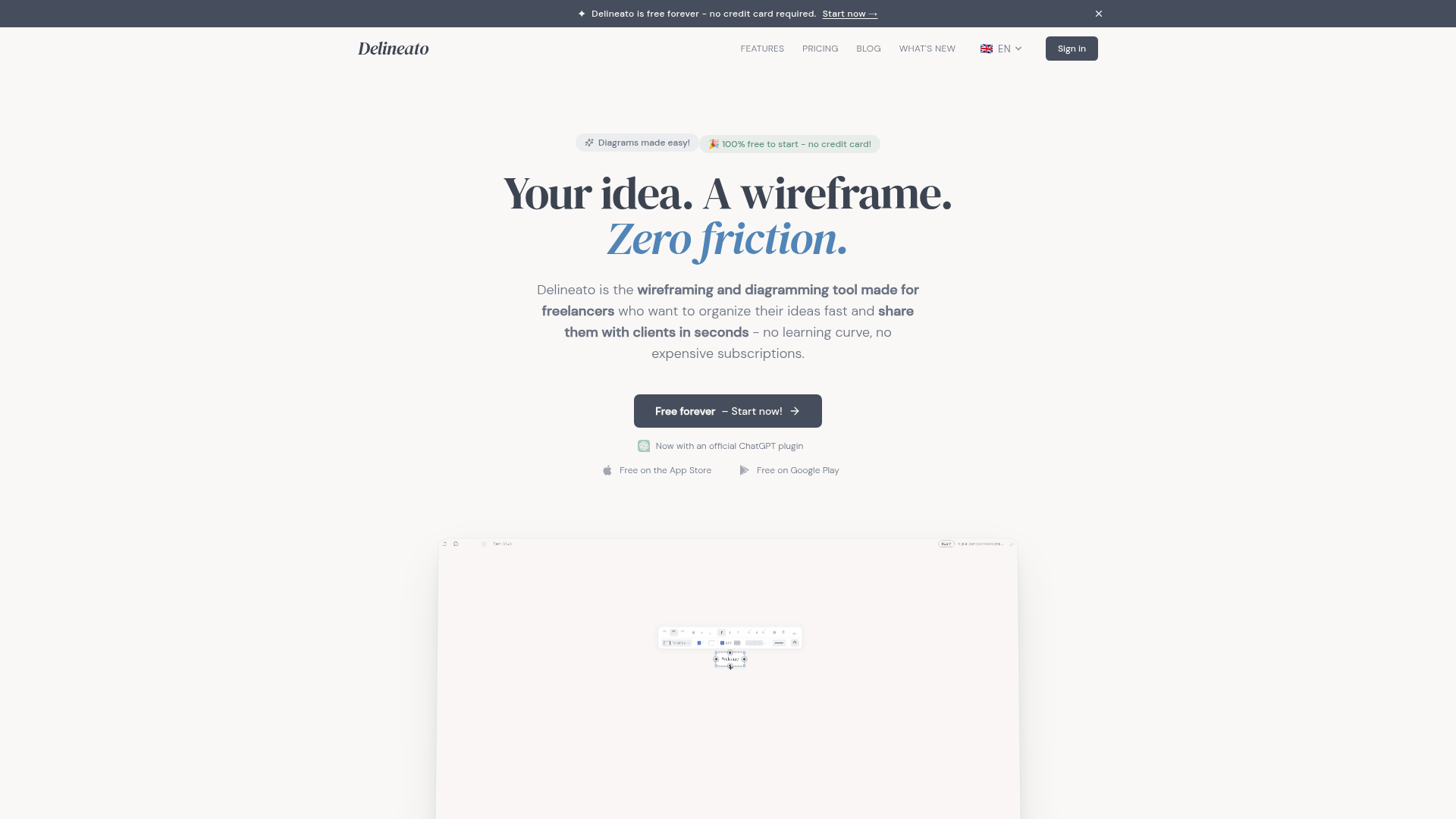
Most diagramming tools make you pay before you can think. Delineato makes you think before you can pay—and then never asks. It's a browser-based wireframing and mind-mapping tool that strips away the two biggest barriers to visual thinking: account creation and pricing anxiety. The pitch is blunt: "Your idea. A wireframe. Zero friction." And for a product that promises speed, the name itself—Delineato, from "delineate"—signals a deliberate focus on clarity and definition.
This is not another Figma clone or a Draw.io reskin. Delineato's bet is that the future of diagramming isn't more features—it's fewer obstacles. The site claims "no learning curve, no expensive subscriptions," and the free tier is genuinely free: up to three diagrams, PNG export, and real-time collaboration with up to three people, no credit card required. That's a radical stance in a category where "free" usually means "trial with watermarks."
The Zero-Friction Pitch: Why Delineato Skips the Sign-Up Wall
The first thing you notice on Delineato's homepage is the absence of a "Sign Up" button. Instead, there's a "Start now" prompt. The site explicitly asks, "Can I use Delineato without creating an account?"—and the answer, buried in the FAQ, is yes. This is a deliberate product decision, not a technical limitation. By removing the account wall, Delineato targets the exact moment of impulse: you have an idea, you want to sketch it, and you don't want to remember another password.
This frictionless approach is a direct counter to tools like Figma, which require an account even for viewing, or Draw.io, which, while free, has a cluttered interface that can intimidate newcomers. Delineato's minimalist canvas—"distraction-free" is a core tagline—positions it as the tool for the 10-minute wireframe, not the 10-hour design system. The site's user testimonials reinforce this: a freelancer says, "I use it to present wireframes to clients. Send the link, they comment right on the node, I adjust. No back-and-forth emails." That's the workflow Delineato is built for.
From Wireframe to Client Approval in One Click
Delineato's core loop is simple: create a diagram, share a link, collect comments, iterate. The "one-click sharing" feature is central to its value proposition. Unlike traditional tools where you export a file and email it, Delineato generates a live link that clients can view and comment on without creating an account. This eliminates the friction of "Can you sign up to see this?" and turns the diagram into a conversation.
The site highlights this with a quote from a product manager: "In 10 minutes I had a diagram ready and shared. My client even said 'finally I understand what you want to build'." That's the promise: not just a drawing tool, but a communication tool. The real-time collaboration feature extends this to teams, with the Pro plan allowing up to three collaborators and the Team plan offering unlimited seats with granular permissions. For freelancers, this means no more screenshot-and-email cycles; for small teams, it's a lightweight alternative to heavyweight project management tools.
Free Forever vs. Pro: The Honest Tradeoff
Delineato's pricing page is refreshingly transparent. The free plan is not a bait-and-switch: up to three diagrams, PNG export, three basic themes, and up to three collaborators. That's genuinely usable for a freelancer testing the waters. The Pro plan, at €6/month (billed annually), unlocks unlimited diagrams, PDF export, all nine themes (including dark mode), and edge branching (a beta feature that lets you split connections). The Team plan, at €12/month per user, adds unlimited collaboration, permissions, branding, and an activity log.
The tradeoff is clear: you pay for volume and polish, not for basic functionality. This is a smart segmentation—it doesn't punish free users with watermarks or feature crippling, but it does create a natural upgrade path. The site's FAQ reinforces this: "Is Delineato free?" is answered with a resounding yes, and "Can I cancel my subscription anytime?" is a given. This no-lock-in stance builds trust, a rare commodity in a category where tools often hold your diagrams hostage.
The ChatGPT Plugin: A Shortcut for Non-Designers
One of the most intriguing moves is Delineato's official ChatGPT plugin. The site advertises it with a badge: "Now with an official ChatGPT plugin." This is a strategic play to reach users who don't think of themselves as designers. Instead of starting from a blank canvas, you can describe your idea in natural language and let the AI generate a wireframe or diagram. This lowers the barrier even further—no need to learn node placement or connection logic.
The plugin is a clever distribution channel: it puts Delineato inside the most popular AI assistant, making it a default tool for a new generation of workers who prefer conversation over menus. It also signals that Delineato is thinking beyond the traditional diagramming market, targeting the growing cohort of "prompt engineers" who need to visualize their ideas quickly. While the site doesn't detail the plugin's capabilities, its existence is a strong signal of innovation.
The Name as a Promise: Delineato's Brand of Clarity
The name "Delineato" is a deliberate choice. It evokes "delineate," meaning to describe or portray something precisely. That's exactly what the tool does: it helps you draw clear lines between ideas. The name is also a nod to the Italian word for "delineated," which adds a touch of elegance and international flair. In a market full of invented names (Figma, Miro, Lucidchart), Delineato stands out as a word that means something—clarity, definition, precision.
The domain, delineato.app, is short and memorable, though the .app TLD is less common than .com. For a tool that lives entirely in the browser, .app is actually a fitting choice—it signals that this is a web application, not a desktop download. The branding is consistent: minimalist, clean, with a focus on the product rather than the company. The site's footer credits "Idea and concept by Peter Fjelds," but the brand itself is the star.
What Delineato Doesn't Tell You (Yet)
Delineato's site is refreshingly honest about what it is, but it's also silent on some details. There's no mention of team size, funding, or roadmap beyond the changelog. The blog hints at future features—"More articles coming soon"—but doesn't commit to a timeline. The mobile apps are free, but the site doesn't specify whether they sync with the web version. These gaps aren't deal-breakers, but they leave questions for power users.
The bigger question is sustainability. Delineato is free to start, and the pricing is reasonable, but the site doesn't disclose how many users it has or whether it's profitable. The stats on the homepage—"+47 beta users, +380 diagrams created, 4.6/5 satisfaction"—are modest, suggesting an early-stage product. That's not a criticism; it's a reality. For a tool that promises "free forever," the long-term viability depends on converting enough free users to paid plans. The current pricing seems designed to do that without alienating the core audience.
For freelancers, students, and small teams who are tired of bloated tools, Delineato offers a refreshing alternative. It's not trying to replace Figma; it's trying to be the tool you reach for when you need to think visually, fast. And with a name that promises clarity, it's off to a strong start.