Experiential Labs
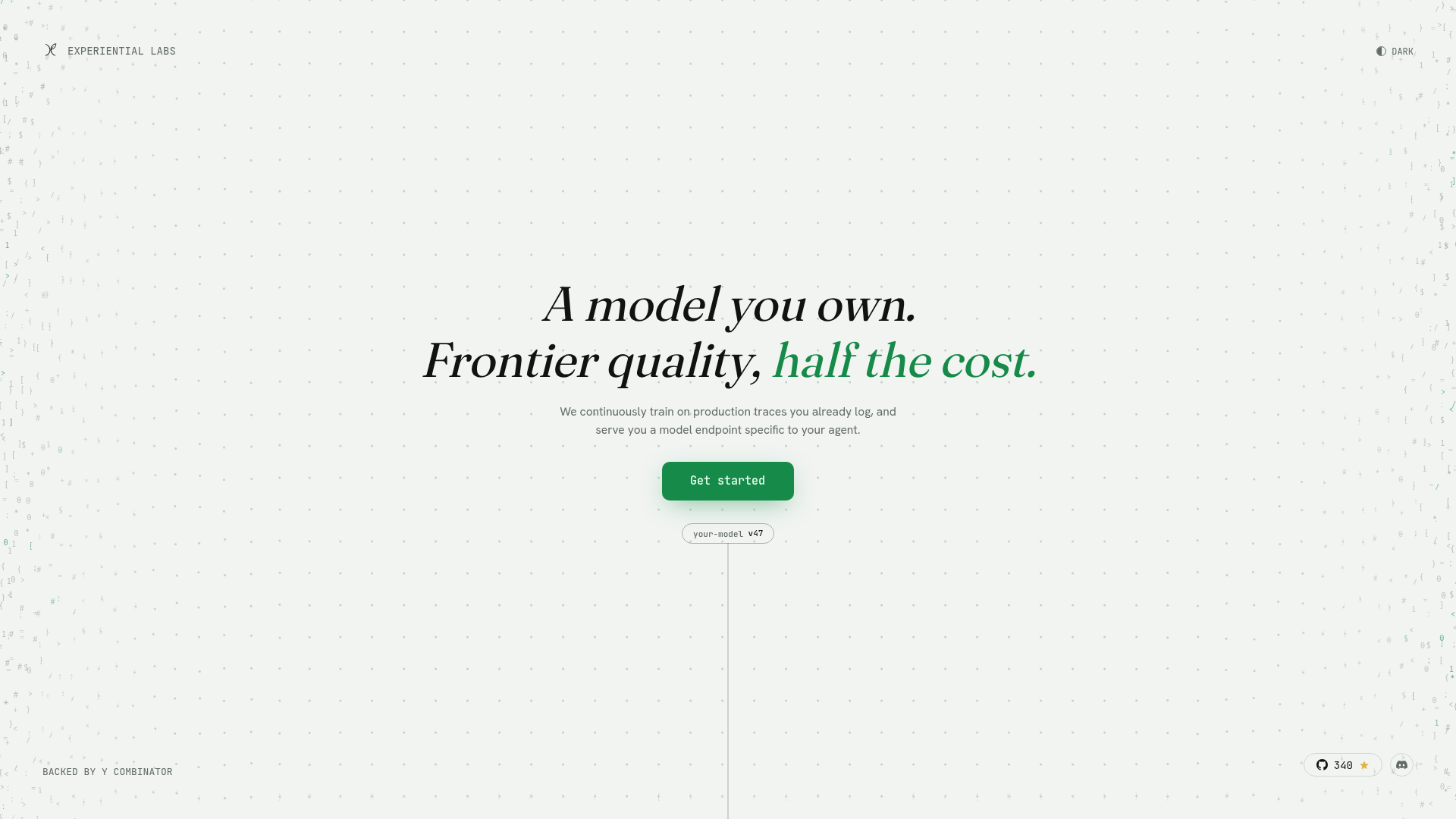
Turn production traces into a self-owned model that beats frontier quality at half the cost.
NewName Editorial
Editorial Team

The AI API era has a dirty secret: every request you send to a frontier model is a payment without equity. You build the workflow, you curate the traces, you debug the failures—but the model itself remains a rented black box. Experiential Labs inverts that relationship. Instead of renting intelligence, it offers a path to own it, trained on the very traces your agents already produce. The pitch is audacious: a model your company owns, guaranteed to match or beat frontier quality at 50% lower cost. That's not a discount; it's a different economic model.
The Ownership Gap in the AI API Era
Most AI spend is a treadmill. You pay per token, per request, per month, and the value compounds on the provider's side. Every interaction with GPT-5.5 or Claude makes their model better, not yours. Experiential Labs targets this asymmetry. The company's core promise—"a model you own"—shifts the locus of improvement. Instead of a static API call, you get a continuously retrained model that learns from your production traces. The website shows a version counter ("v47 · retrained 2h ago") that makes the ownership tangible: this is not a shared, versioned API; it's a model that evolves with your data.
The gap is not just philosophical. For companies running agents at scale, the cost of frontier APIs is a line item that grows with usage. Experiential Labs offers a way to convert that operating expense into an asset. The case study headline—"Cost −97%" for a computer use agent—is a stark illustration, even if the underlying details are not fully disclosed. The message is clear: the frontier is not the ceiling; it's a starting point.
From Logs to a Digital Twin: The Trace-First Loop
The mechanism is elegant in its simplicity. You already log production traces—whether via Arize, Braintrust, LangChain, or a plain database. Experiential Labs hooks into that stream and builds a "digital twin" of your production environment. This simulation is not a static dataset; it's a training ground. The model is continuously trained against this simulation, using a combination of distillation, reinforcement learning, and supervised fine-tuning.
The website illustrates this with a concrete example: a flight-booking agent. The model is shown a prompt—"Find the cheapest NYC to SFO fare next week"—and its response is scored. A successful booking of a $214 nonstop earns a +0.62; a failure to book, quoting $312 with a layover, gets −1.38. This is reinforcement learning on your specific task distribution. The model learns not just to be generally intelligent, but to be good at your workflows.
This trace-first loop is the core differentiator. Generic fine-tuning services require you to curate datasets and manage training pipelines. Experiential Labs automates the loop: traces in, simulation built, model trained, endpoint served. The "digital twin" is the key abstraction—it allows the model to practice against realistic scenarios without needing live production traffic for every iteration.
Routing as a Moving Target: The Per-Request Economics
Owning a model is not just about training; it's about serving. Experiential Labs positions its custom model as one option in a per-request routing system. The website shows a live breakdown of the last 1,000 requests: your model handles 38%, while other models like Fable, GPT-5.5, Haiku, and GLM-5.2 split the rest. The router's job is to pick the cheapest model that clears your quality bar for each request.
This is a subtle but powerful design. The custom model does not need to be the best at everything—it just needs to be good enough for a growing share of requests. As it improves, the router shifts more traffic to it, driving down costs. The mix is dynamic: "The mix shifts as your model learns." This is not a static cost optimization; it's a learning system that becomes more economical over time.
The routing also mitigates risk. If the custom model underperforms on a novel edge case, the router can fall back to a frontier model. This hybrid approach makes the transition to ownership less scary. You are not replacing GPT-5.5 overnight; you are gradually reducing your reliance on it.
The 50% Guarantee: Pricing as a Product Statement
The guarantee is bold: "50%+ cheaper, same quality. Always." This is not a typical marketing claim; it's a product feature. The website implies a contractual commitment, which is rare in AI infrastructure. The guarantee addresses the primary objection to custom models: fear of quality degradation. By promising same quality at half the cost, Experiential Labs makes the economic case undeniable.
But the guarantee also raises questions. How is "same quality" measured? The case studies mention "verdict accuracy +10.9%" for claims research, suggesting a domain-specific metric. The guarantee likely applies to a defined quality bar that the customer and Experiential Labs agree on. The per-request routing is the mechanism that makes the guarantee feasible: if the custom model fails to meet the bar, the router can fall back to a more expensive model, and the average cost still stays under the threshold.
This is a clever pricing structure. It aligns incentives: Experiential Labs only profits if the custom model performs well enough to handle a large share of traffic. The guarantee is not a discount; it's a bet on the trace-driven training loop.
What 'Experiential' Means: Naming a New Category
The name "Experiential Labs" is a deliberate departure from the technical jargon of AI infrastructure. It does not mention "models," "training," or "inference." Instead, it points to experience—the accumulation of interactions that shape intelligence. The company's tagline, "The era of experience," reinforces this. The thesis is that the next leap in AI will come not from larger architectures but from learning from real-world usage.
The name also signals a shift from the "frontier" mindset. Frontier models are about pushing the boundaries of what's possible. Experiential Labs is about mining the mundane—the traces of your agents' daily work—for incremental improvement. It's a more grounded, empirical approach, and the name reflects that.
The domain, experientiallabs.ai, is clean and memorable. The "labs" suffix suggests ongoing research and iteration, which fits the continuous training model. The name is not descriptive of the technical mechanism, but it captures the philosophy. It's a brand that invites curiosity rather than explaining the product.
Open Questions: The Road to Recursive Self-Improvement
The website ends with a provocative phrase: "Towards recursive self-improvement across domains." This is the long-term vision. If a model can learn from its own traces, it can improve itself, creating a flywheel that reduces the need for frontier models entirely. This is the ultimate promise of Experiential Labs: not just a cheaper model, but a model that becomes a strategic asset.
However, the path is not without risks. The quality guarantee depends on the reliability of the simulation. If the digital twin diverges from production reality, the model could learn the wrong lessons. The routing system adds complexity, and the cost savings depend on the model's ability to handle a large share of requests. The case studies are promising, but the details are thin. The website does not disclose the size of the models, the training infrastructure, or the specific terms of the guarantee.
For companies running agents at scale, Experiential Labs offers a compelling alternative to the API treadmill. The trace-first approach is practical, and the guarantee addresses the economic objection head-on. The name suggests a new category, and the vision of recursive self-improvement is ambitious. The question is whether the execution can match the promise. If it can, Experiential Labs may indeed usher in the era of experience—where the value of AI is not rented, but owned.