ForthWrite
ForthWrite drafts email replies in your voice, learning from every send, with privacy and model choice.
NewName Editorial
Editorial Team


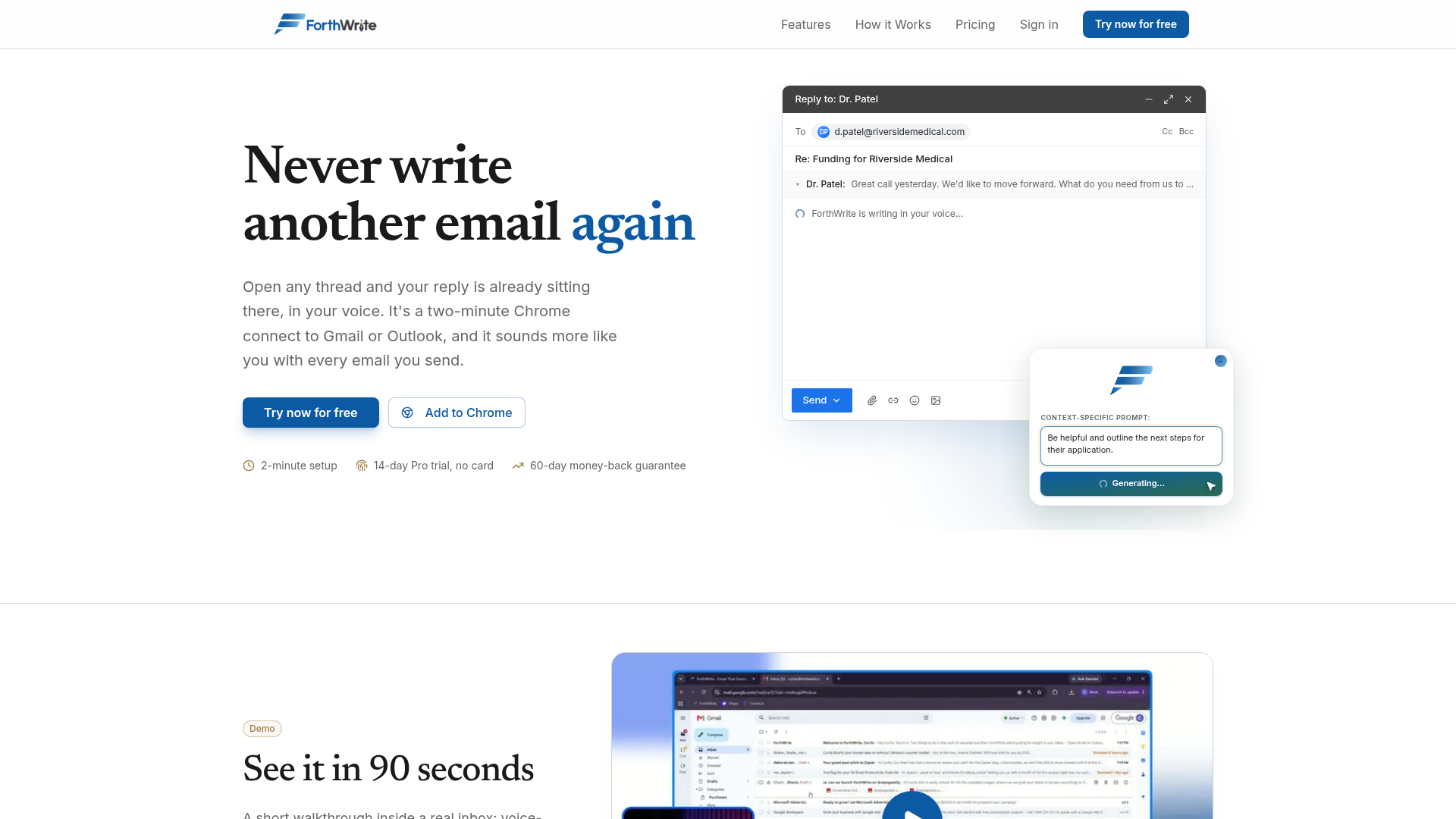
The promise of AI email assistants has always been seductive: never stare at a blank compose window again. But early tools delivered generic, robotic replies that sounded like a customer support bot, not a human. ForthWrite, a Chrome extension for Gmail and Outlook, takes a different tack. Instead of a one-size-fits-all model, it learns your writing voice from your sent mail and drafts replies that sound like you. The tagline—'Never write another email again'—is bold, but the real story is in the details: a two-minute setup, a 60-day money-back guarantee, and a privacy-first approach that stores your data encrypted and isolated. This isn't just another AI wrapper; it's a bet that personalization, not raw generation, is the key to email productivity.
The Email AI Problem: Generic Replies vs. Your Voice
Most AI email tools generate replies that are grammatically correct but stylistically flat. They use a generic 'house style' that could belong to anyone. ForthWrite's founder, Curtis Boortz, a former SBA loan underwriter, experienced this problem firsthand. In underwriting, every deal generates a long back-and-forth with brokers and borrowers, and most of it is the same handful of updates written slightly differently each time. Generic AI wouldn't cut it; he needed replies that matched his team's professional yet personal tone. So he built an internal tool, originally called FinalDraft, that automated the contextual parts of that writing. It worked so well it roughly doubled their outbound email capacity without adding headcount. That experience shaped ForthWrite's core premise: the model must learn from your own sent mail, not a generic template. The website emphasizes 'drafts that sound like you, not generic AI,' and user reviews echo this, with one noting, 'It learns my writing style instead of generating generic AI responses.'
How ForthWrite Learns Your Voice Without Sacrificing Privacy
ForthWrite's voice-matching feature is its crown jewel. It captures tone, sentence rhythm, and sign-offs from your real sent mail. The dashboard shows a 'curve' climbing as drafts get closer to how you actually write. But how does it do this without compromising privacy? The site is explicit: 'We store your sent emails to learn your voice: encrypted, isolated to your account, never shared, never trained on shared models. Your BYOK credentials are encrypted at rest. Wipe your data with one click, anytime.' This is a critical trust signal. For an email tool, privacy is non-negotiable. ForthWrite also holds CASA Tier 2 certification, Google's required security review for apps requesting sensitive Gmail scopes. The restricted gmail.readonly scope is used to read the thread you're replying to, and the company emphasizes that data is never trained on shared models. This privacy-first approach is a differentiator in a market where users are increasingly wary of how their data is used.
Auto-Drafting and the Promise of an Empty Inbox
One of ForthWrite's most intriguing features is auto-drafting. It writes replies in the background as email lands, and can batch draft dozens of threads in parallel. The promise: 'You open Gmail and the drafts are already waiting.' This is a significant workflow shift. Instead of opening an email and clicking 'Generate Draft,' you simply review and send. The site claims this 'gets sharper from every edit you make,' meaning the more you use it, the better it gets. The performance analytics feature tracks acceptance rate, similarity score, edit-distance, and time-saved, giving users a measurable sense of improvement. This isn't just a convenience; it's a productivity tool that could save hours each week. One user review notes, 'This has reduced my time spent in my email more than any tool I've used.' The auto-drafting feature is a bold bet on trust—users must be comfortable with the AI reading their incoming mail and drafting replies without explicit instruction. But for those who send a high volume of email, the payoff is substantial.
The BYOK Bet: Why Model Choice Matters
ForthWrite's 'bring your own key' (BYOK) approach is unusual. It supports nine providers: OpenAI, Claude, Gemini, Grok, DeepSeek, Mistral, Perplexity, Cohere, and LibreChat. The site claims, 'No other email tool lets you pick.' This is a strategic move. Users can choose Claude for tone, GPT for reasoning, or Grok for cost. This flexibility is a response to the fragmentation in the AI model market. Instead of locking users into a single provider, ForthWrite lets them optimize for their needs. It also addresses cost concerns—users can use cheaper models for routine emails and premium models for complex ones. This BYOK model also aligns with the privacy-first positioning: users retain control over their API keys and data. However, it also means users need to have their own API keys, which could be a barrier for less technical users. The site doesn't disclose pricing for the Pro tier, but the 14-day free trial and 60-day money-back guarantee reduce the risk of trying it.
Naming, Positioning, and the 'Forth' in ForthWrite
The name 'ForthWrite' is a portmanteau of 'forth' (as in 'back and forth') and 'write.' It evokes the idea of writing emails that go forth, and the back-and-forth nature of email conversations. It's a clever, memorable name that hints at the product's purpose without being generic. The domain, forthwrite.ai, is clean and professional, with the .ai TLD signaling its AI focus. The brand positioning is clear: 'Email drafts that sound exactly like you wrote them. Save time without sacrificing quality.' The tagline, 'AI email writer for Gmail and Outlook that learns your style with every message,' is descriptive and benefit-driven. The name also suggests a sense of forward motion, which aligns with the promise of never writing another email again. However, the name might be slightly ambiguous—does 'forth' refer to the fourth iteration or the direction? But in practice, it's distinctive and easy to remember.
What ForthWrite Doesn't Tell You (Yet)
ForthWrite is currently in launch stage, built and run by one person, founder Curtis Boortz. The site shows over 1,000 installs and a 5.0-star rating on the Chrome Web Store, but it doesn't disclose revenue, funding, or detailed pricing. The 60-day money-back guarantee is a strong signal of confidence, but it's unclear how many users actually take advantage of it. The site also mentions a consulting practice for financial services firms, which suggests a niche focus. The biggest open question is scalability: can a solo founder maintain the product, handle support, and keep up with model updates? The site says, 'If you have feedback, a bug, or just want to tell me what's not working, email me directly at [email protected]. I read every message.' This personal touch is appealing, but it also highlights the resource constraints. For a product that promises to learn your voice, the proof is in the usage. The website's demo video and user testimonials are compelling, but independent reviews are limited. For professionals who send a high volume of email and value a personal writing style, ForthWrite is worth a trial. The 14-day free trial and 60-day guarantee lower the risk. But users should be prepared to invest time in setting up their persona and providing feedback to see the voice-matching improve. In a market crowded with AI email tools, ForthWrite's focus on voice personalization and privacy could be its winning edge—if it can scale beyond its solo-founder beginnings.