Impact-Site-Verification: 41b53a0c-6d04-458b-a457-fe9e29acde1a

SaaS & Productivity··5 min read

Foundstep

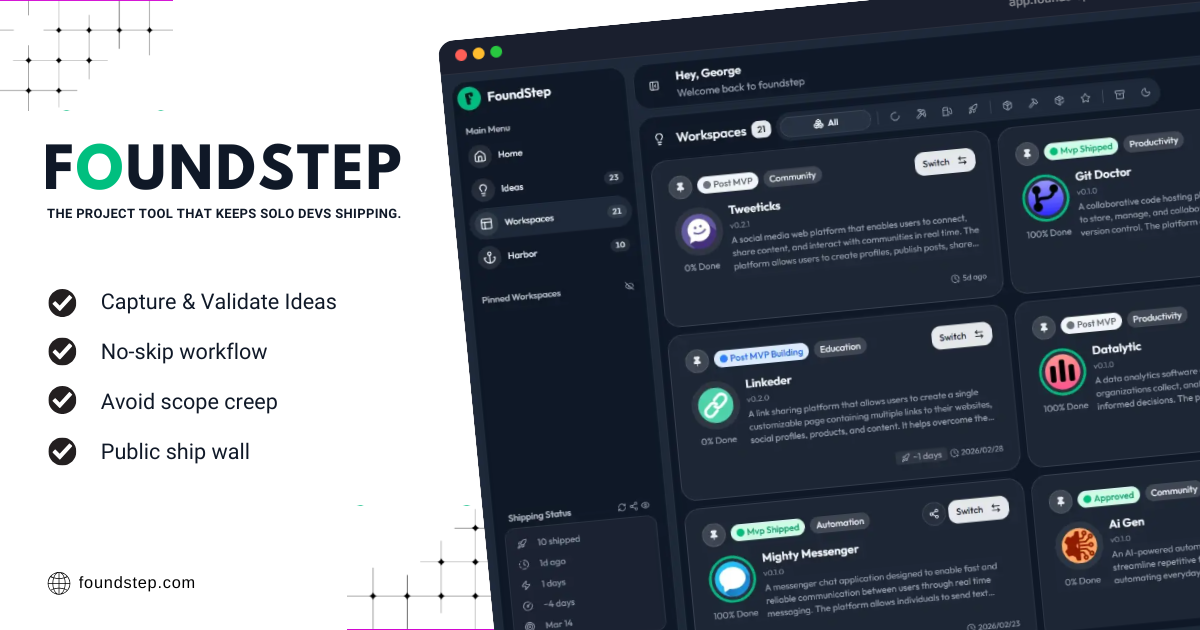
Project management that hard-caps features, locks scope, and makes shipping irreversible for solo devs.

NN

NewName Editorial

Editorial Team

Foundstep product image 1
Foundstep product image 2
Foundstep product image 3

Most project management tools are built on a promise of flexibility: move cards, add columns, adjust scope, invite collaborators, redefine done. Foundstep starts from the opposite premise. For the solo developer who has started eleven side projects and shipped zero, flexibility is not a feature — it's the bug. The tool's entire design is an argument that the freedom to add one more feature, defer the hard part, or quietly abandon a repo is what kills projects. So Foundstep removes options on purpose.

The bug is freedom

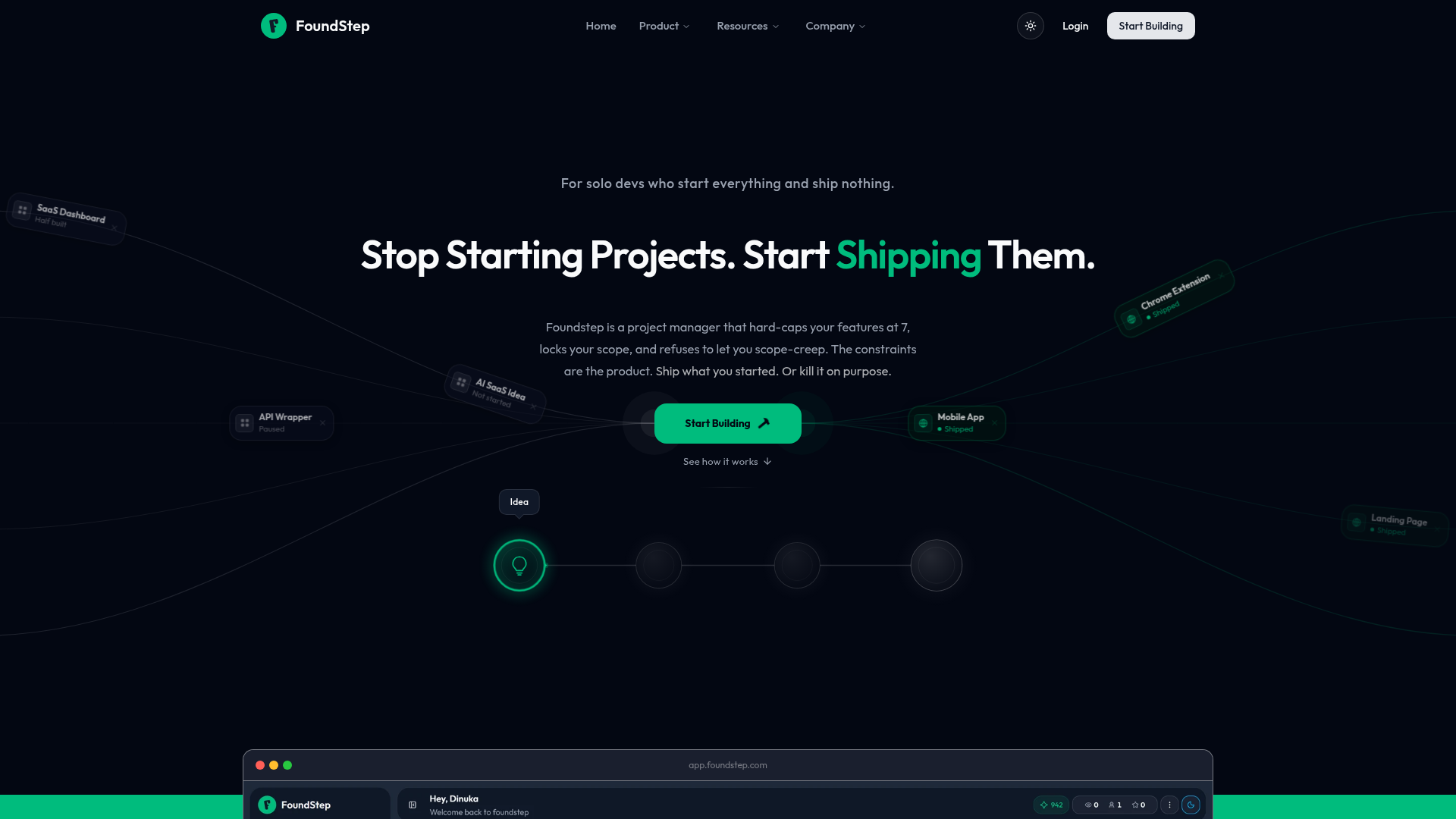
The homepage doesn't mince words: "You don't have a building problem. You have a shipping problem." The narrative walks through a familiar arc — week one momentum, week three "just one feature," month two with nineteen features and zero users, month six with the repository archived. The diagnosis is that freedom feels productive, but it's the reason projects die. Freedom gives you permission to add another feature, defer the hard part, polish forever, or switch to a new idea. Foundstep's answer is to make those options expensive, slow, or impossible.

This is a contrarian position in a category where every competitor touts flexibility. Notion, Linear, and Trello all give teams infinite configurability, which works when external managers and deadlines exist. For a solo builder with neither, that same flexibility is fatal. Foundstep isn't trying to be a better task tracker; it's trying to be a different category of tool — one that treats constraint as the core value proposition.

A pipeline that refuses to skip steps

Foundstep enforces a strict five-stage lifecycle: capture, validate, lock scope, build, and ship. Every project moves through the same gates, and skipping is not an option. Before writing a line of code, the platform runs the idea through AI research across six dimensions: Market Demand, Competition, Pricing, Reach, Founder Fit, and Buildability. The AI gives evidence, but the verdict — Build, Wait, or Kill — is the user's, and it must be written down. That written reasoning is recorded permanently.

This validation stage is a deliberate friction point. Most side projects die because the idea was never stress-tested, and Foundstep forces that test early. It also adds a 24-hour cooldown before a Wait verdict can be flipped, preventing impulse pivots. The philosophy is stated bluntly: "The best code you will ever write is the code you never wrote. Choosing Wait or Reject is a deliberate, recorded decision — not a failure."

Scope locking as a product feature

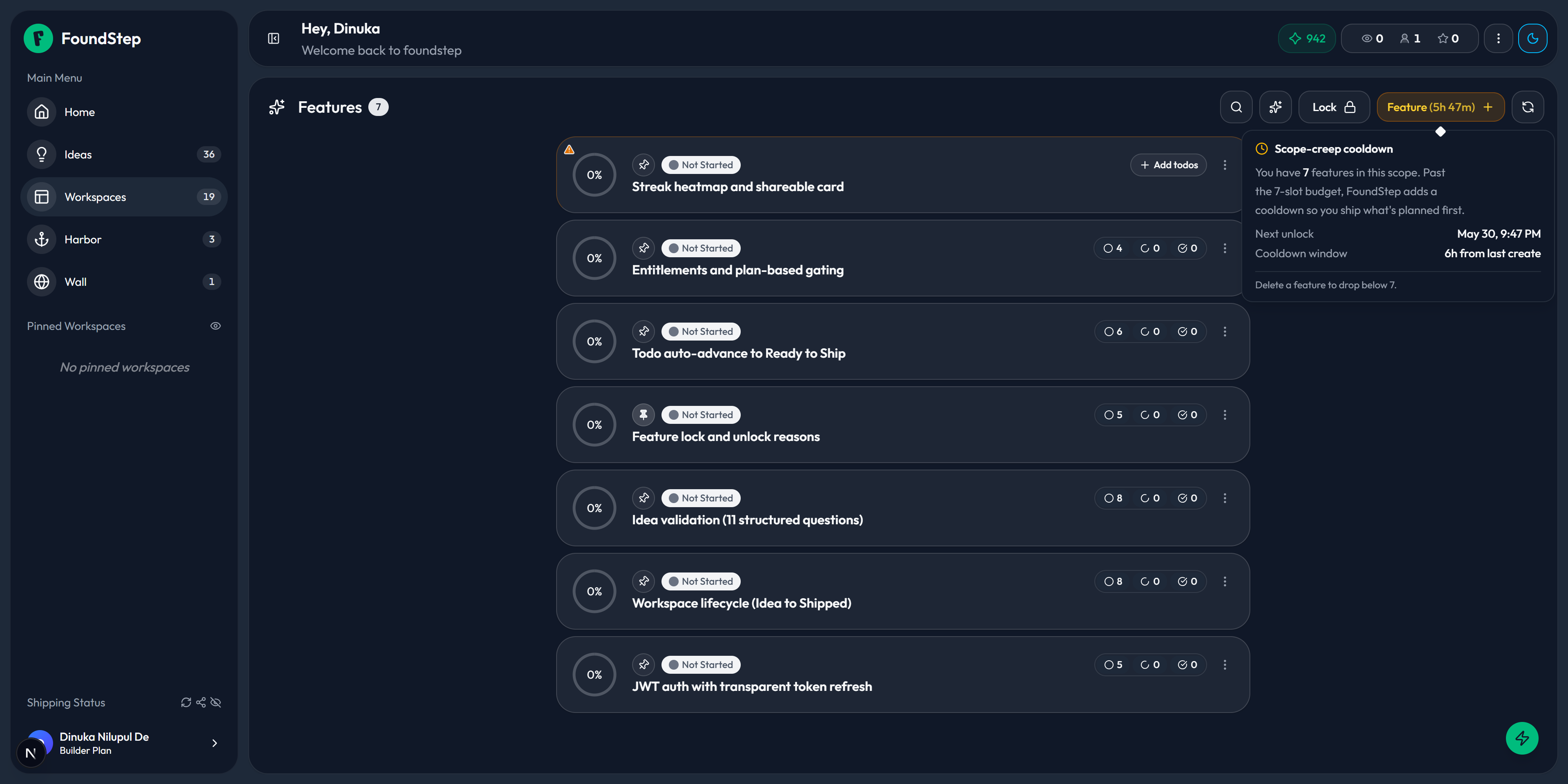
The most distinctive mechanic is scope locking. Once features and todos are planned, the user locks them. Adding anything after that requires a written reason and a wait: 24 hours for the first unlock, 36 for the second, and each subsequent addition adds 12 hours more. The feature list is hard-capped at seven per MVP. Want an eighth? Wait a day. The cap is enforced with cooldown timers that make scope creep progressively more painful.

Removing items stays free — cutting scope is encouraged. Adding scope demands accountability. Every unlock, reason, and timestamp is stored in what Foundstep calls the "Shame History," a permanent, searchable log. The name is deliberately provocative, but the function is serious: it makes every scope change visible and costly. The tool also makes shipping irreversible. Once a version is marked shipped, it becomes read-only; changes require starting a v2. This forces a deliberate ship moment instead of endless polishing.

The shame history and the public wall

Foundstep extends accountability beyond the individual. The "Harbor" gallery and the public "Wall" show shipped projects, but also killed ideas and archived workspaces. The stats on the site — builders, viewers, active ideas, killed ideas, shipped workspaces — are presented as honest numbers, refreshed daily. The point is that progress is not just personal; it's observable. The shame history is private, but the wall makes some of that discipline public.

This public dimension is a clever twist on the solo-dev problem. Without a team or manager, external accountability is absent, so Foundstep builds it in artificially. The public wall turns shipping into a social act, even for a single-user tool. It's a way to make the cost of abandonment visible, not just to the user but to a community of peers.

Who this tool is not for

Foundstep is explicit about its target user: solo developers, indie hackers, and side-project builders who have started multiple projects and shipped none. It is not for teams — there are no collaboration or multi-user features. It is not for people who want to wire up custom workflows or who want a tool that bends to their habits. The FAQ is blunt: "If you don't want constraints, you want a longer feature list."

This clarity is a strength. By refusing to be all things to all people, Foundstep avoids the bloat that dilutes most productivity tools. But it also means the tool is useless for anyone who needs to work with others, and the rigid pipeline may feel suffocating to developers who thrive on exploration. The wrong-fit trials, as the site warns, are the ones that end in disappointment.

Pricing discipline: pay to be constrained

Foundstep's pricing reflects its philosophy. The Starter plan is $12.99/month (or $10.99/month billed yearly) and includes up to 10 active workspaces, all core features, and 600 AI credits per month. The Builder plan is $29.99/month (or $23.99/month billed yearly) and lifts the workspace cap, adds 1500 AI credits, and includes everything in Starter. There's a 7-day free trial, and all features are on both plans — the difference is volume, not gating.

The pricing is straightforward, but the value proposition is unusual: users are paying for discipline. The tool's job is to make it harder to avoid shipping, and that friction is the product. Whether that's worth $13 or $30 a month depends on how much a user values finishing what they start. For the target audience — developers who have abandoned a dozen projects — the cost may be trivial compared to the cost of another abandoned idea.

Foundstep is not a project management tool in the traditional sense. It's a commitment device disguised as software. The constraints are the product, and the shame history is the mechanism. For solo developers who are tired of starting and never shipping, it offers a different kind of freedom: the freedom that comes from having fewer options.