Impact-Site-Verification: 41b53a0c-6d04-458b-a457-fe9e29acde1a

AI & Machine Learning·Seed··7 min read

Freesolo

Post-training for small models, driven by the agents they'll power.

NN

NewName Editorial

Editorial Team

Freesolo product image 1
Freesolo product image 2
Freesolo product image 3

The AI industry has spent the last few years convincing itself that scale is destiny. Frontier models keep growing, and with them, the compute bills and latency budgets of every team that depends on them. But Freesolo, a seed-stage startup from Y Combinator's latest batch, is betting on the opposite direction: that the intelligence needed for most tasks already exists in small models, and that the real bottleneck is the post-training process that closes the quality gap. The company's pitch—"Small models, frontier performance"—is not a new aspiration, but its approach to getting there is unusual: it wants to make post-training so accessible that the training itself can be driven by AI agents.

The small-model tradeoff that post-training is meant to break

For any engineering team shipping AI features, the choice between a frontier model and a small one is a familiar pain. A frontier model like GPT-5 or Claude Opus delivers impressive reasoning, but it comes with high latency and per-token costs that make it impractical for high-volume, real-time interactions. A small model, on the other hand, is fast and cheap, but its raw performance often falls short. The result is a compromise: teams either overspend on frontier models for tasks that don't need their full capability, or they accept the quality drop of a small model.

Post-training is the set of techniques—fine-tuning, reinforcement learning, distillation—that can push a small model's performance closer to that of a frontier model on specific tasks. The problem, as Freesolo's website states, is that "the current standard isn't enough." Traditional post-training pipelines are manual, expensive, and require deep expertise. They are also static: a model is trained on a fixed dataset and then deployed, with no mechanism for it to learn from its own mistakes in production.

Freesolo's thesis is that the missing piece is iterative post-training using agent loops. Instead of a one-shot training run, the model is repeatedly evaluated, its failures are analyzed, and the training data is updated accordingly. This is a fundamentally different workflow, and it is one that Freesolo believes can be automated to the point where the activation energy to train is dramatically lowered.

Why agent loops are the missing ingredient in training

The concept of an agent loop is simple: an AI agent performs a task, receives feedback, and adjusts its behavior. In the context of post-training, this means using an agent to generate new training examples, evaluate the model's responses, and iteratively refine the training set. This is not a new idea in research labs, but it has been impractical for most teams because it requires significant engineering effort to set up and run.

Freesolo's blog post about using DSPy-style recursive prompt optimization to train a browser agent is a concrete example of this approach. The post describes training a model that solves a 30-step challenge in 265 seconds at a cost of $0.06 per run, with a GPT-OSS 120B model matching frontier performance. While this is a single anecdote, it illustrates the potential of agent-driven training: the model is not just trained once, but continuously improved through a loop of generation, evaluation, and refinement.

The implication is that post-training is not a one-time event but an ongoing process. This is a shift from the traditional model of training as a discrete step in the ML lifecycle. For Freesolo, this is the core insight: "Iterative post-training by using agent loops is what gets small models over the line." The company is building tools to make this process autonomous, efficient, and inexpensive.

Flash: a post-training package designed to be driven by agents

Freesolo's first product, Flash, is a managed post-training package that is explicitly designed to be driven by coding agents like Claude Code, Cursor, and Codex. The pitch is simple: "Point your agent at it and get a production-ready model back." This is a radical simplification of the post-training workflow. Instead of a team of ML engineers managing training pipelines, a developer can instruct their existing coding agent to use Flash, and the agent handles the rest.

This is a clever go-to-market strategy. By integrating with the tools that developers already use, Freesolo lowers the barrier to entry. The agent is the interface, not a new platform that requires a learning curve. For a startup, this is a way to get traction with minimal friction: if a developer can say to their coding agent, "Use Flash to train a model for this task," and it works, the value proposition is immediately clear.

However, this approach also raises questions. How much control does the user have over the training process? What happens when the agent makes a mistake? Freesolo's website does not provide detailed documentation, but the promise of a "production-ready model" suggests that the package handles the full pipeline, from data preparation to evaluation. The risk is that the agent-driven approach may be too opaque for teams that need to understand and customize the training process.

What the community projects reveal about Freesolo's early positioning

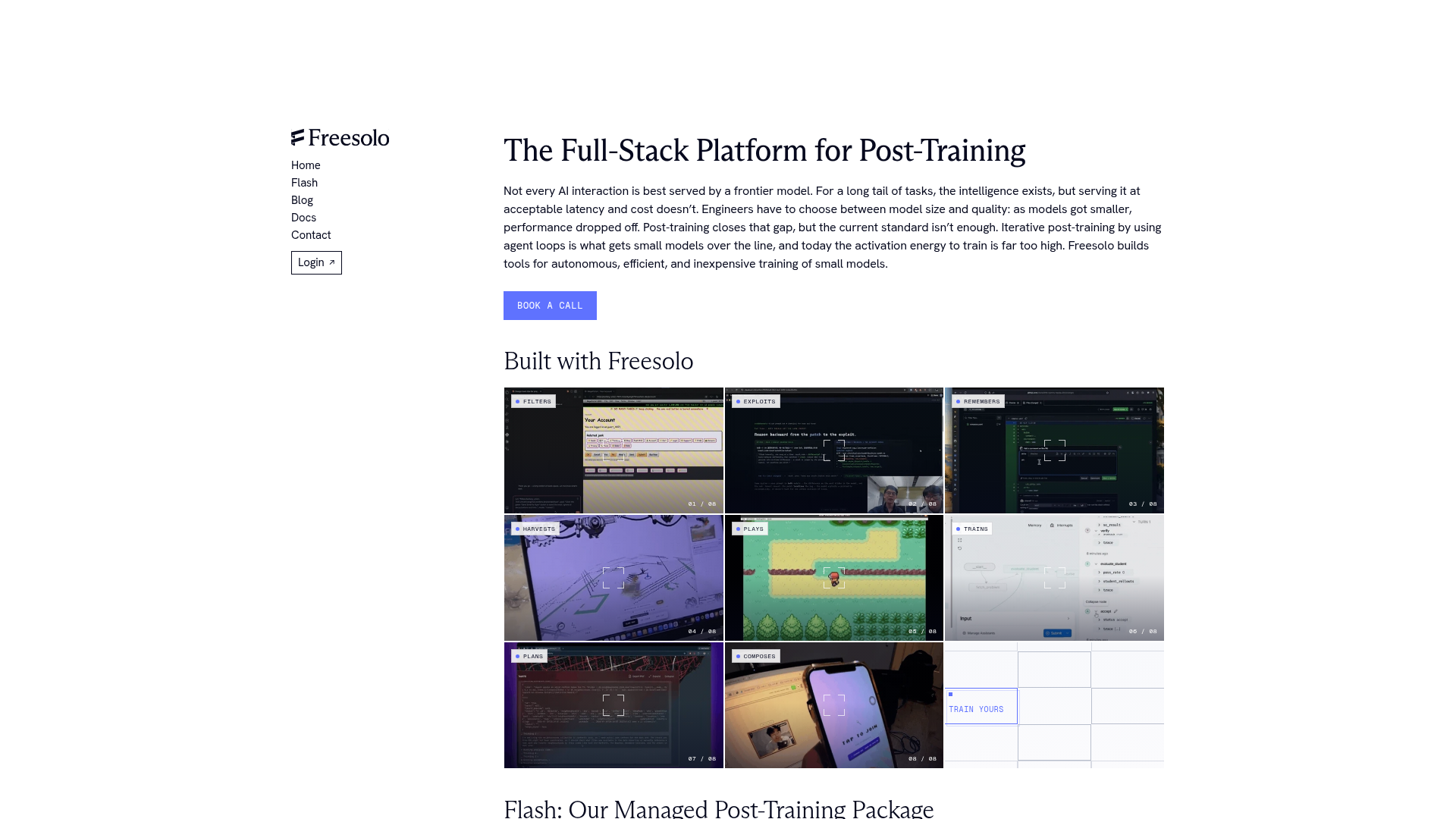
Freesolo's website showcases a series of community projects under the heading "Built with Freesolo." These are not enterprise deployments but rather a diverse collection of experiments: a browser agent that filters content, a code agent that finds exploits, a review agent that remembers, a robot that harvests, a game agent that plays Pokémon, a training agent, a simulation agent that plans, and a gesture agent that composes music. The projects are linked to GitHub repositories, suggesting they are open-source or at least publicly visible.

This is a deliberate choice. By highlighting community projects, Freesolo is signaling that its platform is accessible to individual developers and hobbyists, not just large enterprises. The projects are creative and varied, demonstrating the breadth of applications that small models can power. This is a smart positioning move: it makes the technology feel approachable and fun, even as the underlying capability is serious.

At the same time, the community projects are a double-edged sword. They show potential, but they are not proof of production readiness. A game agent playing Pokémon is a far cry from a mission-critical enterprise application. Freesolo will need to show that its platform can handle real-world workloads, not just hackathon projects. The company's blog post about the browser agent is a step in that direction, but more evidence is needed.

The name 'Freesolo' and the promise of autonomous training

The name "Freesolo" evokes the idea of climbing without a rope—a solo ascent with no safety net. It is a fitting metaphor for a company that wants to make AI training autonomous. The name suggests independence and self-reliance, which aligns with the vision of agents training models without human intervention. It also has a playful quality, hinting at the audacity of the endeavor.

The domain, freesolo.co, is short and memorable, though the .co TLD is less common than .com. For a startup, this is a minor tradeoff; the name itself is distinctive and likely to be remembered. The branding is clean and modern, with a simple logo and a straightforward tagline.

From a positioning perspective, the name works because it captures the core value proposition: freeing developers from the complexity of training, allowing them to go solo with small models. It also implies a level of risk-taking that is appropriate for a startup challenging the frontier-model orthodoxy. The name is not generic; it has a point of view, which is a good sign for a company trying to stand out in a crowded AI landscape.

Open questions: who is ready to hand training to an agent?

Freesolo's vision is compelling, but it hinges on a significant assumption: that developers and organizations are ready to delegate the training of their models to AI agents. This is a leap of faith. Training is a critical, often opaque process, and trusting an agent to manage it requires a high level of confidence in the agent's capabilities. Freesolo's Flash package is designed to make this easy, but the company will need to prove that the results are reliable and that the process is transparent enough for users to trust it.

Another open question is the target market. Freesolo's tagline is "Post-Training Built for your Agent," which suggests a focus on developers who are already using agents in their workflows. This is a growing segment, but it is still early. The company's community projects suggest a grassroots approach, but converting those projects into paying customers will require a clear value proposition for enterprises.

Finally, there is the question of competition. The post-training space is becoming crowded, with established players like Weights & Biases and new entrants offering fine-tuning and RL services. Freesolo's differentiator is its agent-driven approach, but it is not clear how defensible this is. If the approach proves successful, larger companies could easily adopt it.

Despite these uncertainties, Freesolo is a startup worth watching. It has identified a real pain point—the cost and complexity of post-training—and is offering a novel solution. The name, the product, and the community engagement all point to a company with a clear sense of purpose. Whether it can convince the market to trust agents with training remains to be seen, but the attempt itself is a signal that the AI industry is moving toward a future where small models, trained autonomously, are the norm.