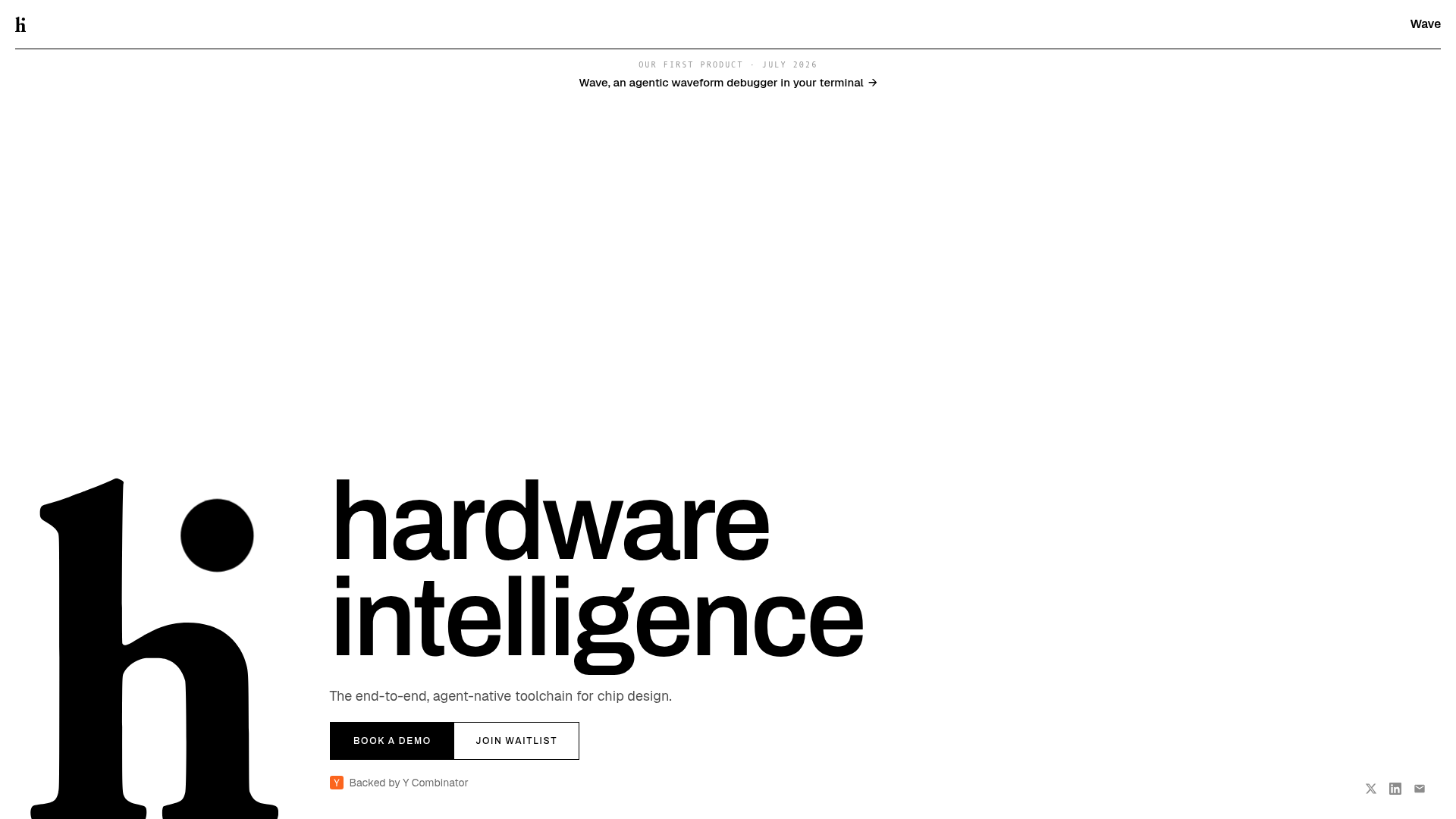
hardware intelligence
An agent-native chip design toolchain, starting with a terminal-based waveform debugger.
NewName Editorial
Editorial Team

The semiconductor industry has a dirty secret: the software that designs chips is often older than the engineers using it. While AI models train on GPUs that push the limits of physics, the tools used to verify those chips still feel like relics from the 1990s. hardware intelligence, a Y Combinator-backed startup, is trying to change that with a bold thesis: bring the $20B chip tooling industry into this decade by making it agent-native.
The $20B tooling gap that AI chips exposed
Chip design is one of the most complex engineering feats in existence. A modern processor can have billions of transistors, and verifying that every one of them behaves correctly is a monumental task. This is where electronic design automation (EDA) tools come in—they simulate, analyze, and debug the chip before it's fabricated. It's a massive market, estimated at $20 billion, but it's been dominated by a few legacy players for decades.
The rise of AI has put unprecedented pressure on this industry. AI accelerators like GPUs and TPUs are pushing the limits of what's possible, and their design is more complex than ever. Yet the tools used to design them haven't kept pace. Engineers are still spending hours staring at waveforms, manually debugging signals, and writing scripts that feel like they're from another era.
hardware intelligence sees this as an opportunity. The company's tagline—"AI tools for the chips your AI runs on"—is a clever double entendre. It's not just about using AI to design chips; it's about making the chip design process itself intelligent. The startup is building an end-to-end, agent-native toolchain that aims to automate and accelerate the most tedious parts of chip design.
Wave: an agentic debugger that lives in your terminal
hardware intelligence's first product, Wave, is an agentic waveform debugger that runs in your terminal. For the uninitiated, waveforms are the graphical representation of electrical signals over time. When a chip doesn't work as expected, engineers dig into waveforms to find the root cause. It's a painstaking process that involves scrolling through millions of cycles, zooming in on anomalies, and correlating signals.
Wave is designed to change that. Instead of manually hunting for bugs, you can ask Wave to find them for you. It's an "agentic" tool, meaning it uses AI to understand your intent and take actions on your behalf. You might type something like "show me why the FIFO overflowed at cycle 12,000" and Wave would analyze the waveform, identify the relevant signals, and present the answer.
The terminal-first approach is a deliberate choice. It reflects the company's belief that chip design tools should be as fast and flexible as the developer tools that software engineers use. By living in the terminal, Wave integrates seamlessly into existing workflows, scripts, and CI/CD pipelines. It's a stark contrast to the bulky, GUI-heavy tools that dominate the industry.
The product is still in its early stages—the website lists it as "our first product · july 2026"—but the vision is clear. Wave is the first step toward a broader toolchain that could eventually cover synthesis, place-and-route, and other aspects of chip design.
Why chip tooling is stuck in the 1990s
The EDA industry has been notoriously slow to innovate. The big players—Synopsys, Cadence, Siemens EDA—have been around for decades and have built massive, entrenched ecosystems. Their tools are powerful, but they're also complex, expensive, and often painful to use. The learning curve is steep, and the workflows are rigid.
Part of the problem is that chip design is a high-stakes, risk-averse field. A bug in a chip can cost millions of dollars and delay product launches by months. So engineers tend to stick with tools they know, even if those tools are outdated. This creates a barrier to entry for startups like hardware intelligence.
But the AI revolution is changing the calculus. AI chips are being designed at a breakneck pace, and the traditional tooling is struggling to keep up. The complexity is outpacing the ability of human engineers to manually debug every signal. This is where agentic AI can step in, automating the mundane and helping engineers focus on the hard problems.
hardware intelligence is betting that the industry is ready for a change. By building tools that are agent-native, they're not just adding AI as a bolt-on feature; they're rethinking the entire workflow from the ground up. It's a risky bet, but one that could pay off if they can convince chip designers to give up their legacy tools.
The name says it all: hardware intelligence
The name "hardware intelligence" is a bold statement. It's not just a description of what the company does—it's a declaration of intent. The company is saying that hardware design should be intelligent, not just the chips themselves. It's a name that positions the company at the intersection of two of the most exciting fields in tech: hardware and AI.
The domain name, hardwareintelligence.ai, reinforces this. The .ai extension is a nod to the company's AI focus, and it's a popular choice for AI startups. The name is memorable and descriptive, though it's also a bit generic—there are other companies with similar names. But for now, it works. It tells you exactly what the company is about.
The branding is minimalist and modern, with a focus on the product. The website is clean, with a simple tagline and a call to action to book a demo or join the waitlist. There's no fluff, just a clear message: we're building the future of chip design tools.
What's missing and what's next
As with any early-stage startup, there are more questions than answers. The website doesn't disclose funding details beyond the Y Combinator backing, nor does it list any customers or metrics. The product is still in development, and it's unclear how well Wave will perform in real-world scenarios.
The biggest challenge for hardware intelligence will be adoption. Convincing chip designers to switch from their trusted tools to a new, terminal-based debugger is no small feat. The company will need to prove that Wave is not just a novelty but a genuine productivity booster.
There's also the question of scope. Wave is just one piece of the chip design puzzle. To truly disrupt the industry, hardware intelligence will need to expand its toolchain to cover more of the design flow. That's a tall order, but if they can execute, they could become a major player in the EDA space.
For now, hardware intelligence is a company to watch. It's tackling a problem that's often overlooked—the boring, tedious work of chip verification—and applying modern AI techniques to solve it. If they succeed, they could bring the $20B chip tooling industry into the 21st century.