Impact-Site-Verification: 41b53a0c-6d04-458b-a457-fe9e29acde1a

Other··4 min read

HERA

Catches thousand-dollar drawing mistakes before the shop floor

NN

NewName Editorial

Editorial Team

HERA product image 1

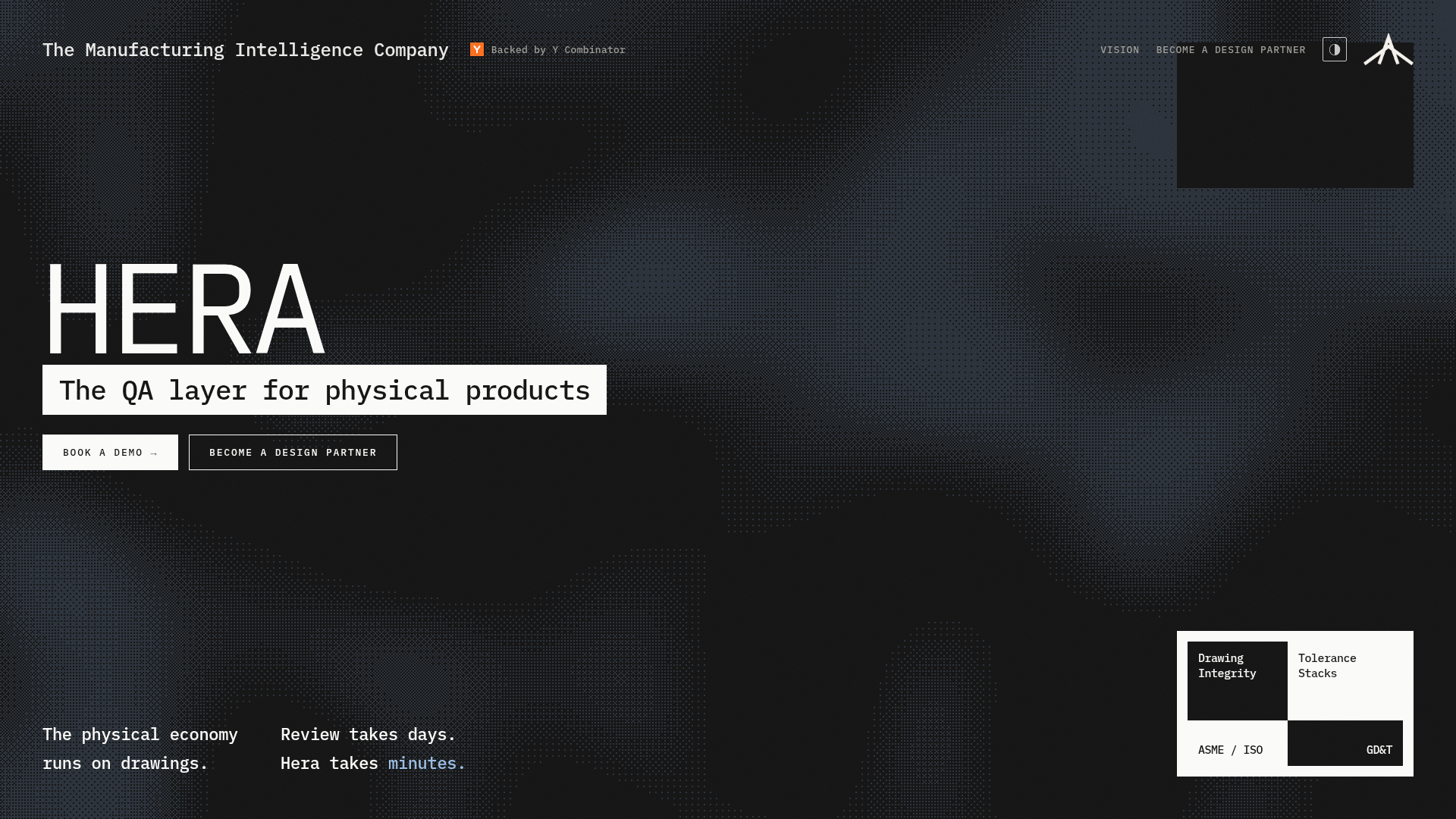
The physical economy runs on drawings, but the review process still runs on senior engineers reading prints by hand. HERA's bet is that this is the real bottleneck—and that an AI that reads a drawing like a designer can compress days of review into minutes, catching expensive mistakes before they reach the shop floor.

The drawing is the contract

Every part ships against a fresh drawing. That print is the single source of truth for geometry, tolerances, and assembly. When a callout is missed or a datum is undefined, the problem doesn't surface until the floor catches it—after tooling is cut, after material is ordered, after time is spent. The cost of a drawing error is not the paper; it's the rework, the scrapped parts, and the schedule slip. HERA treats the drawing as a legal document, which is exactly what it is in a manufacturing context.

Why review is a senior-engineer bottleneck

Drawing review is not a task you can hand to a junior. It requires deep familiarity with ASME Y14.5, the boiler code, and the factory's own standards. It means checking tolerance stacks across sheets and interfaces, looking for contradictions in datums, and verifying that the design intent is actually communicated. This is work that senior engineers do by hand, print after print, and it's slow. HERA's pitch is that this is the bottleneck: review takes days, and those days are expensive. The company is not trying to replace the engineer's judgment; it's trying to remove the mechanical reading and checking that consumes their time.

Four checks, one pass: what Hera actually reads

HERA's review is organized around four critical checks. First, GD&T conformance to ASME Y14.5-2018—the standard that governs geometric dimensioning and tolerancing. Second, code compliance with ASME BPVC, B31, and AWS—the codes that govern pressure vessels, piping, and welding. Third, tolerance stacks across sheets and interfaces, which is where many subtle errors hide. Fourth, drawing integrity: datums, contradictions, and the overall coherence of the print. Each check is a distinct capability, and together they cover the most common sources of expensive mistakes. The website shows a sample flag: "Ø 300⊕ Ø.005 A BDATUM B UNDEFINEDASME Y14.5 §7.3 · SHEET 03"—a concrete example of the kind of error that a reviewer might miss on a quick pass.

The console as a design-review memory

The HERA console is not a single magic button. It's a suite of modules: DDC-02 Design Intelligence, which reads the drawing like a designer; GDT-03 GD&T/MH, which checks the math against the code; ASM-04 Assembly Review, which walks the whole package; and EVD-00 Evidence Chain, which traces every flag. This modular structure suggests that HERA is building a system that can be tuned to a factory's specific standards and codes, not just a generic AI reviewer. It also means that the console can grow with the factory, adding new checks as standards evolve. The naming of the modules (DDC, GDT, ASM, EVD) hints at a systematic approach, almost like a checklist for the review process.

Auditable by construction: the evidence chain

One of the most important features for a manufacturing context is the evidence chain. HERA doesn't just flag an error; it traces it, showing the exact clause in the standard and the sheet location. This is critical because a review tool that can't explain its findings is useless in a regulated environment. Engineers need to sign off on drawings, and they need to know why a flag was raised. HERA's promise is "Auditable. Repeatable. Signable." and the evidence chain module is what makes that possible. It's not enough to catch a mistake; you have to be able to defend it in a design review or an audit.

A founder on your floor in a week

HERA is still early—the site is a landing page with a demo booking and a call for design partners. The deployment model is telling: "A founder on your floor. Live in a week." This is not a self-serve SaaS product. It's a high-touch engagement where the founders themselves come to understand your factory's standards and set up the system. That's a smart move for a product that needs to be trained on a factory's specific codes and drawing conventions. It also signals that HERA is willing to do the hard work of integration, which is often the real barrier to adopting AI in manufacturing. The design partner program is a way to build the product with early customers, which is typical for Y Combinator startups (HERA is backed by YC).

HERA is not trying to automate the entire manufacturing process. It's focused on a narrow but painful problem: the drawing review. By reading prints with the same rigor as a senior engineer, but in minutes instead of days, it could become the QA layer for physical products. The evidence chain and the modular console suggest a thoughtful approach to a conservative industry. The real test will be whether factories trust the AI enough to let it sign off on their drawings—and whether the founders can turn a week-long pilot into a permanent fixture on the shop floor.