Impact-Site-Verification: 41b53a0c-6d04-458b-a457-fe9e29acde1a

Developer Tools·Seed··5 min read

Hoplite

Cloud sandboxes, autonomous agents, and a phalanx that ships your backlog.

NN

NewName Editorial

Editorial Team

Hoplite product image 1
Hoplite product image 2

Hoplite's pitch is disarmingly simple: coding agents should run in the cloud, not on your laptop. The company, backed by Y Combinator, positions itself as the deployment layer for autonomous coding agents—the infrastructure that lets a fleet of AI workers operate in parallel, each in its own isolated sandbox, without draining your MacBook's battery or demanding your attention. The name, drawn from ancient Greek citizen-soldiers, is a deliberate nod to the power of coordinated formation over individual effort. But beneath the classical metaphor lies a practical question: can Hoplite turn the messy, interactive work of software development into a scalable, reviewable pipeline?

The Laptop Is the Wrong Battleground for Coding Agents

Local coding agents—tools that run on your machine—have a fundamental limitation: they die when your laptop sleeps. Hoplite's landing page hammers this point with a simple visual: a MacBook with its lid closed, accompanied by the line, "Local agents die when your laptop sleeps. Hoplite agents keep shipping from the cloud." It's a compelling argument, especially for developers who've watched a long-running agent task get interrupted by a Zoom call or a commute.

But the problem isn't just sleep. Local agents are also constrained by the resources of a single machine. You can't run a hundred agents on a MacBook Air without melting it. Hoplite's answer is to move agents into cloud sandboxes, each with its own environment, dependencies, and tools. The company's marketing materials emphasize "isolated sandboxes" and the ability to "run hundreds concurrently without worrying about resource constraints." This isn't just about convenience; it's about a fundamental shift in how coding work gets done—from a single, interactive session to a parallel, asynchronous operation.

How a Thread Becomes a Pull Request

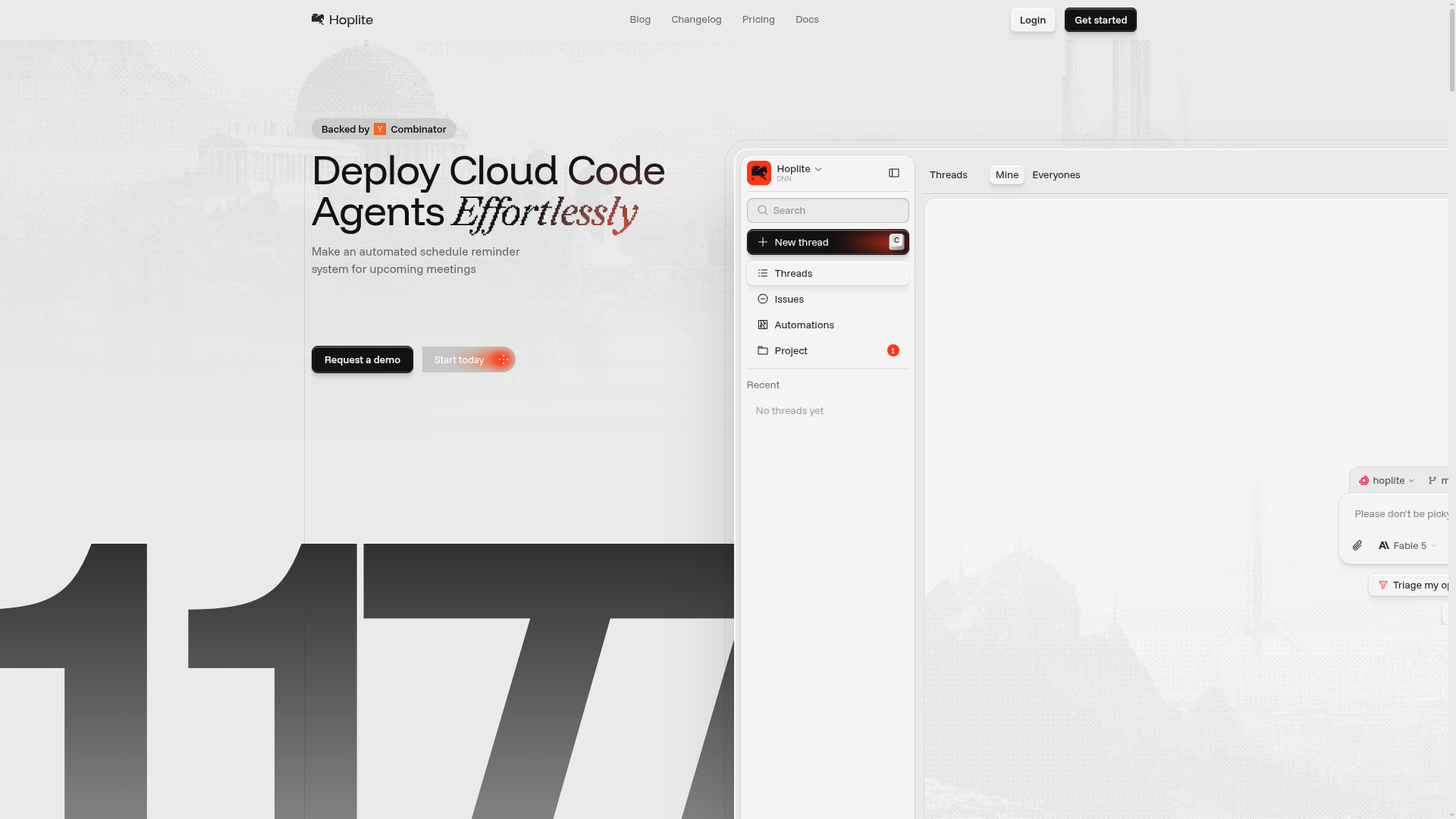
Hoplite's core unit of work is the "thread." A thread is a task given to an agent, running in its own sandbox, with access to your repository and environment. The workflow is designed to be familiar: you describe a task in plain English, the agent works through it—reading code, editing files, running tests—and ends with a pull request for your review. The interface, as shown in the demo, resembles a chat thread, but with a key difference: every action is streamed live, and you can approve or reject file edits, shell commands, and PR actions.

The company emphasizes that "every thread gets a real machine, not a text buffer." This means dependencies are installed, tests actually run, and the app boots on a live preview URL that the agent checks its own work against. This is a significant differentiator from simpler AI coding tools that might generate code without verifying it works. Hoplite also records video walkthroughs of new features, so you can see the before-and-after user flow without manually stepping through the app.

From Sentry Alert to Merged Fix: The Automation Loop

One of Hoplite's most compelling use cases is its integration with Sentry. The company's blog describes a tutorial for "fixing production errors while you sleep." The idea is simple: you set up an automation that checks for new Sentry issues on a schedule. When an error appears, Hoplite spins up a thread, reproduces the bug with a failing test, and opens a pull request with a fix—all before you've had your morning coffee.

This is a powerful example of the "automation" feature, which lets you describe work once, pick a cadence, and have Hoplite run it in a fresh sandbox every time. The company's pricing page mentions "enabled automations" as a per-workspace limit, suggesting this is a core selling point. The integration with Slack and Linear means you can spin up threads from your existing tools, and the agent picks up the context and gets to work. For teams dealing with a constant stream of bugs, this could be a game-changer.

The Phalanx, Not the Hoplite: Naming as Strategy

The name "Hoplite" is not just a cool-sounding word; it's a strategic choice. The company's FAQ explains: "Hoplites were the citizen-soldiers of ancient Greece—capable alone, devastating in formation. One agent is useful; a phalanx of them ships your whole backlog." This metaphor extends to the product's visual identity: the logo features a horse, and the footer includes an image of the Acropolis. The branding consistently reinforces the idea of coordinated, collective effort.

This naming strategy is clever because it positions Hoplite not as a single agent tool, but as a platform for orchestrating fleets. It also differentiates from competitors with more generic names like "CodeAgent" or "AI Coder." The domain, hoplite.sh, is short and memorable, though the .sh TLD might be less familiar to non-developers. The name also carries a subtle implication of discipline and structure—attributes you'd want in an autonomous coding agent.

Pricing for Agent Fleets, Not Individual Developers

Hoplite's pricing is structured around per-seat plans, with two tiers: Pro at $99/seat/month and Scale at $299/seat/month. Both include pooled sandboxes, new threads per rolling hour, enabled automations, and included credits for model usage. The Pro plan offers 25 pooled sandboxes per seat, 100 new threads per rolling hour, and 25 enabled automations, with a fastest schedule of every 5 minutes. Scale bumps those numbers to 150 sandboxes, 500 threads, and 100 automations, with a fastest schedule of every minute, plus larger sandboxes (8 vCPU, 32 GiB) and configurable idle timeouts.

This pricing model is designed for teams, not individual developers. The per-seat cost is high compared to a typical developer tool subscription, but it includes credits and the ability to run many agents concurrently. The company emphasizes "simple and transparent pricing" and avoids "mental maths," but the tiered limits can still be complex. The yearly option saves 17%, which is a nice incentive for commitment.

What Hoplite Doesn't Tell You Yet

Hoplite's website is polished and convincing, but there are gaps. The company doesn't disclose its founding team beyond the YC backing, and the blog only has three posts, all from 2026, suggesting a very early stage. The pricing page mentions "included credits" but doesn't detail what happens when you exceed them. The FAQ addresses data privacy, stating that code and credentials are encrypted and that neither Hoplite nor model providers train on your data, but the specifics of the security architecture are not detailed.

The biggest open question is reliability. Running autonomous agents in the cloud sounds great, but what happens when an agent goes off the rails? Hoplite says you can approve every action, but that could become a bottleneck if you're running hundreds of threads. The company's answer is likely that you review the pull request, not every keystroke, but the tension between autonomy and control is real.

Despite these unknowns, Hoplite's positioning is clear: it's the infrastructure for the next generation of coding agents. By moving agents to the cloud, standardizing the thread-to-PR workflow, and integrating with the tools developers already use, it's making a bet that the future of software development is a phalanx of AI workers—and that Hoplite will be the one to deploy them.