Landing Zones Canada
Airbus-backed drone simulation training from Medicine Hat, targeting the real bottleneck: threat emulation.
NewName Editorial
Editorial Team
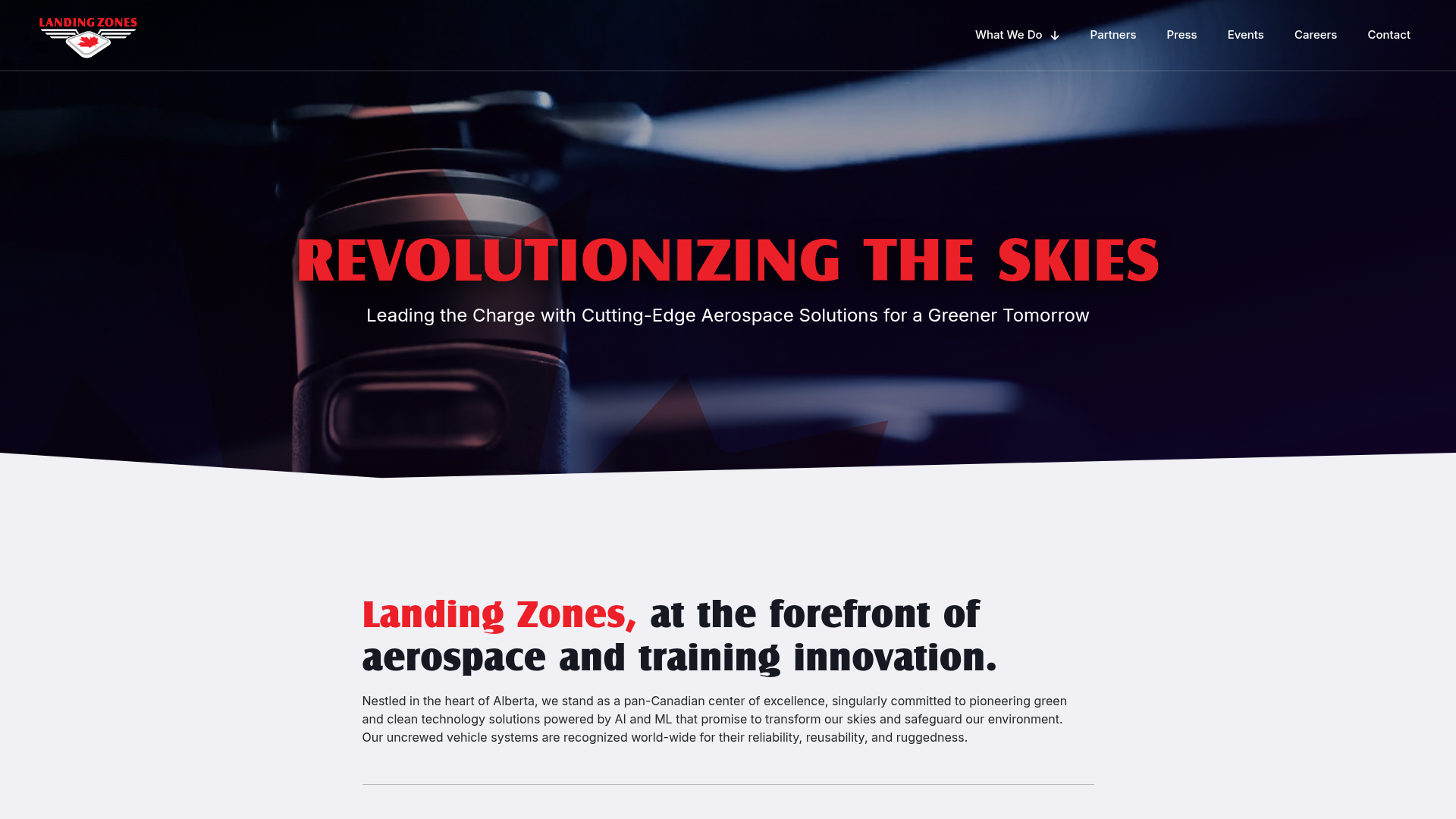
Landing Zones Canada does not call itself a drone company. Its homepage talks about 'green and clean technology,' environmental sustainability, and a 'greener tomorrow.' Yet the company's most concrete product is a radiosonde-replacing RPAS, and its most consequential partnership is with Airbus, the aerospace and defence giant. The gap between that green branding and the grey reality of military drone training is the story.
Public materials suggest LZC is repositioning itself as a pan-Canadian center of excellence for uncrewed vehicle systems, with a specific focus on advanced drone simulation training and threat emulation. That is a sharp pivot from the eco-friendly language that still dominates its website. The question is whether a company that markets itself as green can credibly sell defence-grade simulation to governments and OEMs — and whether the Airbus partnership is the signal that matters.
The quiet pivot from green tech to grey threat
Landing Zones Canada's website is a study in mixed messaging. The hero section promises 'cutting-edge aerospace solutions for a greener tomorrow.' A section on environmental sustainability talks about restoring and preserving the planet. But the company's actual business, as described in the Airbus partnership announcement, is 'advanced drone simulation training' and 'threat emulation technologies for modern drone threats.'
That is not green tech. That is defence tech.
The company's own tagline — 'Autonomous aircraft company providing advanced drone simulation training' — is more honest than its homepage. The website's language may be a holdover from an earlier phase, or a deliberate attempt to appeal to public-sector clients who care about sustainability. Either way, the gap between the brand and the business is wide enough to notice.
For a company that wants to be a national training hub, that gap matters. Defence procurement is not a green-conscious market; it is a threat-conscious one. If LZC wants to be taken seriously by the Canadian Armed Forces or allied militaries, it needs to lead with its simulation and threat-emulation capabilities, not its sustainability credentials.
Why a drone threat needs a training ground
Drone threats are not abstract. They are small, cheap, and increasingly capable. A quadcopter carrying a small payload can disrupt an airport, a military base, or a critical infrastructure site. Counter-drone systems exist, but they are only as good as the operators who use them. And operators need to practice against realistic threats — not just theoretical ones.
That is where simulation comes in. A drone simulation training system can generate realistic threat scenarios, allowing operators to practice detection, tracking, and engagement without the cost and risk of live flights. It can also help test counter-drone systems in a controlled environment, measuring their effectiveness against a range of threat profiles.
Landing Zones Canada's focus on 'threat emulation technologies' suggests it is building precisely this kind of training ground. The company's legacy in 'advanced training, testing, and evaluation services' — as its website puts it — gives it a foundation to build on. The question is whether it can scale that legacy into a pan-Canadian capability.
The Airbus signal: what a global OEM sees in Medicine Hat
Airbus is not a random investor. It is one of the world's largest aerospace and defence companies, with deep expertise in both commercial aviation and military systems. Its decision to partner with a small firm in Medicine Hat, Alberta, is a signal — not just about LZC's technology, but about the Canadian market for drone training.
The partnership is described as 'undisclosed investment from Airbus,' which suggests a financial commitment, not just a technology collaboration. That is a meaningful vote of confidence. It also gives LZC access to Airbus's global network, which could open doors to international clients.
But the partnership also raises questions. Why Medicine Hat? Why LZC? Public materials do not say. What is clear is that Airbus sees value in LZC's simulation and training capabilities, and that LZC's location in Canada — a country with a growing interest in drone defence — is part of the appeal.
For LZC, the Airbus partnership is a credibility boost that no amount of green branding could buy. It is the kind of signal that matters in defence procurement, where trust and track record are everything.
Training, testing, and the radiosonde side quest
The website's most concrete product is the GITPO Radiosonde Remotely Piloted Aerial System (RPAS), which replaces single-use radiosondes — weather balloons that are often discarded in forests and fields. That is a real environmental problem, and LZC's solution is genuinely green.
But the radiosonde product is a side quest, not the main storyline. It is a useful demonstration of LZC's engineering capabilities, and it gives the company a credible sustainability story. But it is not the core business. The core business is training and simulation.
LZC's website also mentions 'engineering and training solutions' and a 'proven track record supporting many of the world's largest aerospace OEMs.' That suggests the company has been doing this kind of work for a while, even if the public-facing brand has been softer.
The tension between the radiosonde product and the drone training business is not a problem per se. It is a portfolio. But it does mean LZC has to manage two very different narratives: one about environmental stewardship, the other about defence readiness. That is not easy.
What the public site leaves unsaid
For all its ambition, LZC's public website is thin on specifics. There are no customer names, no case studies, no technical details about the simulation platform. The site does not disclose how many employees it has, what its revenue is, or how the Airbus partnership will change its operations.
That is not unusual for a defence company, where secrecy is often a requirement. But it does make it hard to evaluate LZC's claims. The site says it is a 'pan-Canadian center of excellence,' but there is no evidence of that beyond the company's own words.
The most honest thing on the site is the tagline: 'Autonomous aircraft company providing advanced drone simulation training.' That is what LZC does. The rest is marketing.
For a company at the intersection of aerospace, defence, and simulation, the lack of public detail is a risk. It means the company's reputation will be shaped by its partners — Airbus, and whatever clients it can win. If the Airbus partnership translates into real contracts, LZC will be a name to watch. If not, it will remain a small firm with a big website.
Landing Zones Canada is betting that drone threat emulation is a bottleneck worth solving. With Airbus's backing, it has a chance to prove that bet. The next step is to show, not just tell, what its training ground can do.